


Reptile & Amphibian Forums

Welcome to kingsnake.com's message board system. Here you may share and discuss information with others about your favorite reptile and amphibian related topics such as care and feeding, caging requirements, permits and licenses, and more. Launched in 1997, the kingsnake.com message board system is one of the oldest and largest systems on the internet.

Click for 65% off Shipping with Reptiles 2 You
https://www.crepnw.com/
Click for 65% off Shipping with Reptiles 2 You

Evidence against the coral snake mimicry hypothesis

CKing Dec 09, 2003 09:05 PM

Here is an interesting observation from 2 field biologists studying Sinaloan milksnakes on an island off the Mexican coast:

"On Isla Isabel, milksnakes have been observed at dusk and nighttime ingesting recently hatched blue-footed booby nestlings (Sula nebouxii). ...Blue-footed boobies are formidable birds that peck violently at any animal approaching the brood, including crabs, lizards, and humans (pers. obs.). In eighteen years, we have never seen the island's feral cats or black iguanas even attempt to approach a blue-footed booby nest, although these predators frequently move through the colony. Why then does a booby sometimes stand by as a snake enters its nest and ingests a chick? Possibly the elongate shape and serpentine locomotion of a milksnake at low light levels simply provide insufficient stimuli to elicit a booby's defensive behavior."

The answer to that question is the words "low light levels." At low light levels, a moving tricolor snake turns into a solid medium gray color with no hint of red, white or black rings. The tricolored pattern simply disappears in the dark when the snake is moving. When the snakes are seen, however, the boobies pecked at them, showing no fear. When the boobies showed no reaction to the presence of the snakes, it is most likely because the snakes were simply not seen by the birds. The observations made by these field biologists not only contradict the suggestion that the tricolored pattern of the milksnakes and similarly colored mountain kingsnakes have aposematic value, since the boobies do attack the snakes and display no fear, it also demonstrates that the tricolored pattern is difficult to see in low light level situations, demonstrating crypsis.

Reference

Rodriguez, Ma. Cristina and Hugh Drummond 2000. Exploitation of avian nestlings and lizards by insular milksnakes, Lampropeltis triangulum. Journal of Herpetology 34(1):139-142
Replies (16)

Tony D Dec 09, 2003 10:31 PM

np

CKing Dec 12, 2003 09:41 AM

My point is quite obvious. I just cited another example to disprove the claim that birds have an innate fear of the tricolored kingsnake/milksnake pattern, which was based on experiments using painted sticks and captive birds. Birds in nature show no fear of the tricolored kingsnakes when their behaviors are directly observed in nature. Nesting birds in the San Bernardino mountains were observed by Goodman and Goodman to attack California mountain kingsnakes (a presumed coral snake mimic) when these snakes are near their nests. The blue-footed booby too shows no fear of the tricolored pattern of the Sinaloan milksnake and attacks the snakes on occasion. At dusk and at night, the boobies fail to attack, most likely because the tricolored pattern is cryptic (it has been shown that tricolored snakes turn into a medium gray when moving in low light levels) and thus not seen when they enter nests in low light situations to ingest nestlings.

This piece of evidence is simply a body of slowly accumulating evidence that disproves the coral snake mimicry hypothesis, which is widely cited in the popular literature as scientific fact even though there is not one single piece of observational data to show that birds are fearful of the tricolored patterns of the presumed mimics in nature. The coral snake mimicry hypothesis presumes that red coloration is a "warning" or aposematic coloration when in fact it is a commonly observed color in nature, verifiable by anyone who has walked through a New England woodland in the fall or anyone who has raked through the leaf litter of a forest. Further, the study of poison arrow frogs show that red is not universally used in these toxic animals. The assumption by some scientists that red serves as warning may simply be a relict of our ancestry. Humans are primates, and red coloration is widely used as a sex attractant among primates. Females of our closest relatives, the chimpanzees, for example, have swollen pink patches of skin on their hindquarters to signal estrous and readiness to mate. Even though humans do not have similar sexual displays (except perhaps artificially applied red lipsticks), our sensitivity to red coloration may nevertheless have persisted because our ancestors utilized such displays. The red skin patches are gone, but we still notice red perhaps more than any other color nevertheless. In nature, because of the abundance of red coloration in leaf litter, red colored animals are in fact cryptic, not conspicuous. Since the Batesian mimicry hypothesis of presumed coral snake mimics are presumed to be aposematic because of their presumably consipicuous color, the fact that red coloration and the tricolored pattern are in fact cryptic certainly contradicts the poorly supported hypothesis of coral snake mimicry.

Jeff Schofield Dec 09, 2003 10:39 PM

From the first sailors that went to sea Boobys have always been the DUMBEST birds aflight!! They are known to fly down and land on the back or shoulder of HUNGRY SAILORS!! Not a good way for species self-preservation if you ask me! What these birds can contribute to science will always be in doubt for me.Bad eyesight I am afraid is only the beginning as surely Darwin has begun to select against them.Jeff

CKing Dec 09, 2003 11:02 PM

Do you have evidence that boobies have poor eyesight or are you just guessing that is the reason why they cannot see the milksnakes in low light level situations? Since tricolored snakes do turn a solid gray color when moving in low light situations, and since gray is a cryptic color in low light situations, it is evidence of crypsis. And the authors do point out that the boobies sometimes attack the snakes. Anyone who doubt this claim can check it out for himself/herself. Journal of Herpetology is not a hard to find scientific journal by any means.

As for their lack of fear of human beings, that is not unusual for animals in the Galapagos Islands. Iguanas, seals, even penguins there show no fear of humans.

On the island off the coast of Mexico, the boobies attack humans, probably because this island is only a short distance from the Mexican coast.

chrish Dec 09, 2003 11:59 PM

From the first sailors that went to sea Boobys have always been the DUMBEST birds aflight!! They are known to fly down and land on the back or shoulder of HUNGRY SAILORS!!

This may be true. Sulids (boobies and gannets) will, in general, light on any floating objects on the surface of the ocean. I have seen brown, red-footed, and blue-footed boobies perched on floating logs and debris on several occasions. This is an adaptive strategy for a species that spends much of its life offshore. They are larger and heavier than most other pelagic and semi-pelagic birds and therefore conserve energy by perching whenever possible while offshore.

The fact that some poorly educated humans happen to get themselves way out of their normal habitat onto floating wooden vessels doesn't have any relevance to a Sulid. It is simply trying to conserve energy. Under natural conditions, resting on floating objects poses little threat to a semi-pelagic bird, particularly a big powerful bird like a booby or gannet.

The fact that sailors thought they were "stupid" for doing this is more a reflection of the sailor's lack of understanding of animal behavior than it is any reflection of the intelligence of the birds.

Bad eyesight I am afraid is only the beginning as surely Darwin has begun to select against them.

I would like to know on what evidence you base this assertion that Sulids are dying out. There are (depending on your taxonomy) 3 species of gannet and 6 species of boobies in the world today. None are endangered, as far as I know. Numbers of sulids have declined, I'm sure, but mostly due to human disturbance and destruction of their nesting habitat.

Sulids have great eyesight. These are birds that hunt by flying slowly 20-50 feet above the surface of the ocean then folding their wings and diving headfirst after prey that can be well below the surface of the water. You would be hard pressed to accomplish the same feat. They are extraordinarily graceful hunters, in my opinion.

The supposition that they land on boats because they can't see well is another example of humans making incorrect assumptions about why the birds are behaving in a particular way. It has nothing to do with the birds intelligence.

And if intelligence was the measure by which selection chose its victims, the stupidest booby is a hell of a lot more intelligent that the smartest herp!
-----
Chris Harrison

...he was beginning to realize he was the creature of a god that appreciated the discomfort of his worshippers - W. Somerset Maugham

Jeff Schofield Dec 10, 2003 12:11 AM

Flightless and defenseless while nesting in huge communes, they were always easy pickings for wayward sailors. Just because they can see well FAR AWAY does not mean they can see equally well CLOSE UP. Further, why in the original post were the "" taken off and the authors ASSUMED what colors and patterns were seen by the birds? Is there even any evidence that they SEE COLOR? I think these types of studies(and their anecdotal conclusions)may have a place in the 3rd world but they simply dont hold water without further evidence to back them up.As a critic, I have no burden of proof. As a author, the burden of proof is undenyably lacking. What purpose did the original poster have when posting this?? Did he just think that we would take it as the gospel?? Science demands the proof of any conclusion which I assure you that the article in question has NONE. Prove to me that Boobys see color,Jeff

CKing Dec 10, 2003 01:19 AM

Most birds, unlike most mammals, have excellent color vision. That is why the proponents of the coral snake mimicry hypothesis suggest that birds are the predators which act as selective agents in the evolution of Batesian mimicry among presumed coral snake mimics. It has even been asserted that birds have an "innate fear" of the tricolor pattern because coral snakes are presumably so deadly to birds that natural selection has wiped out all birds occurring within the range of coral snakes which show no such fear. Of course, no one has ever demonstrated this presumed fear using living birds and living coral snakes or their presumed mimics. The observations of the field biologists offer evidence that at least some birds living within the range of coral snakes, i.e. the blue-footed booby, show no fear of the presumably aposematic tricolor pattern. Again, the birds can see the milksnakes and the boobies do attack on occasion. Unless the boobies have a soft-spot in their hearts for snakes (which would be extremely unlikely), they would not have allowed the snakes to eat their chicks if they had seen the snakes crawling into their nests at dusk and at night.
Bird Vision

CKing Dec 10, 2003 01:35 AM

The Abbott's booby is listed as endangered because of habitat destruction, as you said.

"Abbott's Booby (listed as endangered) nests on tall emergent trees of the western, northern and southern plateau rainforest. The Christmas Island forest is the only known nesting habitat of the Abbott's Booby left in the world."

Reference

See link provided.
Christmas Island National Park & Wildlife

chrish Dec 10, 2003 09:54 AM

I knew Abbott's only nested on Christmas Island and wondered if it was endangered, but didn't bother looking it up.

I believe the Peruvian Booby is also in decline due to overharvest of anchovies and the El Nino anchovy fluctuations.

But neither is suffering the selective decline implied by Jeff, which was my point.
-----
Chris Harrison

...he was beginning to realize he was the creature of a god that appreciated the discomfort of his worshippers - W. Somerset Maugham

markg Dec 10, 2003 05:38 PM

n/m

rtdunham Dec 11, 2003 12:47 AM

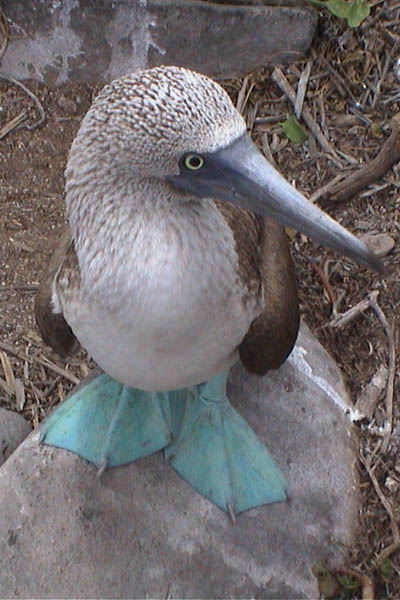
>>blue-footed booby nestlings (Sula nebouxii). ...Blue-footed boobies are...

here's a pic of one of the critters, from a july 2000 trip. this was taken somewhere in the focal length range of my standard 24-120 lens...obviously they're not particularly afraid of man.
terry
albino tricolors
Image

CKing Dec 11, 2003 08:17 AM

Is this picture taken on the Galapagos Islands? Is this bird nesting?

Nesting birds on the island off the Mexican coast will attack any human, lizard, feral cat, crab, etc., that goes near their nest.

rtdunham Dec 11, 2003 10:19 AM

>>Is this picture taken on the Galapagos Islands? Is this bird nesting?
>>
yes and maybe. i'll hae to go back and check out my other pix, as i recall the pair had built a nest--right in the middle of the path, and THEY weren't leaving it, so we had to go around, a bit of a squeeze with the guides trying to follow the government mandates to "stay on the trail" in the area. But i think one or two of my other frames were boobies courting, doing their beak-fencing, so i think we were there in the early nesting stages. The seals were nursing young but that probably doesn't pin down the season real well...

i just went back and checked the data on the pix, it was july 16, if that helps. We DID see babies in some other' species' nests on other islands, though, so it was close to "that time".

terry

rtdunham Dec 11, 2003 10:23 AM

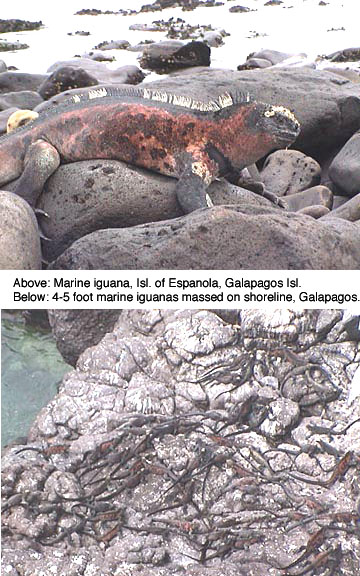
the large numbers of marine iguanas were observed from the edge of a cliff on the island the booby picture was taken on, maybe 50-100 yards farther down the path.
terry

rtdunham Dec 11, 2003 10:26 AM

>>the large numbers of marine iguanas were observed from the edge of a cliff on the island the booby picture was taken on, maybe 50-100 yards farther down the path.
>>terry
Image

rtdunham Dec 11, 2003 10:24 AM

here's why.
Image

Site Tools
