I just returned from the show today ,please allow me to vent.I saw a Boomslang ,advertised in the classified section , as having "a nose rub" in person it look's like 1/3 of it's head was missing!! I've never seen anything like this before. I was and am still P@**ed off about that. Then the non reptile people who show up just to look at the herps. I've never seen a vender have to turn and cover a cage with a King Cobra in it because of repeated taps on the glass to rile it up .Nice King BTW. I then saw a kid about 12 smacking a rubbermade with an EDB in it while Dad stood there and watched.When your's truly told the kid to stop, Dad looked at me like I was nuts.Thank for the space to vent!
Reptile & Amphibian Forums
Welcome to kingsnake.com's message board system. Here you may share and discuss information with others about your favorite reptile and amphibian related topics such as care and feeding, caging requirements, permits and licenses, and more. Launched in 1997, the kingsnake.com message board system is one of the oldest and largest systems on the internet.


Hamburg show (a little long)
rthomse
Jan 17, 2004 02:11 PM
Replies (15)
Chance
Jan 17, 2004 04:48 PM
I believe I know of the boomslang in question. Some friends of mine saw it at the last Hamburg show and said it was in pretty rough shape. However, you can't necessarily blame the seller. My female boomslang has been a very restless captive, and although she managed to breed and produce 4 huge viable eggs, she has somehow managed to rub just about her entire nose off. I've resorted to having to keep her in an enclosure with smooth walls and no branches because of her tendency to rub on anything rough. This rubbing hasn't caused anything major, except to make her rather ugly, but there has been no infection or anything. Nothing I've tried has gotten her to stop rubbing, so with boomslangs it's just something you occasionally have to deal with.
-Chance
Frank_S
Jan 18, 2004 05:23 AM
No I guess you cant blame the vendor . It was the snakes fault it was yanked out of its home and stuck into a cage that stressed it out. It is certainly not the persons fault. BTW this was the same vendor that I over heard a few years back telling somebody that the bite of nigricollis is not very bad to try and sell the snake. Hamburg is not the problem it is the jack @$$ vendors that rape the wild to make a few bucks and don't gave a rats @$$ if the herp lives or dies as long as long as they don't loose any money. Same vendors doing the same crap every show and the only reason they can is because people keep buying stuff from them. Why boycott a very good herp show when it is a few vendors causing the problems. To say that you have not heard any thing good about the Hamburg show in a few years. I can say that their was some very nice CB critters there from vendors who care more about the animals than cash.
Just my 2
Frank Schaeffer
-----
"It's only funny until someone gets hurt....then it's hilarious" 
Chance
Jan 18, 2004 03:47 PM
Leaving aside the wild caught/captive born debate, because that'll never be a very fruitful conversation since there are very emotional people on either side, I was not meaning anything near to what you interpreted it as. Yes, I have wild caught snakes. Yes I have sold wild caught snakes. But you know what, captive ones have to come from somewhere. If the typus was in really bad condition it shouldn't have been at the show for sale. However, and regardless of what Mr. Eimermacher says, some boomslangs, regardless of what they are kept in, will rub and rub and rub until they have just about no nose left. It's just something certain members of this species will do. I don't know the reasons behind it, as I've had 1.2 boomslangs and only one to do that, although they were all housed together, so it just varies with individuals. I've witnessed mine vigorously rubbing her nose on the branches in the cage, not the sides. So it's probably just a psychological thing. The seller in question probably should have left the snake at home, or made the sale before the show with the buyer knowing full and well what he/she was getting so that way the snake would never be out in view of the public. Just my thoughts anyway.
-Chance
Nightflight99
Jan 18, 2004 09:31 PM
However, and regardless of what Mr. Eimermacher says, some boomslangs, regardless of what they are kept in, will rub and rub and rub until they have just about no nose left.
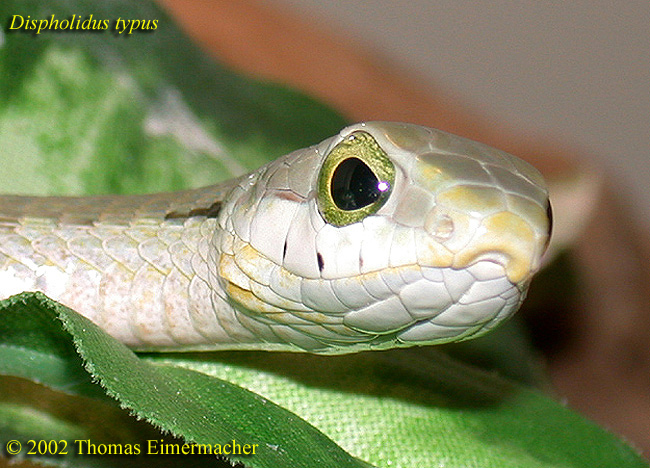
Actually, nothing could be further from the truth. Nose rubs are a common problem in Dispholidus, because they are commonly kept in unsuitable conditions. There are several key factors to Dispholidus husbandry, including space, shelter, and a particularly low stress environment. Like many fast arboreal species, Boomslangs are nervous and easily stressed. Conventional housing methods that are typically applied to many species do not work well for Boomslangs. Fresh imports are especially nervous and require great attention to detail with regard to their housing.
Relative to their size, they require larger enclosures than many species that will keep them from frantically rubbing their nose in a desperate attempt to escape their confinement. In fact, some specimens require enclosures that are far larger than most keepers would deem necessary for a species of that size. The second key factor is the shelter. Due to their nervous nature, Boomslangs will often dive for cover when approached with haste, and may zoom from one end of the enclosure to the other in wild panic to escape the perceived threat. In order to provide them with an adequate captive environment, their setup must contain numerous hide spots and retreats, as well as an arraignment of branches and plants. In the wild, Dispholidus utilizes branches and plants for shelter, and this concept can be very successfully applied in captivity as well. Keep in mind that there is a significant difference between having a few branches and plants in the enclosure, and actually providing a densely-planted, arboreal environment.
Specimens that are rubbing their noses on cage furniture are displaying classic symptoms of stress, which can certainly be rectified by providing the appropriate conditions. I have worked with Boomslangs for some time, visited their natural habitat and studied them in great depth. At times, I have had as many as 17 specimens in my collection, including juveniles, subadults and adults. I have also raised several hatchlings and acclimated many fresh imports. With the housing conditions described above, even the most notorious nose-rubbers will calm down and eventually become well adapted to a captive environment.
If anyone has trouble with nose rubs in Boomslangs, please feel free to contact me to help solve this problem. The claim that some specimens simply rub their noses off for no apparent reason is obviously irrational, since this is a problem that is strictly limited to captive situations, and can definitely be rectified if the appropriate conditions are provided.
Regards,
~TE
Frank_S
Jan 19, 2004 05:21 AM
That sums it up very well.
Thanks
FS
-----
"It's only funny until someone gets hurt....then it's hilarious"
Nightflight99
Jan 18, 2004 12:40 PM
If the setup is adequate, then you will not experience nose rub problems with Dispholidus typus, regardless how nervous and/or restless an individual specimen is. An animal that does have a severe nose rub (for any reason at all) needs immediate veterinary attention and appropriate treatment, and should never be offered for sale at a show.
There is no one else but the vendor to blame in a situation like this. The responsibility and obligation to care for an animal lies with the keeper/owner, even - or especially, depending on your view - if the animal is meant for resale. Leaving animals with obvious medical conditions without the appropriate veterinary care to make a profit is highly unethical and displays are poor set of moral values.
Regards,
~TE
lanceheads
Jan 18, 2004 05:39 PM
I agree with TE, I have seen Boomslangs displayed in zoo's, here and in Europe (without nose rubs), and I have kept them for a few months myself without them rubbing their rostral raw.
Perhaps try to keep the branches smooth, i.e. grapevine or sanding the branches smooth, and DON'T use a screen top.
My 2 cents.
themntl1
Jan 17, 2004 07:12 PM
i saw the snake in question did not look pretty, i am totally dissapointed in hamberg this time due to the fact it seemed like 3 tables had hots on it and the prices on what i wanted was outragious ($150 for a pair of southern copperheads),and i offered a c.b. rhino for trade, and the guy was only gonna offer me $20 credit for my rhino?????????, any way this was the second hamburg i have been to, and neither one impressed me much, but i will give it one more try in june if not i am going to boycott it, lol, anyway thanks for alowwing me to vent to, i hope everyone else was happy at hamburg
rthomse
Jan 18, 2004 07:06 AM
Please understand that my intentions were not to flame the Hamburg show.The October 03 show was great.Good prices and selection.If the Boomer in question had a raw Rostral that would have been one thing.This poor thing appeared to have been placed into a grinding wheel and was actually flat!!The "rub" extended into the internasal and could have been into the prefrontal region.The bottom jaw was ground flat to match.Sorry in my book thats not a "rub"
DrPepper
Jan 19, 2004 06:36 PM
I have to agree. The poor snake looked like someone had literally placed its face against a grinding stone and just held it there until there was almost nothing left. There is no way the damage done could even remotely be described as a 'rub'. Nearly the entire front half of the snake's face was gone. I doubt there was much left of the snake to even say it still had a mouth anymore. It was a disgrace. As a member of the paying public I was embarrassed to see that snake sitting on the table when I walked by. That animal should not have been in public view what-so-ever. 
kingcobrafan
Jan 20, 2004 12:33 AM
who was the vendor? E-mail me if you like. Thanks.
Sincerely,
Bill Huseth
Frank_S
Jan 20, 2004 05:29 AM
nm
-----
"It's only funny until someone gets hurt....then it's hilarious"
PatrickR
Jan 18, 2004 02:39 AM
Hello
Jolliff
Jan 20, 2004 10:21 AM
I actually enjoyed the show as I always do. That is one show that always turns up something different that you never see at any of the other shows. As with all shows, there is good and bad. It is up to the potential customer to inform himself (or herself) on what to stay away from when sifting thru what is available. If you want to get something dirt cheap, you usually get what you pay for. If you are not sure, ask a Vendor who seems to know what he is doing. Most are there to help. If there is alot of WC skinny dehydrated crap on the table, don't buy from them. Pretty soon it will die & the Vendor will realize that they are hurting there own business by putting animals out there in sub-standard condition. Some people seem to enjoy throwing their hard-earned money away on animals on the verge of death - what can you do?
Interesting to finally see a UNIFORMED officer of F&G or DNR there in the morning. Even though he was kind of rude when approached w/ a legit question. Claims he is always there but I know he's not always there in uniform. They are sneaky & obviously consider us the enemy.
nevrmore
Jan 20, 2004 10:49 AM
...i saw this advertised on the dealers website a while back. at the time it was listed as $65, mentioning the rubbed nose.
i was at their shop buying something else and inquired about it. when i saw it then (late december) it's nose was not nearly as bad as it was at the show this past weekend. a couple of days after this, they raised the price on the site to $75. if i'm not mistaken, he was listed as $60 at the show--but as i mentioned his nose was much worse than it had been a couple of weeks earlier.
as for people at the show who didn't really belong there; perhaps you're not from this area (i live about 35 miles from hamburg), but there's really nothing to do around here. i'm not making excuses or justifying some harrassing a snake, but i'm guessing that a lot of people see the reptile show as a sort of local, low-priced, loosely monitored zoo. certainly they can't mandate a competence exam as a condition of admission, though that might be better.
all in all i found the show to be a little disappointing. this was my 3rd time there, but 1st time in the winter months, which might have attributed to the relatively slim selection.
the point is that vendors should take more responsibility. no, a snake with that severe of a rubbed nose should not be offered for sale (especially since they told me that his nose had gotten like that from being at shows. agoraphobic, perhaps.). if a silly little child is harrassing a snake, the vendor should politely ask the child's parent to make him stop. something that irks me is when people decide to stand in front of a table and chat. the vendor should ask them to move along, as it is costing them business. i know that there are a couple tables that i might have spent some money at had i felt like fighting through idlers.
all that said, i did come home with 7 new critters. all are doing well, although my new ball python and cottonmouth have not eaten (the cotton has 3 kills to her credit though).
-----
currently have:
snakes:
1.1 ball pythons (snake'n'bake, sally)
1.0 reticulated python (mousetrap)
1.0 leucistic texas rat (ice)
venomous:
1.0 pygmy rattlesnake (gordon)
0.1 mozambique spitting cobra (fluffy)
1.0 gaboon viper (boone)
0.1 cottonmouth (elizabeth)
lizards:
1.0 nile monitor (dick)
0.0.1 egyptian painted agama (george)
0.0.1 blue tongue skink (skinky)
0.0.1 red sided skink (skinky jr.)
0.0.1 desert horned 'toad' (grinch)
0.0.1 tokay gecko (jacques)
frogs:
0.0.1 pac man frog (flik)
turtles:
1.0 common snapper (snapple)
fish:
0.0.6 red belly piranhas (milich, teo, sonya, kwanda, kasim & neclord)
1.0 betta (big red)
mammals:
1.1 dachshunds (gus & heidi)
5.3 misc. cats (ho-hum, freak, pritchett, ghost, church, gypsy, flypsy, & hand)
1.0 child (michael).
