I believe my female JCP is pregnant. I've been reading posts about "no-substrate" method of incubation and would like to try. Please comment if I have the right idea. I have a Hovabator and would place a small plastic tub inside. Inside tub have small amount of water, and egg-crate on top of that so that eggs don't touch the water. Keep the tub covered and completely sealed (no air vents), set temperature at 90 degrees. Check periodically (allows fresh air in).
Questions:
1) distilled vs. tap water vs. it doesn't matter
2) What stops the water from getting mold or algea?
Any help would be much appreciated as this is my first time.
John
Reptile & Amphibian Forums
Welcome to kingsnake.com's message board system. Here you may share and discuss information with others about your favorite reptile and amphibian related topics such as care and feeding, caging requirements, permits and licenses, and more. Launched in 1997, the kingsnake.com message board system is one of the oldest and largest systems on the internet.


"no-substrate" incubation questions
terrapene
Mar 07, 2004 06:18 PM
Replies (10)
JP
Mar 09, 2004 08:54 AM
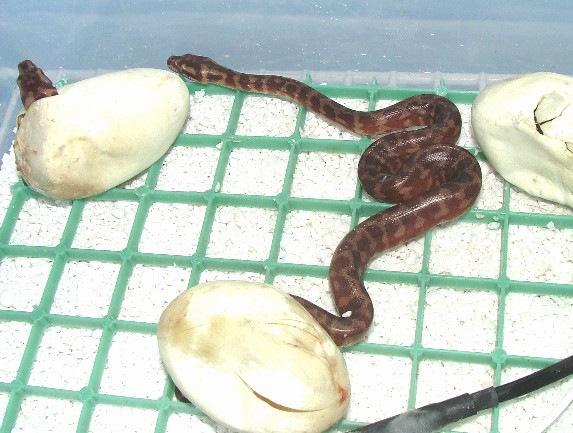
We'll I've only just recently begun to use the no sub method but I love it. What I do first is put down a layer of very wet perlite...so wet that there is actually a bit of standing water that is not all absorbed. I do this for a couple of reasons. For one, I can include more water in my eggbox than if I simply put a shallow layer of water in there. Secondly, I had the same uneasy feeling it seems you do about leaving a quantity of water for two months at 90 degrees...I suspect it would be fine but I also am concerned about any nasties that could grow in the water. I also think that adding the water to the perlite will make it more stable in regards to resisting temperature changes (more mass = more thermal stability). Anyway, on top of the wet perlite goes the platic grate. I put the temperature probe from my thermostat right in my egg box, as well as a seperate digital thermometer probe. As far as your question regarding ventilation, heres what I do. First, realize that my particular egg box lid is by no means air tight. It fits snugly, but definitely not air tight. Secondly, I have a small maybe 1/4 inch hole through which I run my temperature probes, as well as two small ventilation holes at the top on the opposite end. I believe that my set-up allows for a bit of ventilation as is. I generally open the egg box breifly for a visual inspection about once a week during the first 5 or 6 weeks of incubation. This provides air exchange. During the last couple of weeks I check them every two or 3 days. So far as I know, I have not lost any babies due to lack of air. As for your other question. I have a PUR brand faucet-mount purifier, and use that water in the egg box...although I think regular tap water would be fine. The evaporation process leaves behind any disolved salts/ions/chemicals that may be harful. With my process I achieved 100 percent humidity throughout, and never had to add any water.
Joe Pociask Pythons
terrapene
Mar 10, 2004 12:32 PM
Many thanks, I think I'll follow your method, and hopefully give you results in a few months!
JP
Mar 10, 2004 01:34 PM
I've got my first Ball clutch to be laid any day, and expect 6 to 8 good eggs from her. I really believ my method will give me 100% hatch rate. We'll see!
JP
Mar 10, 2004 01:41 PM
At any time, if you think your substrate is becomming too dry, you can easily add more water. If you use the old method, its so sketchy trying to adjust the amount of moisture in the substrate (I used vermiculite in the past). Last year I killed two eggs in a 10 egg ball clutch, and I'm sure it was because I tried to add some water to the substrate about 6 weeks in. With my "modified no sub method", you can add as much water as you want, and it will not affect the eggs. Just make sure that any water you add doesnt come close to the top of the plastic grate the eggs are sitting on, and also be sure that any water you add is very close (exactly is preferable)to the temp in the incubator. Having said all this, I should tell you that with my first clutch I did not need to add any water at all.
redmoon
Mar 10, 2004 01:48 PM
Seems like it would work fine.. I'm thinking of trying something similar with my bearded dragons & corn snakes this year.
jeff favelle
Mar 10, 2004 10:32 PM
Works with all the species I've tried over the last 10 years.
No substrate rooools! 


-----

chainsaw
Mar 14, 2004 08:01 PM
Couple of questions:What kind of incubator/setup are you using,and where do you get the plastic grate?Any pics of your actual incubator?
Thanks
jeff favelle
Mar 14, 2004 09:57 PM
Plastic grate is the coverings for flourescent light fixtures, so it can be found at Home Depot, Walmart, etc etc .
I use top-opening insulated boxes that have 16 inches of water in them, with 250W aquarium heaters as a heat source. No substrate, and glass over top of the egg containers for ease of viewing.
Here's an old pic of an old incubator:

And here's a pic of a new clutch of eggs laid this morning:

chainsaw
Mar 15, 2004 04:48 PM
Thanks for your help.I used a similar incubator years ago,only I used an aquarium.Thought I had to move up to "real" incubators,like the "pro's",instead on homemade!LOL!
jeff favelle
Mar 15, 2004 08:27 PM
Only on a larger scale. Also, glass is a WICKED conductor of heat (and cold), so it makes for a VERY VERY inefficient incubator design.
Cheers man,
Jeff F.
