Reptile & Amphibian Forums

Welcome to kingsnake.com's message board system. Here you may share and discuss information with others about your favorite reptile and amphibian related topics such as care and feeding, caging requirements, permits and licenses, and more. Launched in 1997, the kingsnake.com message board system is one of the oldest and largest systems on the internet.

Click for 65% off Shipping with Reptiles 2 You
Click for ZooMed
Click for 65% off Shipping with Reptiles 2 You

"extreme hypo" hondurans

rtdunham Apr 08, 2004 10:26 PM

After Mike Falcon produced the first of his extremely light hypo hondurans, people began calling them "super hypos". But Steve Osborne has been calling his pretty hypos "super hypos" too. That won't work, since it seems they are very different animals. And Steve used "super" first (originally as part of a longer name he used in marketing his animals).

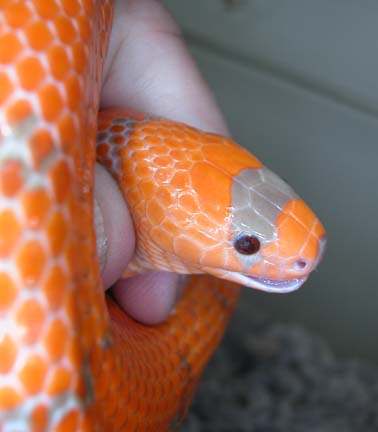
So after a number of conversations between mike & me and a few of the others who own most of the handful of hypos mike's produced so far, it was decided--with mike's final approval-- to call them "extreme hypos". I think this is an excellent solution, because it will eliminate confusion, and it's very descriptive--the melanin is reduced to an extreme degree, so much so the "dark" rings are sort of flesh colored and almost lighter than the adjacent orange rings. PLus as the snakes mature those rings don't darken (see photo) the way they do in almost all the other hypos.

Breedings this season should reveal whether the "extreme hypo" is a unique new genetic morph; whether it's a simple recessive; or whether it's just an unusual line of the regular hypo, the same way one person's line of anerythristics may be cleaner and lighter than another person's bloodline of anerys.

The evidence so far suggests the "extremes" are a new allele. A couple more months and we'll know for sure. In the meantime, maybe kevin, shannon, mike, can add pix of their supers here.

peace
terry dunham
albino tricolors
Image

Replies (12)

Jeff Schofield Apr 08, 2004 11:54 PM

You and I had a discussion about lavender albinos and comparing them to hypos(about 1.5-2 years ago).Remember?Trying to define hypomelanism?Anyway,I have believed that line to be different and we know of the increased likelihood of recessives popping out of already morphed animals.Maybe now would be a good time to revisit that thread and thinking??Jeff

rtdunham Apr 10, 2004 02:03 PM

Jeff, I spent a couple days looking for that correspondence and drew a blank though it's vaguely familiar to me, too. so here are some responses to your (green) questions...
>>You and I had a discussion about lavender albinos and comparing them to hypos(about 1.5-2 years ago).Remember?
Reemmber something that happened 1.5-2 years ago? Ahh, Jeff, how little you know me!
>>Trying to define hypomelanism?
Reduced melanin...melanin can be black or brown pigments...can occur in varying degrees...are those the general ideas?
Actually though i do remember us disagreeing over your position, something about some hypos being albinos or something, (don't want to misstate your arguments, pop 'em up here again!) I don't think i was persuaded. I vaguely remember taking the position that if ALL melanin is lacking it's an amel (albino) and if SOME melanin is present it's a hypo, although the degrees could vary, just as hypo corns might in theory have a greater (or lesser) degree of melanin reduction than hypo hondos or hypos of some other species, for example, and just as there could be two different hypo morphs of a given animal, hondos for example, those two morphs having different degrees of melanin reduction. IF that was the nature of what you're referring to, you're welcome to try it on me again!
>>Anyway,I have believed that line to be different
But in fact both mike's and paul's "extreme hypos" trace back to regular hypos I produced from regular hypos from bill and kathy love, so different? elaborate...
>>>and we know of the increased likelihood of recessives popping out of already morphed animals.
No, I don't. Can you explain? Other than that "already morphed" animals are often bred to related animals to produce more of the morph, which increases the likelihood of other recessive traits also being mainfested (but that's a consequence of inbreeding, not of morph-breeding, if you will) , I'm not aware of any reason to believe that the fact that an animal is a morph makes it more liable to producing subsequent morphs. So again, elaborate...
>>Maybe now would be a good time to revisit that thread and thinking??Jeff
I'm game, put hte ideas up here. Maybe start a new thread?
terry

shannon brown Apr 09, 2004 02:18 AM

change things before its to late.
The luecistic pines and leapord gecko comes to mind.They are really patternless so the name is taken when the real thing comes around?

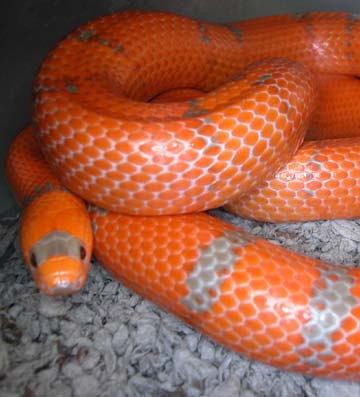
Heres a extreme hypo.

shannon
Image

pweaver Apr 09, 2004 09:46 AM

Maybe I'll call it a Super-Extreme hypo

Does anyone have a picture of the an animal that Osborn refers to as a "Super"...

pweaver Apr 09, 2004 09:46 AM

.

rtdunham Apr 09, 2004 01:37 PM

>>Maybe I'll call it a Super-Extreme hypo

oh, i'd hate to see you do that, i think that's the more complete version of what steve initially called his, "super hypo extreme" or something like that, but i am pretty sure it was using both terms. Steve? Anyway, he's held on to the super term so it didn't seem practical to use that for this new type.

once your animal (s?) get older it'll be itneresting to see if they still look like the extremes i'm describing. In your one pic the head color, the largest area available for scrutiny, looks grayer than on the extremes that have come from mike (photo), which seem more light tan or flesh color ("blond" was another name that was considered). maybe you have a third hypo morph? how thoroughly have you been able to establish its origins, to be sure it's not related to the original hypo animals, which is what mike's came from?

terry
Image

pweaver Apr 09, 2004 01:49 PM

I can try to get a close-up shot of his head and bands for you. They are more of a light gray than a tan though. It's difficult to get right in a picture, as he's one mean SOB. I think he prefers human flesh over pinky rats

I think I gave you the info on his origins as well as I know them in an email a couple of months back. If you can't find the email let me know and I'll resend it.

rtdunham Apr 09, 2004 02:31 PM

>>I think I gave you the info on his origins as well as I know them in an email a couple of months back. If you can't find the email let me know and I'll resend it.
===========
Hi Paul,

Yeah, you did. I went back and found emails from last year. Bottom line is, your animal is a descendent of one or more hypos I sold, and the animals i sold are descendents of the hypos that originated with bill and kathy love. Which I think is also true of mike falcon's animals that have produced his unusual new hypos. So yours and his could be the same thing.

As you noted last year: " It's odd though that these aren't turning up everywhere, with the number of hypos you've sold over the years...." and I'd have to agree.

I guess we'll learn more about what's going on as time passes. This year, with hoped-for first breedings of extreme hypo x extreme hypo AND of extreme hypo X "regular" hypo, should give us a lot of insight.

terry

pweaver Apr 09, 2004 02:43 PM

My guess is that your extreme x regular hypo produces just normal looking hypos. Just my guess...

btw, the grandfather of my hypo has bands that are more gray in color than the black that most hypos have. This is the animal that you produced. I think he's the gene carrier for this trait, and that my adults that produced the super/extreme are some type of hets for this. Like you said, this year should tell a lot.

pweaver Apr 09, 2004 02:02 PM

Looks more like Shannon's '03 that your adult though...

pweaver Apr 09, 2004 02:03 PM

.

JMartin Apr 09, 2004 11:04 PM

I agree that there should be a clear distinction between these two lines. Heres my adult male Osborne line "Super" Hypo Honduran. He has retained a bright orange coloration into adulthood.
Josh Martin

Site Tools