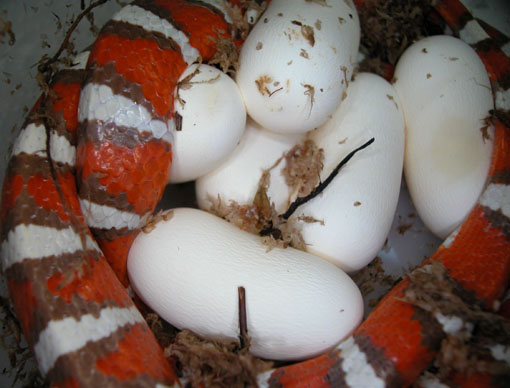
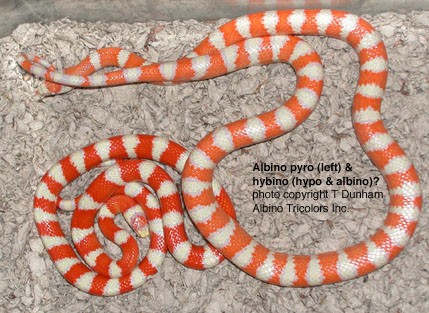
Jason Baylin and I initiated a project this spring to take the first small steps towards eventually producing ghost -- or "super ghost" pyros. Jason put his female "Sentz" line hypo pyro on breeder loan with me to breed x my "anery" (hypoerythristic) pyro male (which i got from ric blair, who got it from the person who caught it). The results to date are shown below: she laid a clutch of six eggs this morning, all of them apparently good.
(Jason's female is of the very pale type of hypo originally referred to as "memmo" hypos because of frank memmo's involvement, and more recently referred to as "sentz" hypos because of steve sentz' earlier ownership of the foundation stock. They're also sometimes called "cover" hypos because of jack cover's earlier involvement. They're much lighter coffee-and-cream brown than the hypos produced by brian barczyk, which i'm also working with. But it's not yet known with certainty whether the two are unique morphs or variations on a single hypo morph: early breedings by jeff teel and mark petros suggest strongly that that might be the case, but a few more test breedings are required before that can be established as fact. This same uncertainty and testing is also underway with the new "extreme" hypo Honduran milksnakes first produced by mike falcon, btw.)
So the babies from the eggs shown will be double het for sentz hypo and "anery" hypoerythristic (again as explanation for those who haven't been following pyro morphs, the "anery" is more accurately called a hypoerythristic, because as can be seen in the photo i posted yesterday of it copulating with a normal, it's really a pale pink...some red, or color from erythrins, is still present, so "an"erythristic--meaning NO erythrins--is incorrect: A true anery would be only black and white and possibly gray. But the anery term is also incorrect for "an"erythristic hondurans, most of which clearly retain a very pale pink or pale orange coloration, and efforts to call that hondo morph the more accurate "hypoerythristic" instead (first proposed by Louis Porras) have not cuaght on. The pyro "anery" retains even more pink than the hondos, though, so whether or not the hondo nomenclature catches up with accuracy, someday the terms for the pyros may have to be refined. Right now I try to use the terms in combination, to increase awareness of the distinction--maybe eventually we can drop anery in favor of the more proper and descriptive term.)
But these difficulties show how important it is to pick the best names right from the beginning.
All of which leads to several questions: The expectation is that the 1/16 of babies from these double hets will be BOTH hypo and "anery" (hypoerythristic) -- very pale versions of the anery (hypoerythristic) -- they should be pink and light creamy brown and white. But is the term "ghost" the right term to describe those animals? It's usually used to describe the double-homozygous offspring of hypos and true anerys (but it's bastardized to use with the "ghost" honduran, too). If not "ghost," then what? If a true anerythristic pyro shows up someday, totally free of pink or red or orange (no erythrins) IT should properly be called anerythristic, and the double-morph babies of it and hypo should properly be called ghosts. PLUS, if there do end up to be TWO different hypo morphs, how do we distinguish between what might ultimately be two different types of "ghosts"? So there are some challenges here, and the forum is as good a place as any to pursue the best answers.
Personal opinions: As is being proposed with hondurans, if there turn out to be two diff types of hypos, the lighter ghosts, with greater degree of melanin reduction, would be called "extreme" ghosts; that same distinction might work with the pyros, if the ghost terminology is adopted--there could be ghosts, and "super" ghosts or "extreme" ghosts. Yes, "sentz" hypo and "blair" anery would communicate what animals we're talking about. But there are a couple problems: 1) look how the "sentz" line was formerly something else, and is also now sometimes referred to in yet a third way, referencing a potentially even earlier owner of the line. So name-based terminology has its shortcomings, most especially the fact that... 2) Neither term is descriptive--neither tells how THAT hypo or THAT anery is different visually from other forms of that morph that already exist or that might turn up someday.
If the barczyk and sentz hypos prove to be the SAME allele, then they'd both simply be hypos and i guess there's nothing wrong with distinguishing LINES of a morph by referring to the owner's name. But what happens when they're inbred and animals appear showing features of both lines?
And you thought our challenges as herpetoculturists were merely to get the animals to breed!
Meanwhile, besides hoping that all six of these eggs hatch, i'm sure jason's hoping along with me that we end up with 2.4 ! 
peace
terry