

Reptile & Amphibian Forums

Welcome to kingsnake.com's message board system. Here you may share and discuss information with others about your favorite reptile and amphibian related topics such as care and feeding, caging requirements, permits and licenses, and more. Launched in 1997, the kingsnake.com message board system is one of the oldest and largest systems on the internet.

Click here to visit Classifieds
https://www.crepnw.com/
Click here for Dragon Serpents

I had my vet do a venomoid operation

MsTT May 12, 2004 08:14 PM

On a dead snake, to get his professional opinion of the procedure. It's not something we would want to do to a live animal, but we had this opportunity to learn some things from a patient we were unable to save.

I asked him to thoroughly take apart a dead black mamba so that we could learn more about the anatomy for the next time we had to perform surgery on a live patient. I asked him to remove the venom glands from the dead animal and to pay special attention to the head structures, since we get so many mambas in with head trauma. See the link below for some examples.

I'll eventually be posting a more complete account on the web page of what my vet thought of this "venomoid" operation, but here are some basic conclusions.

1. My vet was really not thrilled with the idea that anyone would want to do this to a live patient. Digging the venom gland out of an elapid's head meant going quite deep through a lot of delicate internal structures. It is not a trivial operation by any stretch of the imagination. He was willing to do it to a dead animal but he did not think it would be a good thing to do to a live animal.

2. The first "venom gland" my vet removed turned out to be a small muscle that was positioned right at the base of the fang. It looked a lot like gland tissue. Keep in mind that the person who made this mistake is an experienced reptile vet who has worked for Fish and Wildlife doing surgical implants on snakes for telemetry studies. Distinguishing that small muscle from the actual gland was difficult even for a veterinarian who had some previous experience doing oral surgery on elapids.

3. Given the reports of fully hot snakes running around with obvious scars from a venomoid operation, this makes me wonder if amateurs with much less skill than a veterinarian are actually removing the wrong piece. Obviously it is not too difficult to get that little muscle confused with the venom gland, given that an experienced reptile veterinarian did exactly that on his first attempt.

Makes ya wonder, doesn't it?
Mamba rescue
Replies (8)

pseudechis May 12, 2004 11:15 PM

imagine how much pain these snakes have its depressing.i would adopt a mamba but that would be completly stupid on my part and not to mention ilegal in three waysi would donate but no $$$.keep it up.
Zach

MsTT May 13, 2004 10:57 AM

Couple of clarifications - sorry, I was tired and made some errors in the initial post. The attempt that my vet made at "venomoid" surgery on a dead patient was initially with a Mexican jumping viper, and that was the dissection I actually saw where the muscle was removed instead of the venom gland. I was not at the clinic during the black mamba dissection and I got feedback from the vet afterward.

The feedback was pretty much the same on the elapid. Venom glands are buried way down deep and are both hard to get to without cutting through a lot of tissue and easy to mistake for other tissue that isn't venom gland.

I think it is a good idea to do "learning necropsies". If we can't save a life at least we can learn something that will help the living. The more intimately familiar my vet is with elapid and viperid anatomy, the better off my live patients are. So I'll probably be making more reports of this nature as rescue operations continue.

Donations of freshly dead (not frozen) venomous snakes will be cheerfully accepted towards this goal.

Chance May 13, 2004 12:10 PM

MsTT,

Your information regarding this both fascinates and greatly disturbs me. We have known for quite some time that "venomoid" snakes occasionally aren't quite as 'cold' as they were when bought, but I personally never knew how similarly-looking the tissues are in that area. As a lay-person to venomous snake head anatomy, I, like the venomoiders, was picturing an actual venom sac easily distinguishable from the surrounding tissues. Of course that's not true. That does bring up an incredibly serious issue, like you eluded to in your first post, as to how many snakes are floating around out there from hand to hand (literally) that are still quite hot. I guess time and news articles will tell...unfortunately. I hate to think that stopping the venomoid practice will only come at one or a few persons' lives, but it seems like that may be the only way they will put down their razor blades. I really don't have much of a problem with having a vet perform the surgery if he/she is very herp knowledgable and knows exactly what he/she is pulling out of the snake. However, as you've shown, that's few and far between at best. Thanks again for the valuable information you are providing to members of this board and elsewhere. If I have any fresh deaths, I'll be sure to contact you and send them your way. If you were needing frozen, I'd have a number already.
-Chance

MsTT May 13, 2004 12:30 PM

I am tempted to take photos of the next "venomoid" procedure to post to show evidence of what I am saying, but I am concerned that this will basically amount to a do it yourself venomoider lesson. That is not something I want to make available for the obvious reasons.

There seem to be two ways to tell the difference between the small muscles that attach to the base of the fang and the actual venom gland. One is by isolating the structures with precision microsurgical instruments and taking a biopsy to examine under the microscope so you can see the difference between muscle tissue and gland tissue on a cellular level. The other is by finding out that the snake is still hot after you butchered it and removed the wrong piece. There is no clear visual differentiation between the gland and the structures right next to it.

The equipment my veterinarian used to make the determination of what was muscle and what was venom gland cost about 2-3K (good German microsurgery tools, good hospital microscope). Garage hacks spend fifty cents on scalpel blades and $14.95 on cautery tools from Home Depot. I think they are going to be making mistakes, and I think they do not have a good way of finding out they have made a mistake. I know that some of these mistakes are running around envenomating mice.

Assuming you can make one 100% positive determination initially of which structure is the venom gland in one species, you should be able to find the same structure again in the same kind of snake. But anatomy can differ between species, and you still need to make the original determination without error.

One interesting point is that removing a muscle instead of the gland may render a "dry bite" a lot more likely, because you might have snipped one of the muscles that expresses the venom gland during a bite. So you could have a snake with intact glands and a missing muscle that would deliver mainly dry bites unless it did enough chewing or head motion to express the gland mechanically.

rayhoser May 15, 2004 03:59 AM

To MSTT and co.
Compliments to your vet for doing "dummy runs" first for the venomoid op.
Dummy runs should be done for all aspects of the operation, including such matters as pre and post op, sedation, restraint, fixing of head and mouth, etc.
Three comments on the above posts are factually incorrect and/or misleading.
Assuming the operation is done by cutting through the side of the head, no tissue (or very little) is bypassed to get to the venom gland, ALTHOUGH some may need to be moved or separated at the anterior and posterior ends.
The external procedure isn't recommended, for several reasons (not given here).
Via internal excision (as implied in the above posts), that is via the roof of the mouth, no particularly complicated tissue is cut, save for some muscle, which will heal with suturing (and probably without!).
Secondly the claim that the venom gland is hard to distinguish from other adjacent tissue is not so. This comment must have been made by a person with no knowledge of the said anatomy and tissues. It looks totally different and is really hard to confuse. The only vaguely possible point of confusion is perhaps muscle surrounding the gland and/or that at the posterior part, but frankly I am surprised at the remarks in earlier posts.
Thirdly the comments about differences in venom glands between species need to be tempered. In this regard, all snakes are from the same factory and in terms of family at least, all are essentially the same, save for size of the gland and to a limited extent shape and to a lesser extent positioning in the head. Having said this, they all fit the same profile and a person familiar with the venom gland structure of one species, would be effectively competant with all of that family as the variation is minor and around the same basic plan.
Finally and not relevant to posts in this thread (yet), the procedure is minor and not cruel when done properly and should as a routine be 100% incident free (as detailed in the paper link below).
Photos of the procedure on live (and still healthy) snakes are online at:
http://www.smuggled.com/VenArt1p.htm
Finally, it is recommended that no one trade in allegedly venomoid snakes due to the legal liability issues raised in the paper itself and elsewhere, including I think, this thread. The need for venomoid snakes is perhaps restricted to persons who show such snakes in confined places such as schools for educational purposes and similar.
In these sort of situations, venomoid surgery is in my view to the snake's long-term advantage for several reasons, including the alleviation of the need to forcibly restrain and harshly handle the snake, negating any day-to-day cruelty or torment the snakes may otherwise experience. These reasons formed the basis for a large number of operations, all of which were unqualified successes.
ALL THE BEST
First successful Venomoid surgery pics done on Australian Elapids

rearfang May 15, 2004 01:46 PM

I really can't see how disecting a live snake is less stressful than handling (which is the whole reason behind venomoiding)even if the operation and recovery is short term.

The snake will still be stressed long term. Let's not fool anyone. The whole reason for venomoiding is the handler's convieniance.

I have to disagee on the idea of this surgery being humane in any form.

Frank
-----
"The luxury of not getting involved departed with the last lifeboat Skipper..."

MsTT May 21, 2004 10:21 PM

A brief recap of posts which have been deleted, hopefully without any content that would cause them to be deleted again.

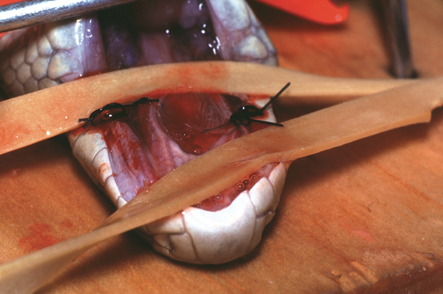
Cold torpor (paralyzing snakes by putting them in the refrigerator until they are too cold to move) has no anesthetic or analgesic value. All it does is paralyze them; the animals remain fully conscious and feeling. This fact may be confirmed by any veterinarian with a modern education in the field of reptile medicine. Mr. Hoser is not a veterinarian and he says that he does not use any anesthesia or pain relief medication when he is cutting into live animals.

As can be seen in his photo, the animal is being cut on a non sterilizable surface (eg, a plank of wood). Its mouth is restrained open by ordinary (non sterilizable) rubber bands which appear to be strapped to nails hammered into the plank of wood. The suture material and the types of knots visible in the mouth are not appropriate to the patient and to the situation.

Before forming an opinion about this article you may want to show it to an experienced reptile veterinarian whom you trust. His or her opinion should be quite enlightening.

MsTT May 21, 2004 10:21 PM

The email address of the RSPCA that is in charge of investigating reports of animal cruelty in Victoria is rspca@vicrspca.aust.com.

Inappropriate use or non approved surgical experimentation on animals which are kept under a scientific permit may be investigated by Ron.Waters@dse.vic.gov.au.

Site Tools
