My pic is a large Retic!! Whats yours??? & why???
Thanks, Chad
Welcome to kingsnake.com's message board system. Here you may share and discuss information with others about your favorite reptile and amphibian related topics such as care and feeding, caging requirements, permits and licenses, and more. Launched in 1997, the kingsnake.com message board system is one of the oldest and largest systems on the internet.



My pic is a large Retic!! Whats yours??? & why???
Thanks, Chad
n/p
This question is asked a number of times on other sites, and for some odd reason there is always a lot of controversy surrounding everyone's answers. This is obviously a opinion-based question, relying on both each person's individual experiences with said animals as well as his/her "book" knowledge on them. I personally like both answering and reading other people's answers to this question. I'm always interested in hearing other people's experiences with certain snakes, especially if I desire now or in the future to work with them. That little disclaimer being said, the following is my vote and my reasoning behind it. Lots of people here could probably already guess at my answer, however.
I believe the world's most dangerous snake is the Papuan taipan, Oxyuranus scutellatus canni. The most obvious first reason for this would be the toxicity of their venom. According to Dr. Bryan Fry, the coastal taipan, and their close Papuan cousins, have an LD50 of 0.106 mg/kg subcutaneously, ranking them at the 6th most toxic snake on Earth currently. Though there certainly are more toxic snakes, there are also many more reasons why the Papuans, even over their mainland coastals, rank at number 1 for me. For me, the only reason I separate the Papuan and coastal for this discussion is based on average sizes. Papuans are known to reach slightly longer lengths than their mainland cousins, and when it comes to taipans, the bigger they are, the more dangerous they become.
To continue with the reasoning, you can simply take a look at taipan anatomy. Taipans, coastals and Papuans anyway, have the longest fang to head size ratio of any elapid. Note, this is a ratio. I'm not saying they have the longest ever recorded fang sizes, just the largest proportion. Adults sometimes have fangs over 2cm in length. For all us US people, there are 2.54 cm in one inch, so that means the longest recorded fangs of a taipan have been nearly 1 inch in length. Big compared to a gaboon? Of course not. But big compared to any other elapid? Heck yes! This enables the taipans to inject their venom very deeply into their prey or would-be aggressors. Also, taipan body anatomy helps to explain the amazing feats they seem to be able to perform. Upon initial observation, it is easy to notice the rather slender neck in comparison to the much heavier posterior and larger head. This slim neck allows the taipans to strike and even charge with pretty amazing speed. Again, this speed can't really compared to the striking speed of a viperid, but for an elapid it's pretty impressive.
To speak a little more about venom, very large taipans have been recorded to give a maximum venom yield of 400 mg, with the average being 120 mg. It's rather needless to then point out how many times over dead an average adult human would be in the case of an average bite of an adult taipan. Speaking of venom output, Dr. John Morrison concluded that taipans, as compared to tiger and brown snakes, produced more and more venom in 3 consecutive strikes whereas the other two groups of snakes tended to produce less and less. Because taipans are very well known to bite multiple times in a single go, this makes the scenario for a huge amount of insanely toxic venom being injected *very* likely.
Lastly I'd like to touch a bit on taipan temperament. Just like with many other venomous snakes around the world, stories abound regarding the legendary aggressive taipan which will chase down anyone unfortunate enough to come in its path. While I used to believe this was hogwash like most other fantastical snake stories, I now know to give it at least a little bit of thought. In the past month or two, my two juvenile Papuan taipans have begun to really show their stuff with their threat displays. Now every time I walk into the snake room, they will flatten out their necks and move in a slow deliberate motion, back and forth. If I get even slightly too close, they seem to have no inclinations about charging. These guys are just about 2.5' or so right now, so I can just imagine what that would be like from an 8' specimen. Because of being able to see this in person, I can now imagine where those amazing stories come from, as it is not too difficult to picture a person knowingly or unknowingly happening upon a large taipan which, if it felt cornered for one reason or another, could charge the person. Also, they seem very inclined to jump around backward as if trying to defend the entire body, tail and all. Regardless, seeing this new surge of threat displays has certainly caused me to give even more respect to these awesome snakes.
Anyway, the above has been my reasoning on why I believe the Papuan taipan is indeed the most dangerous snake on the planet. Though they, thankfully, don't kill anywhere near as many people annually as much less toxic species in lesser developed countries do, I'd say if given the right conditions, they would. A large number of people in PNG are killed by the 'Dirioro' or 'Gobari,' both of which mean 'the black snake with the red back.' Luckily though, medical procedures and access have been improving in that country so the likelihood of dying due to them should be dwindling. Thanks for reading. I look forward to reading everyone else's responces.
-Chance
My vote would be Bothrops asper. As well as (some) other lanceheads.
I have been told that encountering B.Asper in the wild, can be rather unforgiving. I have worked many bothrops species in captivity, along with elapids,(P.colletti.Dendroaspis ssp., Oxyuranus scutellatus,etc.) but they were NOT as predictable in behavior as B. asper.
As far as toxicity, canni wins hands down over asper. I thought the thread was most dangerous snake? A wild caught Retic from Vietnam should be considered also! LOL!
Oop's! I meant, Bothrops asper is NOT as predictable as the un-formentioned species.
Heh, well, I guess that's something I like to hear in the early morning before I take a drive to Tulsa and fly to Belize  Ah well, thanks for the last minute warnings! B. asper is probably my main target species for this week. Keep an eye on the website for pictures to be posted throughout the week (rivervalleysnakes.com).
-Chance
>>Heh, well, I guess that's something I like to hear in the early morning before I take a drive to Tulsa and fly to Belize Ah well, thanks for the last minute warnings! B. asper is probably my main target species for this week. Keep an eye on the website for pictures to be posted throughout the week (rivervalleysnakes.com).
>>-Chance
Since I have had the pleasure of interacting with both B. asper and Papuan taipans in the wild, I will only say that my vote for the most dangerous goes to the taipan every time. Yes, a big asper is an awesome snake with equally awesome attitude, strike range and speed (they are certainly NOT simply like a rattle-less rattler!!!), and I would advise extreme caution if you are going to mess with one, but it simply cannot cover ground with anything like the speed of a taipan. To me, they are in entirely different categories.
To illustrate the point: I have caught a number of big, p*ssed off aspers and atrox, without undue hassle, and would be more than happy to do so again any time. I have assisted in the capture of two Papuan taipans, and if I ever encounter another one in the wild, I wouldn't try to catch it by myself for all the money in the world.
Cheers,
Wolfgang
-----
WW Home
I have to do all the work next time you come over for a holiday ... ROFLMAO
Mate my mission in life is going to be to see you dance with a Moreguina maniac ...
Cheers
Dave
>>To illustrate the point: I have caught a number of big, p*ssed off aspers and atrox, without undue hassle, and would be more than happy to do so again any time. I have assisted in the capture of two Papuan taipans, and if I ever encounter another one in the wild, I wouldn't try to catch it by myself for all the money in the world.
>>
>>Cheers,
>>
>>Wolfgang
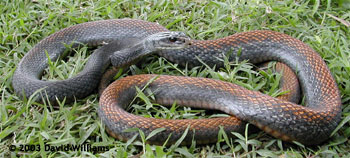
Australian Herpetology ONLINE - Chasing PNG Taipans
-----
David Williams
PNG Snake Venom Research Project
PO Box 168
Port Moresby, NCD, PNG.
>>Mate my mission in life is going to be to see you dance with a Moreguina maniac ...
ROFLMAO!!!
Are you talking about a taipan or one of the local rascals? Either way, it would scare the proverbial out of me... 
Cheers,
Wolfgang
-----
WW Home
Whichever one turns you on the most ...
... although C might bash my head in with a pair of gentle giants if I set you up with one of the local lovelies ... 
Talk to you soon mate!
Dave
>>Are you talking about a taipan or one of the local rascals? Either way, it would scare the proverbial out of me...
>>
>>Cheers,
>>
>>Wolfgang
>>-----
>> WW Home
-----
David Williams
PNG Snake Venom Research Project
PO Box 168
Port Moresby, NCD, PNG.
WW,
What's the largest atrox you've come across? Are 2m specimens in existence?
I've found, that as long as you don't try to physically pin them(wild aspers), they aren't terrible to bag. They run, but rarely strike. Only when restraining to pin have they gotten irritated.
Your worst asper experiences, were they simply bagging, or restraint for scale clipping, venom extraction, etc??
MCH
Hi Matt,
>> What's the largest atrox you've come across? Are 2m specimens in existence?
Define "atrox"... I have been trying to for 10 years and still can't...
More seriously, I caught a 170 cm female in Venezuela, although that was one of those "cf. atrox" that Campbell and Lamar placed into asper but that are actually closer to atrox. 200 cm specimens are not rare in northern Venezuela, by all accounts - they do reach asper-like sizes there. The largest "proper" atrox I caught was a 130 cm female in Suriname - and that was the largest specimen by a long shot out of 40 or 50 I caught there. The other amazing thing was that this single snake probably produced about as much venom as all the others put together - scary!
I measured a 198 cm female in Ecuador, but that was captive bred, so I imagine it may well be larger than anything you are ever likely to find in the wild. I have not found any preserevd specimens that even approached 200 cm.
>>I've found, that as long as you don't try to physically pin them(wild aspers), they aren't terrible to bag. They run, but rarely strike. Only when restraining to pin have they gotten irritated.
Lumping asper and atrox together for the purposes of this dicsussion, most of the ones I have dealt with have been like that as well. If you find one coiled up, and you can hook it and bag it in one smooth operation (requires ProBagger or similar), then it's a piece of cake. Obviously, if you drop it or fumble in some other way, you get fireworks. Specimens caught on the road usually just try to run - they bite when pinned, as you say, but nothing too unmanageable. A combination of jigger, tongs and hoop bag allow a safe capture in a matter of a few seconds.
>>Your worst asper experiences, were they simply bagging, or restraint for scale clipping, venom extraction, etc??
The most dicey one was catching a four footer while carrying only a hook and a bag under my belt - the only way I was going to get that one into the bag was by pinning and necking it. Pinning a a very upset Bothrops on soft leaf-litter is not recommended. At all. And once, I was doing venom extractions and sampling on a series of atrox, with a colleague from a venomous snake institute, in an extremely hot shed, which got some of the snakes seriously excited. A couple went so nuts that we decided it wasn't worth the risk to sample them. Since my colleague was a veteran of over 100,000 extractions, I was happy to respect his judgement on that one
Apart from that (and a few fumbles that were down to me, not the temper of the snakes), I have never really found them all that difficult, provided I have the right equipment. One of the benefits of the long and thin build of them is that, although they can move fast, they are actually not very strong in terms of muscle power, which makes control pretty easy once you pin them. Also, except for very large specimens, they can't put all that much body mass into their jerks, unlike some rattlers, so once you have necked them, it is not too hard to keep a safe grip wven if they do struggle.
For field capture, having a bagging device, tongs and a jigger (for road cruising) takes 90% of the heat out of it, except for very large animals, which I don't like to use tongs on.
Cheers,
Wolfgang
-----
WW Home
I have maintained both coastal and Papuan Taipans in my collection----They are, needless to say, extremely fast and very deadly !! I have personally collected Bothrops asper in the Darien of southern Panama and in Tabasco, Mexico....they too, needless to say, are also fast and deadly. The most dangerous snake I have ever maintained and/or handled are the Tree Cobras--Gold's Tree Cobras are the fastest thing w/ventral scales...if you ever have to handle an infuriated specimen, may God be with you---you are in for one hell of a surprise....Black Mamba's cannot match the ferocity of an enraged Gold's and speedwise would be considered "slow".....Earl Turner
Depends on whether the question is:
1. Which snake would you least like to take a bite from?
2. Which snake would you least like to handle for routine cage maintenance?
3. Which snake would you least like to have to milk or medicate hands-on?
I'd say a king would be my answer to #1, a big evil Bothrops as #2, and Proatheris or Echis as #3. I %$#@! hate having to go hands on with tiny little evil tempered vipers.
Close contenders for #2 would be Pseudohaje gouldii and an adult wild caught taipan. Proatheris would be another close contender for #1, as would a Gould's.
My picks would be:
The one in front of me that should be holding my attention.
The only one more dangerous would be:
The one whose strike range I have entered without knowing it.
Those are the only two snakes I worry about.
Karl
...that sells sick animals knowing full well they probably won't make it.
Chris
makes it the most dangerous snake, but okay
AP
The dealer is dangerous as he 1. knowingly bilks people out of their hard earned money (and this is a RICH man's hobby...no arguement there, I hope). It's undetectable until someone compolains to someone else, etc...God only knows how much damage can be done until he gets shut down via word-of-mouth only then to re-surface sometime in the future under an assumed name and 2. sells animals with crypto or some other sickness spread via airborne spores which can (not always) infect the rest of said person's collection.
The unscrupulous dealer is also a "snake" in the figurative sense.
Maurice Cullen (Beaver) once told me "Snake people are sometimes snakes, themselves".
Help, tips & resources quick links
Manage your user and advertising accounts
Advertising and services purchase quick links
