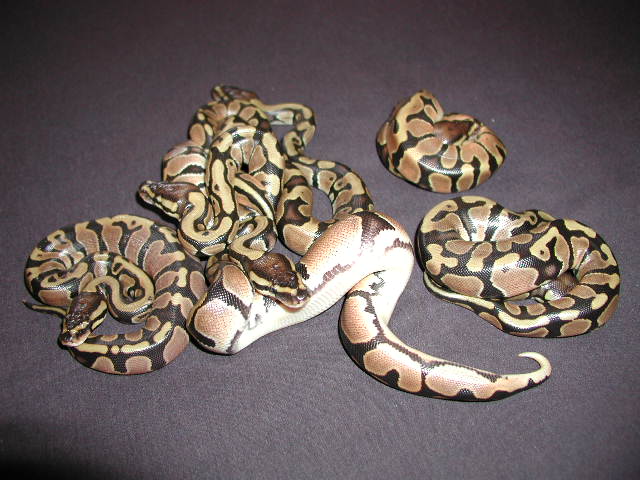
Seems to me that you are probably on to something but that it might take an extra generation to pin it down.
With co-dominant mutations it's not that out there for the heterozygous animals to be pretty subtle. Just be glad if the turn out to be consistent (i.e. easy to pick out due to the belly etc.). The dad looks odd enough to me in that one pic. Is he sort of axanthic looking in addition to the faded reduced pattern and white belly?
As far as figuring out how they may or may not be related to pastel you have a lot of work on your hands. In the case of the cinnamon pastel (I also didn't see much there before the pewter) we still don't really know how it relates to pastel jungle. Just because they combine to produce a really weird animal (the pewter) doesn't necessarily mean they are alleles (different mutations of the same gene). They might be unrelated mutations and the interaction in the double het is such that it produces a pewter anyway. The test will be when the pewter is bred to a large number of normals. If cinnamon pastel and pastel jungle are alleles, then the pewter has no normal copies of the common gene and all of it's offspring will be either pastel jungle or cinnamon pastel (no normals or pewters when bred to a normal). If they are two different genes then it will produce about 1/4 normal and 1/4 pewters (and 1/4 pastel jungle and 1/4 cinnamon pastel).
So, by all means breed your animal to a pastel but you will then need to keep any odd looking combination babies and breed them to normals and see if they produce any normal babies or not to see how the two mutations relate.