>>Now that I have more than one snake again(), I figure I better start keeping records like in the old days.
>>
>>But I figure now I don't need to do as much long hand: Are there any computer programs, or even predesigned forms which can be printed out and copied and then filled in available?? Thanks in advance.
>>-----
You may elect to transfer notes to a computer periodically, but i think the card-right-on-the-enclosure method is an essential tool, being right where you need info when you need it.
Here's a pic of a typical front of a rack system tray during breeding season:
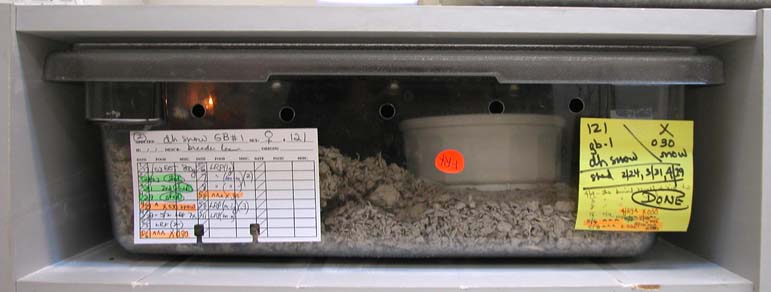
The card on the left (used year-round) records each feeding record including date and type of food (live? dead? pinky? fuzzy? mouse? rat? scented? by what?); dates the animal goes into shed; shed dates (the green notations); any/every medication, regurg, copulation (the orange notations), egg deposition (is coded yellow), beginning and end of brumation; periodic weights, etc. Not bad for a 4 x 6 card. I've got five year old snakes now on card 18, for example, so they have a pretty effective lifespan (the cards, as well as the snakes!)
The post-it sticker on the right is used during breeding season only. Those post-its identify the female in question; the male she's to breed to (checked & double checked each time she's moved); the date and sperm rating of each copulation; the shed date prior to deposition, and the outcome of laying. I move these cards with the eggs when the eggs are moved to their incubation box: the lay date helps me keep the clutches in sequence and once they hatch, i record the genotype/phenotype/gender outcomes on the post-it as well.
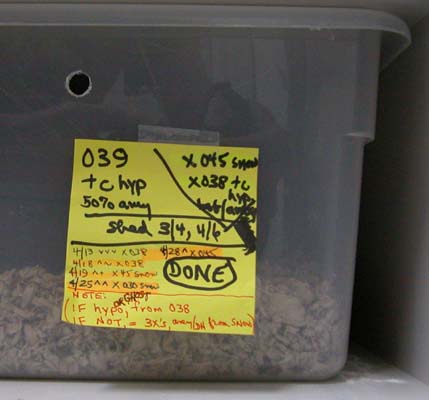
Here's a closeup of an unusual example: In this instance, i bred a female x two different males, making sure i'd know which male was the father due to the phenotype, or appearance, of each youngster. I noted that on the card, so i couldn't get confused later. One of the big advantages of these on-the-cage-cards is that people (ok, me) often think they'll remember something when it happens, but weeks or months later, that crystal clarity has faded or disappeared, buried by 100 other "must recall" incidents that occurred since, some perhaps of very similar nature. As breeders we can't afford a single mistake of that kind, so i've found it useful to write it down.
During breeding season i also keep a log on an excel spreadsheet: it records for ALL females, grouped with the males they'll be bred to, the dates of their first and second sheds, the dates and sperm ratings of all copulations, the date of the post-breeding shed, the date a box is added, the date they lay, the number of eggs, etc. The beauty of a spreadsheet program is that i can then sort, for each male's "harem", by the 2nd shed date, for example: that re-orders the females in the sequence in which they're most likely to be receptive to breeding, the sequence in which they should be offered to the male. This is important because i often breed a male to half a dozen or more females. Later, I can again re-sort the info based on the column showing dates of pre-lay sheds: This tells me when I need to add layboxes, and where. This is all just effective management when your collection grows beyond your ability to retain all this detail in your head.
peace
terry



 ), I figure I better start keeping records like in the old days.