Reptile & Amphibian Forums

Welcome to kingsnake.com's message board system. Here you may share and discuss information with others about your favorite reptile and amphibian related topics such as care and feeding, caging requirements, permits and licenses, and more. Launched in 1997, the kingsnake.com message board system is one of the oldest and largest systems on the internet.

Click to visit DM Exotics
Click for ZooMed
Click for 65% off Shipping with Reptiles 2 You

Heres my dragon pics, real (monitors), and beardies...

SHvar Aug 17, 2004 01:39 AM

Sobek on her log at over 6ft 2 inches and 2years 8 months old, my female BT/WT/WT cross...

This is Sobeks basking spot, the top level at least, note the temp, its also 165-172f larger than her STV length and wider also..
Sedona my red ackie at 2 years old and 24 inches, note the basking temp, the high spot was 200 on a cool evening..

This is my adult beardie pair that produces some abosolutely huge babies, snuggles in on the log at 16-18 months old and 571 grams and 19 inches, she lays 21 eggs every 3-4 weeks, 118 so far this year starting at 10 months old. Nemo is the hypo-orange-pastel-german giant on his basking spot, Snuggels has her own basking spot although they usually bask together, eat together, sleep together, and he protects her, and her eggs constantly and even helps dig the nest sometimes, hes 21.5 inches and 2 years old, 671 grams, yes they live together 24/7, he even eats after she is done..

This is their basking temp...

The dragon baby on the right is the male hatchling I kept from Nemo and Snuggles, he is Frodo, hes 4 months old and 16 inches long, the male snow giant on the left is 5 months old and 16.5 or more inches long, they were waiting for more superworms in this pic, yes 2 males living together, hunting together, eating together, sleeping etc, [removed inflamatory comments]...

An old pic of Shadow my almost 4 year old male BT/WT cross..

A basic note on every reptile I have and some I help raise and care for, none I repeat none have any UVB lighting, all live on dirt (the beardies less of it), have high basking spots, good temp gradients, and varying humidity levels, they all eat whole animals except the beardies also eat greens daily with their crickets, lobster roaches, and superworms. Sobeks next cage (in the next few months hopefully, woohoo new house soon) will also have a dish big enough to soak as occaisionally she wants to, so I have to allow her to soak outside of this cage as theres not enough room for a water dish that big in it. Well next she will have to outgrow a 10ft long by 6ft high by 5ft wide cage. I might also obtain a 5ft male Sienna Leguaan (sienna WT) from a good friend called Blaize, hes a loveable creature but his owner doesnt have that much time anymore working away from home so much, the banded WT he is keeping though.
This is Blaize, I helped raise him from the time he was 12 inches long total...

______

post edited for inflammatory comment.

Edited on August 18, 2004 at 17:13:37 by phwyvern.

Replies (35)

cee4 Aug 17, 2004 08:24 AM

Do you really use no uvb light? Do you use supplements? Just curius how this works, it always seems like overkill to give both supplements and uvb. Although I can see using supplements if you use uvb bulbs as they are not as good as the sun but the supplements are a replacements for the sun..I use both anyway..Its kinda like us humans taking vit. D supplements because we dont get in the sun enough, if we take the vit. we dont have to have the sun as well..But if you dont take the vit.D and stay out of the sun our bones would get soft..But if we get plenty of sun we dont need supplements..Does any of this make sense...This probable wont change the way I do things anyway. I was just curious why you dont use the lighting and I would assume have never had problems with MBD.

SHvar Aug 17, 2004 10:35 AM

If you check the independant tests on UV bulbs they dont put out near enough to be usable for any reptile, which also show a normal blacklight making much much more, which says something in itself. Until UV lights came out on the market what did keepers and zoos use? Zoos didnt and still dont use UV lights, yet where have all Aussie reptiles in captivity except illegal examples worldwide come from, captive breeding in zoos. Someting to think about UV lights for reptiles dont have warnings on them about UV output and eye or skin damage, yet Blacklights have since what the 60 or 70s, something to think about. I make no empty calims or try to be some nazi organization that insults someone or trys to get them removed because they dont agree with my husbandry or anyone elses. I simply ask for anyone who makes claims to step up and prove what they claim or prove me or anyone else wrong, or prove on your own that what I do is right or wrong, it works for so many.

mystical-dragons Aug 17, 2004 12:16 PM

Actually some Reptile UVB bulbs come with warning of UV output. Well At least ZooMeds do, both fluorescent Repti-Sun 5.0 as well as the Powersun. Zoomed is pretty much the standard for UVB bulbs until the past few years with the introduction of the mvb by Westron. Also you may want to check out the Westron bulbs on www.Reptileuv.com. They actually come close in matching UV readings.

I know whenever my bulbs get old my dragons look duller then usual. When I get new fresh bulbs they color up quite a bit that day. I would think healthy happy dragons would show the brightest most vibrant colors, or at least to what their genetics can obtain.

It looks like yours can be much brighter then they are, and I don't think it's the dirt that makes them dull looking. Yes, dirt is dusty, but it looks like they have underlying potential to be very colorful dragons if given uvb lighting. It can only help, can't hurt sun loving reptiles to get some UVB. There is a yahoo group that has A lot of independent testing reports, and some good info on what the bulbs available can produce, and how to get the most out of them. Over the years they get better, and the bulbs have come a long way from what they were 10 years ago.

Unfortunately this site is temporarily down which is weird, but should be back up today. Probably just updating. They have independent studies/reading of many bulbs, as well as reading outside in different locals.
http://groups.yahoo.com/group/UVB_Meter_Owners
-----

Webshots photos
www.Mystical-Dragons.com

SHvar Aug 17, 2004 09:33 PM

On those 2 for colors. I did find the only difference was the brightness of color in them. The pics of Nemo and the snow giant do not do them justice what so ever. Nemo is actually very very bright orange, but almost creamsicle orange, most who see him think hes a toy if he sits still because he is so big and bright. My camera doesnt always seem to get those colors either. Snuggles was very bright when she was small , but she was a dull colored sandfire yellow gold cross that was bought as a group of 10 looking dull once. I need to get pics of their daughter at Bayoubeasts place, I gave them her because I dont have time to keep track of anymore females and their constant egglaying, anyways she is a miniature of her father a bright orange beautiful animal, not near as big as her younger brother though, although both were big hatchlings from big eggs. I researched results from independant testing and compared the UV bulbs myself from multiple companies with multiple dragons with only a few increasing in color, but the most consistant results in color came with a walmart blacklight (UV exposure warning on package), they developed neat background colors and bright areas around the eyes. Ive tried it with several monitors with absolutely no change but it made it harder in hot weather to keep a good temp gradient with the extra light source.

wideglide Aug 17, 2004 12:37 PM

Here's some info proving your statements wrong.

Link I

Check out the 5th paragraph under Conclusions in the above link.

Link II

Above link indicates the level of the output of the sun is more than needed to produce adequate levels of D3.

Two quotes from above link:

"Bernard et al [24] exposed vitamin D deficient iguanas to UVB from a Sylvania 2096 fluorescent tube (not yet available) for 12 hours daily and found that so much previtamin D3 was produced that the researches wondered if the normal feedback mechanisms applied to iguanas."

"How strong is a reptile light? A Vita-Lite at 12 inches produces about 1.1 µW/cm2 [21], which would produce 20 mJ/cm2 over any exposed skin in 5 hours. That should be sufficient to begin vitamin D3 production."

Link III

The above link will reiterate the fact that the current UVB bulbs available produce more than adequate amounts of UVB for the production of D3.

I have emailed the Denver Zoo as well as left a message on the voicemail of an animal worker there inquiring as to wether or not they use UVB producing bulbs. It is my understanding from reading a post from a gentleman who used to work there that the Denver Zoo does indeed use Active Heat UVB bulbs. When I have proof of this I'll provide it.

Now, can you prove or backup what you've stated? If so that's great and I'd love to see it. If not I suggest you stop making statements you do not know for a fact are true.
-----
Rob Talkington

SHvar Aug 17, 2004 09:54 PM

Ask multiple zoos, ask people who worked at those zoos, long before UVB lights werte on the market, after all where did all berdies in the US come from, CB offspring in zoos, hmmm. Anyways they didnt use those bulbs back then, in fact make a list of zoos using them and what type of them they use with what animals, how abbout San diego, Washington, Bronx, Chicago, and while your at it Amsterdam, Berlin, and many many more. Ask someone who worked with reptiles in those zoos for many years, hmmm, Frank Retes for one, as he said many many times before it has to do with husbandry and temps as well a proper diet not magic lights that make UV, and they dont compare to the sun, I dont care what they claim. Also, as far as quoting that site, I recieved an email once from forum management that an entire post was removed from a discuccion similar to this because of Melissa Kaplans site was quoted, they said they removed the post because they were stopping another Kaplan bash fest. Anyways ask Bayoubeasts about his long history with Green Iguanas, and those that are in hi house now, they get no UV lighting yet are beautiful active bright, territorial, and constantly growing. You may forget I help with rescued animals that have been through bad lousey husbandry and were kept under UV lights, but they are sick, dieing, and some deformed, yet in a few weeks to a few months they are double their size in most cases, happy, healthy, and many deformities seem to disappear even bad cases of MBD as the dragon male in his basement now that looked like a starving twisted corpse, now a fat growing beardie that is losing most of his deformities, he recovered so fast as well so many other animals that former owners dont recognize them in a few weeks time. Im sorry articles on claims are not proof, they are quotes of observations, no proof.. Im talking about real world animals that I see on a regular basis, that Ive seen change in them, that Ive directly set up the husbandry for...

-ryan- Aug 18, 2004 10:58 AM

Comparing a zoo to a hobbyist is a little bit of a stretch. I use supplements and UV lighting... I just figure it's extra insurance, and I think it's a good idea to use both. That's my opinion on the subject.

Majesty_Cassy Aug 17, 2004 01:47 PM

Well, I can say that the Zoo I volunteer at (I help in the Reptile Zoo For Children) uses UVB bulbs and always has. There is no substitute for natural sun. Even humans need the sun to survive.

-----
Ken
If you kill it, You better be willing to eat it!

2 Bearded Dragons
1 Iguana
4 Oscars
2 Dogs
2 Children

SHvar Aug 17, 2004 09:57 PM

Try to find zoos that have growth and reproductive sucess.

Majesty_Cassy Aug 18, 2004 08:01 AM

Yes. We produce offspring and have a very high success rate.

-----
Ken
If you kill it, You better be willing to eat it!

2 Bearded Dragons
1 Iguana
4 Oscars
2 Dogs
2 Children

SHvar Aug 18, 2004 10:05 AM

Ya know, it doesnt matter really, after all how many species of reptile do they breed or have they had breed?

wideglide Aug 17, 2004 03:40 PM

>>If you check the independant tests on UV bulbs they dont put out near enough to be usable for any reptile, which also show a normal blacklight making much much more, which says something in itself. Until UV lights came out on the market what did keepers and zoos use? Zoos didnt and still dont use UV lights, yet where have all Aussie reptiles in captivity except illegal examples worldwide come from, captive breeding in zoos. Someting to think about UV lights for reptiles dont have warnings on them about UV output and eye or skin damage, yet Blacklights have since what the 60 or 70s, something to think about. I make no empty calims or try to be some nazi organization that insults someone or trys to get them removed because they dont agree with my husbandry or anyone elses. I simply ask for anyone who makes claims to step up and prove what they claim or prove me or anyone else wrong, or prove on your own that what I do is right or wrong, it works for so many.
-----
Rob Talkington

tazok Aug 17, 2004 04:05 PM

In regard to "Someting to think about UV lights for reptiles dont have warnings on them about UV output and eye or skin damage, yet Blacklights have since what the 60 or 70s, something to think about."

That because UV is their intended use. Of course they're not going to have a warning label saying they produce UV light. That would be like matches saying, "may start a fire."

Some people do need warning labels I guess though.

Like on a hair dryer, "Do not use in the shower."

SHvar Aug 17, 2004 10:03 PM

And keep hands and feet away from blade right, almost all of the time it happens though toes and fingers chpped off. Actually if true they would need warning labels to cover them for legal reasons, to prvent being sued over missuse. Makes you wonder, about people and if there isnt a label does it make much? I have an example I have alergies, my hepa filter that I use on a rare occaison now that prescriptions have helped so much has a UV sterilizer in it, it has a tube that is like a flourescent light but is completlely clear and has UV warnings all over as well safety devices to prevent exposure.

-ryan- Aug 18, 2004 09:06 PM

You said it yourself earlier....UV lights don't give off as much UV light as say...the sun, therefore there isn't a risk of skin or eye damage with the flourescent lights. The Mercury Vapor lights are more powerful, and they do have warnings.

You go outside everyday (well, I do at least), and the sun is much much much more powerful than those little lights. I think a day under a flourescent UV lamp is about the same as a half hour under the sun at noon or something like that. They are powerful enough though that I see them as being a useful part of reptile husbandry...that's just my opinion.

wideglide Aug 17, 2004 08:38 AM

And your monitor's one spot is at 200 degrees? You just must be lucky because everything you seem to be doing with regards to beardies is usually advised against.

You go ahead and do things how you want to but be advised when you bring it to this forum your methods will be criticized and it will be made perfectly clear those without years of experience should not do what you do.

You know good and well from the history of posts involving your methods of husbandry the only thing you're going to accomplish here is conflict and I believe that is against the TOS. Maybe it will be different this time. We'll have to see where the thread goes. I guess it all depends on if you decide to argue with the majority or users here when they disagree with your husbandry methods.

You know what might prevent the big arguing mess? If you decided to agree that what you are doing are your own decisions based on suggestions by only a few people and your own experience. If you could give that to the people who really try to help others who are new to dragons I bet there will be no arguments.

The main concern here is that others who do not have the experience you do, do not try these methods themselves because it's just too dangerous and strays too far from what has been proven to work by the majority of keepers. Not only are the new keepers not able to spot signs of trouble early enough, if they follow your methods the level of support to these people goes from a great number to only a few.

So what do you think? Does that sound reasonable?
-----
Rob Talkington

SHvar Aug 17, 2004 10:25 AM

And their completely natural healthy lifesytle. The basking temps are surface temps they are not ambient or air temps those are around 85-90f on the warm end of the cages. Truthfully I never purposefully set the exact basking temps for the beardies to any exact temp, I set the cages up and made sure it was over 130f originally, after a day or so I normally check it but if they use that temp and they dont get burnt then I dont worry about it. If I go into my back yard which is around 89f right now, I can find objects (rocks, boards etc) that have a surface temp of 110-160f easily from just normal sunlight. Imagine on a hot day in Africa, ot Australia what those temps are? Ive seen pics from those countries of this being checked, the basking temps avialable, and observed being used were between 130-200f, depends on the ambient temp and time of day. The average basking temp used by lizards in general being around 150f. I dont claim to be reinventing the wheel, I am simply demonstrating what so many others do with many species of lizard and snakes (snakes of course need less because they are always on the ground surface). I learned myself from my animals and from a few notable and very sucessful reptile keepers and breeders years ago, I just used my own brain and sought out what worked, also again made adjustments for individuals. Keep in mind that every cage offers a wide range of choices from high basking temps, to room temp or close ambient temps, from hide spots to burrowable deep dirt, from drinking water (in with my monitors) to live prey (insects) in some cages 24/7. I do what works for my animals, and what works for many animals so well and that I need to spend less time interferring with their lives and stressing them out because they have choices. Dont get me wrong I do handle every animal in my collection except my Asian wolf spider (dont want to get bit). In fact like Sobek, my ackie, or a few of my beardies they are down right affectionate coming to me and others to be handled etc. Anyone can choose to believe or not to believe what they want, I am mearly showing pics of how so many do it and that it works great, Im not worried about dirt making their skin look dirty for pictures, they use it to be healthy. Again I offer choices to the animals they use what they need, after all we are just keepers, the animals are the experts, they know what they need way more than we do. Offer choices to them and see what they use. I know how a handful of so called experts on this forum believe that they are a dictatorship on info here, if this post or any others are removed it demonstrates this. I am not here to cause problems I am here to help others and to show that theses a way that works that the animals do excellent. Nobody can sue over taking advice on a forum beause it is a public exchange of info in which you make your own mind up to what you do. I am merely showing (not claiming with only words) what works and showing that I offer choices. I made the offer to anyone who wnats to see my animals in person can make arrangements to do so, I have nothing to hide nor do I make any claims and not stand behind them. I live in Middletown PA, and go to every if not most Hamburg PA shows, and Lititz PA also.

CheriS Aug 17, 2004 01:11 PM

1. Those young dragons do not look healthy, the one's backbone is showing through its skin and has sticks for front legs, the other's the hip bones are showing... how do you think this is good? I think you should get fecals of both to a vet ASAP

2. As far as the male eating after the female, like a nice gentlemen, looks like either can eat whenever they want with all the dried up food laying all over in the dirt. You think that is good for them? Thats not picking on you, they are your pictures and obviously a reflection of how you care and feed them.

3. What are the dark patches on the females head, and discolored areas on her side and back leg? Also, you have noticed that she has about zero fat pads on her head? You might want to work on helping her regain those before you have another problem on your hands. Separating her from the male and allowing her to recover from too early breeding and egg laying would be something nice you could do for her.

4. Is the monitor in the top picture the one that had to have surgery to removed egg bound eggs when she was younger... maybe too young?

Seriously, I think you need to take another open eyed looked at the conditions of your dragons, all the markers are there for poor husbandry and they could only benefit from you learning to improve it and how to care for them properly. You insist for advocating your "methods" to other, yet refuse to see that these are not healthy dragons. If I remember correctly, out of your first 3 clutches, you only had a couple of eggs that made it to hatching? I AM NOT trying to pick on you, I am trying to get you to look at what you are doing and stop trying to convince us and others that you have a method that works... it does not.

This is a healthy 4 mo, almost 5 mo old female... can you see the difference between her and yours? She has had the benefit of UVB, proper temps, clean enviroment and good line breeding from parents that were healthy and old enough to support developing healthy eggs.
Image
-----
www.reptilerooms.com

riiotgrrl Aug 17, 2004 05:14 PM

I am also curious about something. Have you ever seen A thermal burn on a reptile. It really isnt pretty. With a basking spot of 168*f, i can see in your future some very hefty vet bills.
-----
"i wasn't born with enough middle fingers"

1.0 ball python- Azazel
1.0 columbian boa- Brooklyn
1.0 red blood python-Hiss
1.0 peach phase thayeri-Sancho
0.1 creamsicle corn- Pandora
0.1 partial stripe ghost corn- Raven
1.1 hognose- Pricilla and Odd
0.1 russian tortoise- Manja
0.1.1 leos- Boji and Kodama
0.1 beardie- Indie
1.0 BTS- Griffon
0.1 Iggy- Sunny
0.0.2 Red american toadlets with 0.0.7 legs total (er, i have one w/3....)
0.0.1 gray tree frog toadlet
0.0.6 land snails
0.0.2 millipedes of unknown species from TN
0.0.1 spotted slug
5.3 bettas
0.1 pacific parrolet- Mishka
1.1 cats- Cairo and Oberon
2.3 ratties Rizzo, Bounce, Bree, Blitzkreig, and Zelda

riiotgrrl Aug 17, 2004 05:17 PM

This is what happens when you keep baby beardies togther in smaller quarters. I rescued indie from being eaten by her tank mates. Even thpugh you may not have a small tank, 2 males together will eventually end up having eachother for dinner.

-----
"i wasn't born with enough middle fingers"

1.0 ball python- Azazel
1.0 columbian boa- Brooklyn
1.0 red blood python-Hiss
1.0 peach phase thayeri-Sancho
0.1 creamsicle corn- Pandora
0.1 partial stripe ghost corn- Raven
1.1 hognose- Pricilla and Odd
0.1 russian tortoise- Manja
0.1.1 leos- Boji and Kodama
0.1 beardie- Indie
1.0 BTS- Griffon
0.1 Iggy- Sunny
0.0.2 Red american toadlets with 0.0.7 legs total (er, i have one w/3....)
0.0.1 gray tree frog toadlet
0.0.6 land snails
0.0.2 millipedes of unknown species from TN
0.0.1 spotted slug
5.3 bettas
0.1 pacific parrolet- Mishka
1.1 cats- Cairo and Oberon
2.3 ratties Rizzo, Bounce, Bree, Blitzkreig, and Zelda

SHvar Aug 17, 2004 10:42 PM

Its usually big breeders that cannot keep their offspring separated because its not financially feasible to profits. Ive also seen this among some at small breeders, yet Ive done it with proper husbandry with no fighting, no biting, and no dead dragons, why? Its about options, if they have what they need they wont fight, these 2 are huge babies, maybe you dont understnd just how big they are and theyve grown that way together, they are 16.5 inches or larger already, yet they are barely 4-5 months old, none of their nest mates are even close, most are half of their size, by the way I dont have them in my collection, Ive given them away or a friend sells them as its his business, I do this as a hobby, I dont really care if they make any babies, they are my pets, I have a good full time career that pays for them as a hobby. I dont see returns into these babies, I get what I pay for food, and a few supplies and the breeders I buy such as the Snow Giant and the female that was purchased at the same time and is in someone elses collection, I dont have time for that many females.

SHvar Aug 17, 2004 10:34 PM

Temp, not from higher basking temps, Ive seen those on rescue aniamls many many of them, usually larger reptile kept with one small high wattage basking light. Understand those temps again are surface temps, go into your backyard with an infared thermometer and check a piece of plywood in the sun for a few hours, a rock, a brick, and a few other surfaces, you will be suprised at the surface temps, now imagine the surface temps on a hot morning in the outback, in Africa, or in Asia, those temps are much much higher, in fact higher than what I offer as basking temps. I only use 45 watt bulbs, but my larger reptiles use multiple bulbs to warm their entire body evenly. As I said before the ambient (air) temp over those basking spots is between 86-90f, depends on the temp that day maybe a few degrees higher at most, I also offer the animals the ability to get away from those temps and cool down by a temp gradient from 68 or so to 90f, thats important in the animals life. Ive never had any reptile burn itself in my care in over 13 years, period, but Ive seen many rescues that as I said didnt have the ability to evenly warm their entire STV section for normal life purposes and get burns on prominent sectons of their backs.

riiotgrrl Aug 17, 2004 10:52 PM

n/p
-----
"i wasn't born with enough middle fingers"

1.0 ball python- Azazel
1.0 columbian boa- Brooklyn
1.0 red blood python-Hiss
1.0 peach phase thayeri-Sancho
0.1 creamsicle corn- Pandora
0.1 partial stripe ghost corn- Raven
1.1 hognose- Pricilla and Odd
0.1 russian tortoise- Manja
0.1.1 leos- Boji and Kodama
0.1 beardie- Indie
1.0 BTS- Griffon
0.1 Iggy- Sunny
0.0.2 Red american toadlets with 0.0.7 legs total (er, i have one w/3....)
0.0.1 gray tree frog toadlet
0.0.6 land snails
0.0.2 millipedes of unknown species from TN
0.0.1 spotted slug
5.3 bettas
0.1 pacific parrolet- Mishka
1.1 cats- Cairo and Oberon
2.3 ratties Rizzo, Bounce, Bree, Blitzkreig, and Zelda

SHvar Aug 17, 2004 11:33 PM

1. "Those young dragons do not look healthy, the one's backbone is showing through its skin and has sticks for front legs, the other's the hip bones are showing... how do you think this is good? I think you should get fecals of both to a vet ASAP "

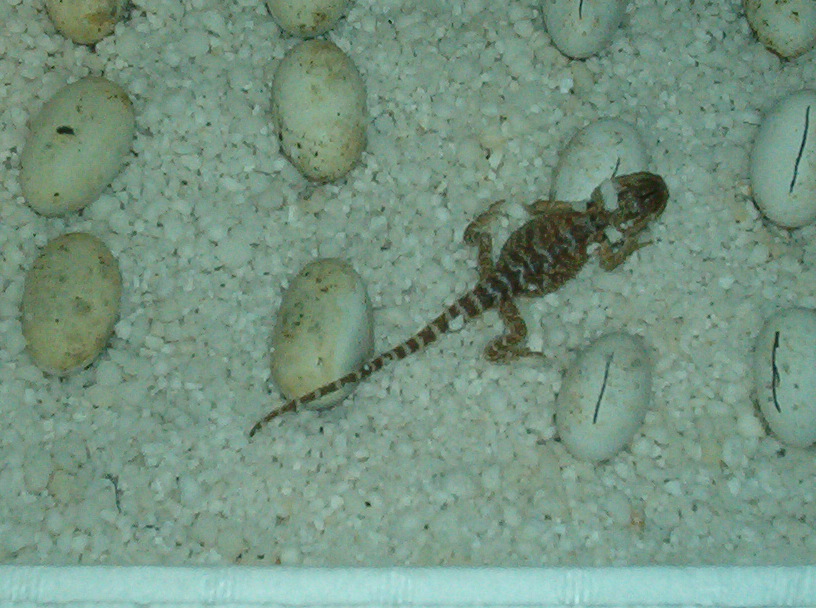
--I think you see my bad photography, those baies are huge, yet very very young, there is nothing in their fecal matter, do you have any 16.5 inch 4-5 month olds? The pic also shows them leaning against a plastic surface, see them on their feet and how fat they are, usually they burn it off fast though. Heres a measurement of leg thicknesses of both, so you dont have to assume from my bad picture taking ability, they both have front legs almost 1/2 inch in thickness, and tail bases and inch or more thick, they are both very big babies. Heres a pic tonight from inside a cooler thats a better background (transport container for educational shows), its 12 inches from front to back.

2. "As far as the male eating after the female, like a nice gentlemen, looks like either can eat whenever they want with all the dried up food laying all over in the dirt. You think that is good for them? Thats not picking on you, they are your pictures and obviously a reflection of how you care and feed them."

---That dried greens you see is from the day before, the crickets and lobster roaches I feed them eat that overnight, and yes they throw some about when eating and running through the dish. Yet 99% of the time they eat every bit of it in a few hours in the dish. As far as is that healthy, yes they eat what they want and need it there and the rest is gone by morning, just as all of their shedded skin disappears overnight from the feeder insects also.

3. What are the dark patches on the females head, and discolored areas on her side and back leg? Also, you have noticed that she has about zero fat pads on her head? You might want to work on helping her regain those before you have another problem on your hands. Separating her from the male and allowing her to recover from too early breeding and egg laying would be something nice you could do for her.

---The discolored areas on her head are from digging nest sites so often, yes she digs alot even when shes not laying, the dirt is watered down once a week or once every 2 weeks to get moisture back into it. That dirt by the way is something I tried, its a mix of old used potting soil and some cocopeat mixed, they use it and it works so I dont worry about dirt that washes off quickly, they get dirty the next day anyways. As far as her weight and fat reserves, she lays 21 eggs every 3-4 weeks, 6 clutches this year so far and doesnt lose more than a few ounces which she recovers in less than a weeks time, she can eat as much as she needs or wants to, thats how I lets them live. If I wanted to Id take pics of them after soaking them in water for a few hours after new shedds and make them pretty for everyone to see just how brightly colored they are, but why, Id rather someone see how they live and are everyday.

4. "Is the monitor in the top picture the one that had to have surgery to removed egg bound eggs when she was younger... maybe too young?"

She was 18 months old and bound up with eggs because I had the wrong substrate, causing her to be dehydrated internally, not too young, her mother, Shadows sister layed Sobeks clutch at exactly 6 months and 2 weeks old, its about how good your husbandry is, females lay eggs whether you want them to or not unless you get them fixed as Sobek has been since that incident. I used a dirt that I bought from a local hardware warehouse made from recycled tree bark at the time and she refused to dig in it, she couldnt lay after I was able to switch out 450 lbs of dirt although she tried with no luck as she was dehydrated, anyways I didnt want to risk her life so had her ovaries removed. She absorbed her first and second clutch at 6 months old and 1 year old, it was easy to recognize after learning how to do so, if they are in good health they can absorb a few times but it is streesful to them physically, this is true with all reptiles. Even if some of my beardies clutches were infertile, it doesnt matter to me, the female layed them and showed almost no dufference after laying from before other than a bit of stomach size and a dirty body. As far as that goes as I told someone else I dont do this for money they are pets and its a hobby Ive offered some of their eggs to my monitors to get rid of them, as I dont worry about making money from them.

I recently had a female with that head shape that was kept by someone else for me (I dont have the room as she was to be an extra breeder), she had suffered from inproper husbandry and some inherited internal problems, she was obtained from a very reputable breeder, a nice woman (Im not mentioning names because she was positive on a fecal and after necropsy for something, she should have never been sold for in the first place, but now I know to never deal with this person again). That feamle had a different head shape than any of mine, was fat, thick bodied for her size, thick leg build, and looked almost identical to that beardie other than the fact she was a firetiger, yet was dieing no matter what was done with her, she was kept separate and was recently put down. The fat short head shape doesnt mean anything other than a different head shape. I wont go through to many more details of her infection, and what her symptoms were. It may have been someone on here, I bought her in person.
Image

CheriS Aug 18, 2004 12:45 PM

That picture I posted is of a baby that hatched March 20, she is still in her 4th month, soon to enter her 5th. And she is not alone in her clutch for that, all of them are like her in size, but she and a few other had nice color. She's weighed 268 grams when she was shipped yesterday. Last I checked her lenght was a week ago and she was 17.5 inches, one of her brother's is 18.5 inches today when I checked.

Do you know what yours weigh, then still seem awfully thin..expecially the legs, granted I am looking at photo's from you and the actual dragons from here.... but put the photos together and you still see a big difference. Again I do not mean to pick on you, many people think their dragons are doing great because they do not know any difference.

Look at the two photo's together, can you see a difference? I am lost what you are talking about head shape, her's is shaped like all the dragons we have that are filled out and healthy.

I used her photo as we had just taken it to send to her new owner and she was the same age as yours. She was not wet or bathe to take the picture, she was taken out of her enclosure and the photo shot

The photo you just posted:

-----
www.reptilerooms.com

Tracey Aug 18, 2004 01:27 PM

Just one example.....

Excuse the head shot....I got a little too close for my camerea...lol....a bit blurry....

This male is 5 months old, 17.5 inches long and weighs in at 320 grams....purposely took the pic with him supporting his body weight to match SHVAR's pics....note the filled out fat pads on the head...the thick tail base....it really doesn't matter the length or body shape anyway, most of that is genetics, you look for a well filled out dragons by 4-5 months with good fat pads evident on the head and thick rounded tail base with no hip bones protruding......


-----
Tracey
Tracey's Beardies
www.beardiecrazy.com
"Whining is not only graceless, but can be dangerous.
It can alert a brute that a victim is in the neighborhood" ~Maya Angelou

SHvar Aug 19, 2004 12:08 AM

I dont see any difference in front or back leg thickness in your pics or mine, I also dont see bones protruding on mine, and I see them in person every day. I could weight them, as a matter of fact. The snow giant came from Dragons den at a month old (1 month older than Frodo), Frodo was larger than the snow giant when he was only 2 weeks old, they are close now. Correction Frodo was born in the second week of April, now 4 months old and 227 grams at 17 inches (another correction, just measured him), the snow giant is 5 months old 255 grams (same just weighed and measured) and actually 16.5 inches (shorter but heavier by an ounce). They are not little or light animals by any means. For a while Frodo was 3-4 inches longer than the snow giant, now they are closer in size. I also had one recently that had that same head shape, more rounded sides and nose with thicker build legs but as I said she was thin and dieing, already went through that explanation.

Tracey Aug 19, 2004 08:50 AM

Please take close-up pics of the tail bases and head shots from the side.....a pic is worth 1000 words....so take several....looks like from the second pic you took, the one at the top of the pic doesn't have good fat pads on his headand the other one is impossible to tell as you took the pic from the top.....same with the tail bases....not saying that they aren't there, just show that they are....back up your statement with actually proof. I never said a thing about your animals, was just demonstrating what a healthy filled out 5 month old looks like with pics that show what should be shown.....

I was just responding to your do you have any dragons this long at whatever age....actually I've had many and again, it's genetic with length and body type/shape but the fat stores are the proof in the pudding.....
-----
Tracey
Tracey's Beardies
www.beardiecrazy.com
"Whining is not only graceless, but can be dangerous.
It can alert a brute that a victim is in the neighborhood" ~Maya Angelou

SHvar Aug 19, 2004 12:07 PM

A tail base from Frodo the younger, thinner animal.

The mother, her head never changes no matter what happens, note the thick muscular head, not fat.

Note Nemos jaw muscles, not fatpads. Lizards store fat in tail bases, fatpads are found along the lower abdomen. If youve ever been bitten by a male beardie this size you would know its not fat. Besides Ive seen many rescue bearsies that are skinny skeletons on the edge of death with fat, muscular heads, not fatpads. Im sure I could get some pics soon of more as they show up, also some from a Florida based business that moved from a different state, these examples Ill find pics from were sold as healthy and fat, wait until you see them.
Heres nemos jaw muscles by the way, another fathead..

Tracey Aug 19, 2004 12:43 PM

didn't ask for pics of the mom and dad....I see the hip bone lines on the young one....where's his head shot?....if you crop the second one you took, you don't even have to take another....it shows his head fairly well!
-----
Tracey
Tracey's Beardies
www.beardiecrazy.com
"Whining is not only graceless, but can be dangerous.
It can alert a brute that a victim is in the neighborhood" ~Maya Angelou

Tracey Aug 19, 2004 12:53 PM

not muscles....where on earth did you get that piece of info? Please state a verifiable source with contact info regarding that info.....
-----
Tracey
Tracey's Beardies
www.beardiecrazy.com
"Whining is not only graceless, but can be dangerous.
It can alert a brute that a victim is in the neighborhood" ~Maya Angelou

kephy Aug 19, 2004 10:23 PM

I have some photos of one of my own dragons to compare.

this is my lizard after he had just lost a lot of weight from coccidia
this is the same lizard after he gained the wieght back
Note the area on the top of the head, behind the eye and above the ear. What was flat before is now round and defined. That gives me reason to believe it is fat.

As for the tail:
lizard after coccidia
See where the shape of the tail goes past the hips and up the back?
same dragon months later
The dragon has gained weight and now the shape of the tail blends right at the top of the hips. Everything above the hip is belly.

These are all from the same lizard, and the before and after pictures were all taken around the same times.
-----
Amanda
------------
2.0 bearded dragons (Ocho / Domo-kun)
1.0 pictus gecko (Nicodemus)
0.1 kingsnake (Rio)
0.0.1 tarantula (Calcifer)
1.0 ferret (Playstation)
1.0 cat (Wally)
0.1 dog (Tima)

nufanoo9 Aug 17, 2004 10:56 PM

I love how people can get so worked up over a post. Nowhere in SHarvs post does it say that his way is the only way, nor does he say that anyone else has to do it his way, he is simply posting pictures of his animals and was kind enough to share his observations. Why don't some of you do the same, to give everyone out there some information. Let the animals do the talking, that's what it's all about here, the animals; not warning labels, not what articles say, not what you say, but what the animals say. So if your bearded dragons are doing great with UVB, (along with your other husbandry choices) then great, if SHarvs do good without it, then great, it means there are options for keepers out, (not a set of rules.) Your not building something by reading a set of instructions, everybody has something that works for them. I thought it was a good post and I would think anyone's post is good who shows pictures/details (no right or wrong.) Keep up the good work everyone.

Rudy

SHvar Aug 17, 2004 11:43 PM

But if they give the animal the choices it can use and do what it can with those choices, thats great, I hate limiting the animal to hard step by step this is all they need type husbandry. That and I cant stand seeing UVB used as a crutch for other more serious problems. Offer UVB, offer all of the choices they can use and see what happens. They can lay eggs almost all year around none stop if offered enough food, enough supplementation, and enough of other choices. I was actually considering selling off some of my younger dragons and making space for 2 female ackies to live with my male but shoot in a few months or less Ill have the space for that and more. Ill keep these guys as pets though I believe, Frodos an interesting individual. Im not interested in making money on these guys, shoot i give away most of the babies or recover a few bucks toward food only, if I wanted to I could make a ton of money off of my beardies but dont care to.

PHLdyPayne Aug 18, 2004 01:22 AM

From the pictures those look like a bunch of healthy reptiles. The ackie certainly looks well fed and healthy (not an ackie expert but it certainly looks alert and well filled out). The two bearded dragon adulds are also quite healthy. THough the pictures are not the clearest for the dragons, I can make out fat deposites on the head of the female, though I was a bit concerned of the dark spots on her head, which, after reading the posts below, is just dirt. The male in the picture, with his black beard, certainly has a nice thick tail base and very noticeable fatty deposits on his head.

Though I personally feel keeping the male and female together all the time isn't the wisest course of action, especially when breeding is more a hobby than a career and your dragons are pets not an investment. Why not have them separate? It will certainly cut down on incubating eggs.

I have to admit I was also alarmed at first by the seemingly high basking spot temps but after thinking about it and reading your explaination, I have to say it does make sense. On a hot day at the beach the same is searing and it doesn't even get extremely hot where I am (typically 30C or there abouts which is something like 85F). The important thing is the reptiles can get off the hot surface and find cool areas, like under logs, rocks, etc or just in the cool end. As dragons feel the heat from their backs, if they are too hot they will move, its when there is high heat from below and not too much or just enough from above that dragons and other reptiles suffer from thermo burns (ie from electrical hotrocks overheating).

The babies in the picture don't look underfed or suffering, the one that sort of looks skinny in in fact having his gut hang off his spine because nothing is underneath to support it, not because he's skinny. My dragon looks like this when seen from above when she is standing tall on all four feet, leaving her gut hang down. It is even more noticeable as she has two parallel strips running down her back.

The UVB lights/supplement requirement has not been truly tested by anybody to my knowledge. The importance of UVB light is to allow the reptile to produce the needed Vitamine D3. Vitamine D3 is necessary in a reptile's metabolism to utilize Calcium. TO my knowledge nobody contests that fact. D3 is needed to use Calcium in the body for some reptiles. What has not been proven by research in controlled environments (instead of just what has worked so far in one's reptile caring years) if a reptile is just as healthy if expose to natural UVB to produce D3 or having D3 added into the diet.

The only way to prove which is best or if there really isn't any difference in overall health would be to do the experiment. Such an experiment would only be valid if both groups are equal in as many ways as possible. The prep needed would be somethign like this:

2 groups of hatchlings of equal quality

Parents/grandparents of hatchlings genetically strong, healthy, well fed etc.

Conditions strickly controlled. One group fed dietary D3 only, the other group UVB exposure. Both would have to be feed the same foods (without added D3 except the group being fed that exclusively instead of uvb light), weights, bone density etc would have to be regularly measures and recorded.

Both groups would need to be kept in the same conditions, with one minus the UVB light.

A third control group may be needed to compare both against, to be used a baseline to compare growth etc of the other two groups. A fourth group (optional) exposed to direct unfiltered sunlight to see if that compares at all to UVB bulbs.

As you can see there would be alot of work involve and expense to ensure unwanted or undetected variables won't mar the accuracy of the experiment.

I don't think there is only one way to raise a reptile properly. Svar isnt' the first poster here who doens't use UVB lights at all with their dragons, instead only adding D3 to the diet to balance out the needs of the dragon. If it didn't work and dragons and other D3 requiring reptiles died in droves, I don't think these people would continue using this method. I certainly would love to get rid of the uvb bulb and use strickly supplimentry D3, as I can get a bottle of calcium with D3 or a good multi-vitamin suppliment for alot cheaper than buying a UVB producing bulb. However, I have personally noticed, in just switching from a Zoo Med Repti-sun 5.0 to a 8.0 a difference in colours in my dragon. SHe became brighter under the stronger UVB bulb than she did with the other one. She's even more 'lit-up' when I have her outside in direct sunlight.

Ok, I talked to much, but felt I wanted to voice my opinion here. I also want all the regular posters to remember there is always possible more than one way can accomplish the same thing, keep an open mind and even if you don't agree with a method, it doens't automatically mean it's wrong.

Site Tools