I was feeding today and noticed the wild looking fangs. They are not so far in mouth as people try to make you think 


-----
Marcel Poots (Holland)
'Where is your crown King Nothing?' James Hettfield

Welcome to kingsnake.com's message board system. Here you may share and discuss information with others about your favorite reptile and amphibian related topics such as care and feeding, caging requirements, permits and licenses, and more. Launched in 1997, the kingsnake.com message board system is one of the oldest and largest systems on the internet.


I was feeding today and noticed the wild looking fangs. They are not so far in mouth as people try to make you think
-----
Marcel Poots (Holland)
'Where is your crown King Nothing?' James Hettfield
I hate the way "rear-fanged" implies that the fangs are in the back of the mouth, like most people say. In fact, they are just not at the front of the mouth. To give the rest of you an idea of where they are located, the fangs are pretty much under the eye.
-----
...the oldest task in human history: to live on a piece of land without spoiling it."
Aldo Leopold (1938)
"Sometimes I think the surest sign that intelligent life exists elsewhere in the universe is that none of it has tried to contact us."
Calvin and Hobbes (Scientific Progress Goes 'Boink', 1991)
Nice shots Marcel. Its funny you posted those. I was feeding my hog yesterday and it seemed like I could see her fangs a lot more clearly than in the past. I was going to get some pics to post but decided not to since I was concentrating on the new corns. I knew by the time I got the camera ready she'd be done. Maybe next time. Thanks for sharing. Oh, did you breed your hogs this year or waiting for next seson?
EP
-----
Occupants not paying rent:
16 eggs incubating
7 balls
2.2 corns(candy cane, creamsicle, ghost, normal)
1 pueblan milk
1 everglades rat
1 cal. king
1 gray band king
1 w. hognose
1 bearded dragon
2 fish
1 rat
1 mouse
5 cats
>>Nice shots Marcel. Its funny you posted those. I was feeding my hog yesterday and it seemed like I could see her fangs a lot more clearly than in the past. I was going to get some pics to post but decided not to since I was concentrating on the new corns. I knew by the time I got the camera ready she'd be done. Maybe next time. Thanks for sharing. Oh, did you breed your hogs this year or waiting for next seson?
>>
>>EP
She laid eggs in 2003 and this year she seemed not interrested in breeding at all. The male was all over her trying to breed her 24 hours a day.. Pretty funny sight btw...

-----
Marcel Poots (Holland)
'Where is your crown King Nothing?' James Hettfield
Only smaller. My E. black-necked garter uses her "fangs" only when I feed her toads it seems. She chews and chews and it is quite a bloody mess by the time she starts to swallow. You can see the holes in the toad. I think they use these to pop the toads more so than injecting venom. Although I have heard of people having similar reactions as hogs to feeding-response bites.
> I think they use these to pop the toads more so than injecting venom.
Not a chance.. The fangs are there for delivering the venom. There is no way it is for popping the toad. Anyone who has tried to stick a cane toad here in Australia knows that they don't 'pop'. However, long fangs certainly helps for getting through the thicker skin of the toad.
Cheers
Bryan
-----
Dr. Bryan Grieg Fry
~~~~~~~~~~~~~~~~~~~~~~
Australian Venom Research Unit,
University of Melbourne
~~~~~~~~~~~~~~~~~~~~~~
Population and Evolutionary Genetics Unit,
Museum Victoria
~~~~~~~~~~~~~~~~~~~~~~
http://www.venomdoc.com
>>Not a chance.. The fangs are there for delivering the venom.
Hi Bryan,
I just love your shows on the TV. Good stuff. I always wondered about the popping the toad thing too. The grass snake we have here in Holland (Natrix natrix helvetica) has the enlarged teeth backwards in the mouth too. It has no venom like the hognose. It does have the duvernoy gland (spelling?). They eat much bigger prey then for example a ratsnake does. That makes you wonder if they use the large teeth to 'pop' prey. Anyways, in the enclosed link is a good example what Hognose venom can do.
Marcel
http://www.herpnet.net/bite/
-----
Marcel Poots (Holland)
'Where is your crown King Nothing?' James Hettfield
This reminds me of my Giant Hog bite though nothing like the swelling and duration of the swelling in those photos but it did hurt really bad at first and then no feeling in the affected area. It is still somewhat visible on my finger that got bitten some weeks later now. In the time since then I have been bitten by a 5ft Guyana Redtail and a 7 foot Colombian Boa on my hands and those are gone. I couldn't even find the exact location but I can with the Hognose bite. Maybe it just left a lasting impression in me,literally. The snake that bit me is about 5 feet and it was a feeding response. I was offering a dead rat and the snake seemed interested but reluctant as well, pushing and trying to pin the rat but not getting his face too close to the rat. Then all of a sudden POW I was bitten!!! The snake let go and panicked but it still took the rat once it got oriented. These Hognose are not like the North American Hognose that we are discussing with respect to handling from my experience. My North American Hogs are as docile as the other people's in these posts, but the Madagascar's seem to be unpredictabe at times. I did get bitten once by a Western Hog with a feeding response but I was pulling away from it just in time to get a small nick from it as it was flung out of it's cage by me. I put it back in the cage, fed it and it was fine. Tame as could be the next time I got it out,which was at a pet store that I work at part time to show to a family that wanted a good kid's pet,typical requirements were size and temperment etc.I told them about the "incident" and they were fine with it as well as grateful for all the info on the "fangs" etc. The snake now has a good home, with kids I might add, and is doing great. North American Hogs make great pets for kids and I believe them to be at the top of the list with other snakes that fall into that category for children: Nice Rosys,Balls,most Kings and Corns etc. are great for kids as well. Hogs are right up there too.Maybe I should have done 2 post on this,1 for the person who wants to keep their kids away from Hognose and 1 for the bite posting but
I just got carried away with my responses at one time.
Thanks for reading.
I am not sure I would say they are great for beginners along with corns and rosies. The one thing that has turned me off to suggesting them is sometimes that even CB snakes will go off feed for long durations, especially males. This is often quite stressful for the novice keeper which can lead to stressing the snake (force feeding, etc.). I think they are a perfect second or third snake though.
-----
Andy Maddox
AIM: thekingofproduct
MSN: Poloboy32486@hotmail.com
Yahoo:surfandskimtx04
Houston Herp Key
The Reptizone
>> These Hognose are not like the North American Hognose
Thats because they are in two completely different families. The American hognosed (Heterodon genus) is in the Xenodontidae snake family while the Madagascar Giant Hognosed (Leioheterodon genus) is in the Pseudoxyrhophiidae snake family (that name doesn't exactly roll off the tongue, I'd like to thank the schmuck who decided on using it!). The xenodontine snakes are closer to the Colubridae family (racers, ratsnakes, boomslangs etc) while the Madagascar snakes are actually much more closely related to cobras.
Cheers
Bryan
-----
Dr. Bryan Grieg Fry
~~~~~~~~~~~~~~~~~~~~~~
Australian Venom Research Unit,
University of Melbourne
~~~~~~~~~~~~~~~~~~~~~~
Population and Evolutionary Genetics Unit,
Museum Victoria
~~~~~~~~~~~~~~~~~~~~~~
http://www.venomdoc.com
You have one nifty web site. Lots of info.
Thanks,
Mike B
Wichita, Ks
Hi mate
>>
>>I just love your shows on the TV. Good stuff.
Fangs for that
>I always wondered about the popping the toad thing too. The grass snake we have here in Holland (Natrix natrix helvetica) has the enlarged teeth backwards in the mouth too. It has no venom like the hognose. It does have the duvernoy gland (spelling?).
Actually, it does have venom. Not enough to typically cause any notable signs in humans but its still there. Enough to stun a frog or fish but thats all it really needs. Hence those cute little fangs.
We've shown some of the snakes we think of as 'non-venomous' actually have venoms as potent as a death adders. However, they produce it typically in small amounts. The potential severity comes down to simply how much is actually delivered. The toxicity is there. For the majority of these snakes, the amount delivered is so trivial in bites to humans that for all practical (legislative) purposes, they are completely harmless.
Cheers
Bryan
-----
Dr. Bryan Grieg Fry
~~~~~~~~~~~~~~~~~~~~~~
Australian Venom Research Unit,
University of Melbourne
~~~~~~~~~~~~~~~~~~~~~~
Population and Evolutionary Genetics Unit,
Museum Victoria
~~~~~~~~~~~~~~~~~~~~~~
http://www.venomdoc.com
Thanks for the info.
I just spend an hour on your website. Great info. And I signed up on the forum. I love the picture department
Marcel
>>Hi mate
>>
>>>>
>>>>I just love your shows on the TV. Good stuff.
>>
>>Fangs for that
>>
>>>I always wondered about the popping the toad thing too. The grass snake we have here in Holland (Natrix natrix helvetica) has the enlarged teeth backwards in the mouth too. It has no venom like the hognose. It does have the duvernoy gland (spelling?).
>>
>>Actually, it does have venom. Not enough to typically cause any notable signs in humans but its still there. Enough to stun a frog or fish but thats all it really needs. Hence those cute little fangs.
>>
>>We've shown some of the snakes we think of as 'non-venomous' actually have venoms as potent as a death adders. However, they produce it typically in small amounts. The potential severity comes down to simply how much is actually delivered. The toxicity is there. For the majority of these snakes, the amount delivered is so trivial in bites to humans that for all practical (legislative) purposes, they are completely harmless.
>>
>>Cheers
>>Bryan
>>-----
>>Dr. Bryan Grieg Fry
>>~~~~~~~~~~~~~~~~~~~~~~
>>Australian Venom Research Unit,
>>University of Melbourne
>>~~~~~~~~~~~~~~~~~~~~~~
>>Population and Evolutionary Genetics Unit,
>>Museum Victoria
>>~~~~~~~~~~~~~~~~~~~~~~
>>http://www.venomdoc.com
-----
Marcel Poots (Holland)
'Where is your crown King Nothing?' James Hettfield
Hey,
I think theyre right about garters injecting venom. I feed my Eastern black necked garters juvenile toads and they seem to stop squirming the second theyre bitten. I have seen individuals in the wild beating toads against the rock substrate, but neither mine nor the wild ones ive seen feeding are trying to constrict the frog. Ive also not noticed any systematic choice in where they bite the toads.
I havent met many other people with ebn's. How big are yours? Ive got two males in the 12" range.
Luis
Nice Pictures. The detail is great.
Mike B
That pic just did it for me. Fangs are right there, aren't they? Not way back. Right there close to the front.
-----
Mark 
I think it is ridiculous to restrict handling of hognoses in any form, except for when you have the smell of food on your hands. I maintain a collection of Eastern and Western hognoses for educational outreach programs, and our education department specifically uses hognoses for the kindergarten classes because of their small size and docile nature. Not to mention that they DO NOT bite out of defense. As with handling ANY ANIMAL, your children must be aware of what they have on their hands before picking it up, especially a snake.
-----
...the oldest task in human history: to live on a piece of land without spoiling it."
Aldo Leopold (1938)
"Sometimes I think the surest sign that intelligent life exists elsewhere in the universe is that none of it has tried to contact us."
Calvin and Hobbes (Scientific Progress Goes 'Boink', 1991)
Those hognose bite pictures are mine. I should probably say this snake was my daughters favorite. She learned to handle snakes with this little male hognose. I was happy to have her hold it before and after the bite. This snake bit me because I was holding a dead mouse in my hand while talking to someone in the room. They are harmless snakes unless your reckless with them, as I was.
Joe
Hi Joe,
I have wondered a lot about your pics. Can you tell me a bit about the pain. With what can you compare? Let's say a Bee sting? Does it hurt more?
Marcel
>>Those hognose bite pictures are mine. I should probably say this snake was my daughters favorite. She learned to handle snakes with this little male hognose. I was happy to have her hold it before and after the bite. This snake bit me because I was holding a dead mouse in my hand while talking to someone in the room. They are harmless snakes unless your reckless with them, as I was.
>>
>>Joe
-----
Marcel Poots (Holland)
'Where is your crown King Nothing?' James Hettfield
My friend has a hognose and he got bit as a feeding response. He still had toad scent on his hands when he was scenting the mouse. He had no reaction at all, and the snake had plenty of time to "chew" on his hand. I have been bit by a bullsnake and it swelled up a little. He just had a couple of teeth marks, but no swelling.
well hognoses are rear fanged so there not "right" in the front there back
and hognoses arent venomous enough to kill any human
Hey Marcel,
What kind of camera and/or lens did you use to get those shots?
My wife want's to know. We have a few animals that may have fangs like that like Madagascar Hogs and False Water Cobras, don't know about the Cribos,Diadems,Spilotes etc. I have heard yes on some no on others and even both on the same animals. I just got one of my Giant Hogs out and opened her mouth and I did see a sheath next to the row of regular teeth. I held her up to the computer screen and pretty much in the same place as your Hognose's fangs, were her's, at least the sheath anyway,right under the eye. I will continue to look for the fangs at feeding time which seems to be the best time to look for them. If I can get photos I will, this is very interesting.
Thanks for sharing the great photos.
Jeff
>>Hey Marcel,
>>What kind of camera and/or lens did you use to get those shots?
>>My wife want's to know.
Jeff,
I used a Canon EOS 300D with the kit lens. Great camera for talking close ups.
Marcel
-----
Marcel Poots (Holland)
'Where is your crown King Nothing?' James Hettfield
Very good shots. Here's another to add to the fang album. Shot this quite a long time ago of a Mexican Hognose. I've also included an article for your discussion..
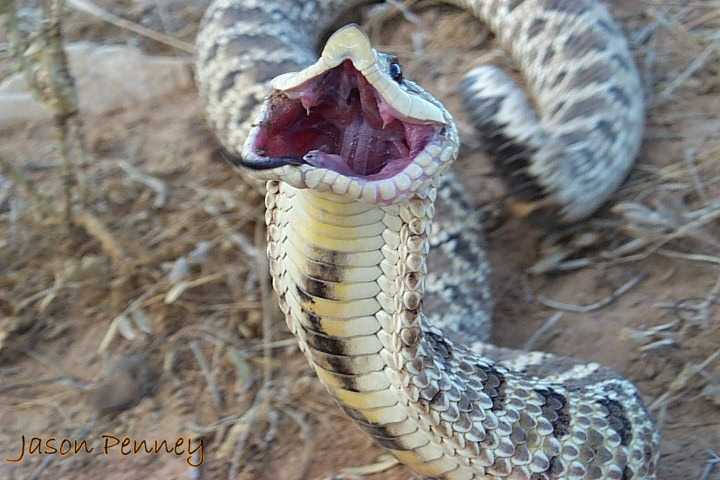
Hognose venomous?
Thanks,
That is an awesome picture. I had seen it before but still think that is one of the best fangs picture I have seen on Hogs.
Marcel
>>Very good shots. Here's another to add to the fang album. Shot this quite a long time ago of a Mexican Hognose. I've also included an article for your discussion..
>>
>>Hognose venomous?
>>
>>-----
>> Snakes of Hudspeth County, Texas
-----
Marcel Poots (Holland)
'Where is your crown King Nothing?' James Hettfield
thank you sir..
-----
Snakes of Hudspeth County, Texas
I have been handling hognose snakes for thirty years and have never been bitten. In my opinion the only way one would bite is during a feeding response. I would feel safe letting any one of my kids handle any north american hognose.
EXCELLENT PICS...............
I have 3.4 hoggies and will be having eggs next season.
as for the person not letting their kids hold them is totally sad......
my son who is a type 1 diabetic, was bitten by one of my big males and the only thing he got was what looked like a small little bug bit. with no effects.
SO for the one who wants to keep their kids away...shame on you, like the one person said, TEACH AND EDUCATE YOUR KIDS.
Todd
Palm Beach Exotics
Help, tips & resources quick links
Manage your user and advertising accounts
Advertising and services purchase quick links
