I have looked over the Internet, but I have been unable to find any infomation on the care of Ringed Pythons (Bothrochilus boa), a species I am considering getting. Does anyone have any information, such as adult size, temp. and humidity requirments, feeding, and lifestyle (arboreal or terrestrial)?
Reptile & Amphibian Forums
Welcome to kingsnake.com's message board system. Here you may share and discuss information with others about your favorite reptile and amphibian related topics such as care and feeding, caging requirements, permits and licenses, and more. Launched in 1997, the kingsnake.com message board system is one of the oldest and largest systems on the internet.



Ringed Python Info.
kryptos_herp
Nov 04, 2004 11:06 AM
Replies (4)
carl3
Nov 17, 2004 07:33 PM
I find their care to be similar to a brazilian rainbow boa....Temps don't need to be too high but humidity should be slightly higher than most other python species, especially when they're about to shed. Also, babies can be fed two smaller prey items rather than one larger prey item to accelerate their growth rate a little bit. They have the most aggressive feeding response of ANY snake species, which can make them somewhat unhandleable at times. Mine are messy and I spend more time cleaning their poop than I do with any of my other snakes. I really enjoy them alot though. Oddly enough, they have interesting personalities and they love to move around quite a bit. Enclosures should have plenty of hiding places as well as a few branches AND most importantly, you should make sure its extremely escape proof....Ringed pythons can get through openings that few other snakes can fit through. Its quite amazing. Anyway, good luck if you go with them. Don Hamper has nice stock to pick and buy from.
-----
Sincerely,
Jason
-----
My Website:
www.members.aol.com/northeastsnakes
Col_Kurtz
Nov 20, 2004 05:43 PM
This is a GREAT breed to get into! I love my Rings. I agree with the other response you have received on most things.
I keep my rings at a slightly cooler temp and slightly higher humidity than my other pythons. A temp range of low 70s to mid 80s. Babies can "cook" easily, and even brief periods in the 90s can and will kill them. I also maintain appx 80% humidity at all times in my ring enclosures. 80 degrees and 80% humidity is an easy rule to remember. Adults are somewhat more forgiving and hardier, but they will never be as forgiving of husbandry mistakes as a ball.
Rings are also not as "stretchy" as many other pythons. You cannot push the size of their prey. They can hurt themselves seriously on prey items that might not seem too big. Stick to items no bigger in diameter than the snake itself. As said before, opt for multiple prey items instead of larger. However, no matter what the feeding schedule, you cannot expect a fast growing animal. They grow and mature at a pretty slow pace. Females might not be of breeding size after three or four years. They do have an AMAZING feeding response! And, for a small snake, they do have sizable teeth. I believe that it for these reasons that rings have gotten a rep for being difficult and aggressive. However, I handle mine nearly every day, and have had only a few bites in several years. Of course, I was being stupid on those occaisions!
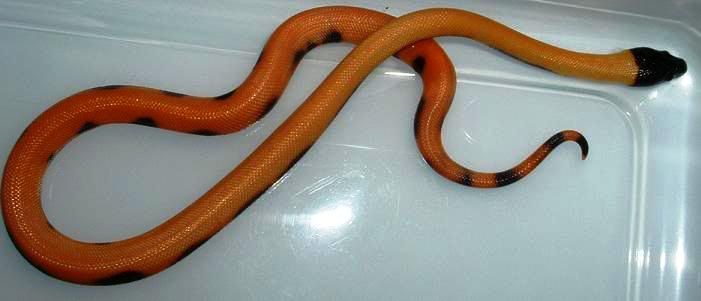
Babies are incredibly striking, with shiny black and blaze, hunter orange rings, or abherrent patterns. Beginning between five and 13 months old, small black dots will appear in the orange bands. This will begin the color change. The orange bands will slowly turn to a more rusty color, and the black portions will fade somewhat, to a charcoal-like color. The head will always stay shiny, jet black. While they lose the striking coloration, they gain unbelievable irredescence, throwing rainbows everywhere. This is definitely a snake you want Reveal bulbs for!
They are indeed very curious animals and can escape well. I lost my first female years ago. Also be carefull handling hatchlings as they literaly jump! They are very active during handling and display surprising strength, for their size, sqeezing your hands. Their scales are very small, creating a silk-like feel and the smooth appearance. I do not believe they need climbing branches in their enclosures. Most of mine are in boxes no more than 3-4 inches tall. However, branches certainly hurt nothing, and a couple of mine do like to climb. As babies they spend most of their time burried in the substrate, and you need to make sure you provide a material suitable for this. I keep mine on cypress, due to the humidity. They will stay on top of the substrate more as they grow, but they will always need ample places to hide.
I hope this helps, let me know if I missed any questions you have. I do not spend much time in these forums, but I will keep an eye on this one. If you do decide to get into rings, I can provide you with some good names. Again, I love these snakes. - Brian
carl3
Nov 24, 2004 08:10 PM
I would love to see pics of your ringed pythons. You really provided some great info. I read my initial reply again and I'm not sure I accurately expressed my experiences with them. They truly are a great species to keep and you're right...because they have the most aggressive feeding response of any snake, they have been labeled as difficult. Overall, they are great!


-----
Sincerely,
Jason
-----
My Website:
www.members.aol.com/northeastsnakes
Col_Kurtz
Dec 14, 2004 05:46 PM
I really do get a kick out of these little guys!
I will check my camera and hard drive to see what pics I have, and post them asap. - Brian
