why not Hybino? i mean u had all the "ingredients" to produce albinos, anerys, hypos, snows, and ghost, so why not Hybino?
ZF, the fact that the ingredients existed capable of producing something aren't a strong argument that they DID produce that. I'm just trying to analyze the different possibilities as objectively as possible, to weigh the arguments. IMHO this is really fun, it's like a mystery has been dropped in our laps and we get to play detective, so I think it's important to hear all different ideas.
But crude oil may be an ingredient from which rocket fuel and nail polish remover can be made and probably bubble gum or some other more dramatic example. So just knowing the potential exists in the triple het parents (to get back to snakes!) reminds us of possibilities to be considered, but it doesn't assess the different possibilities.
To assess them, some thoughts:
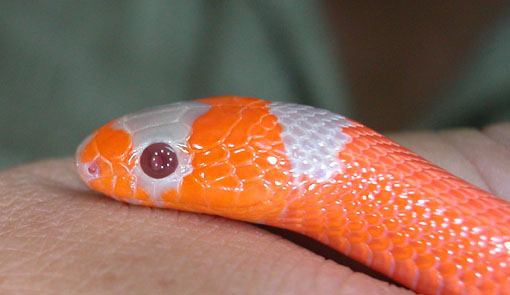
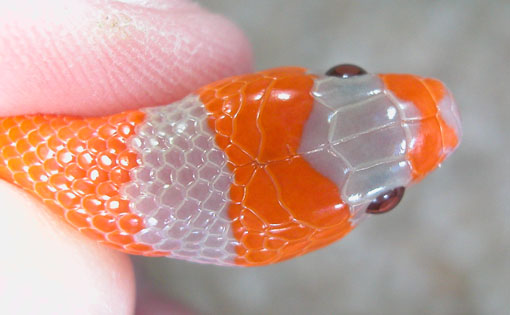
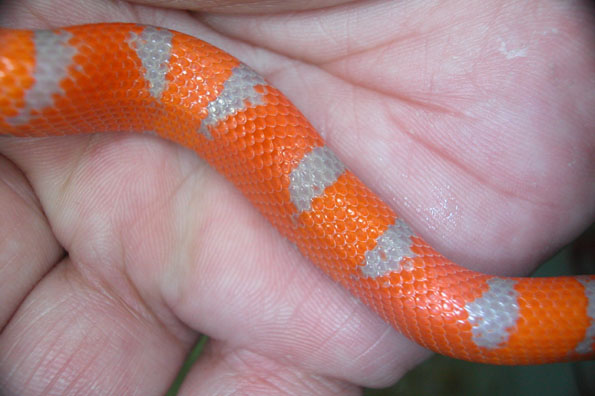
1) An albino LACKS melanin. Has none. Areas that would be black are snow white, unless and until the snake is one that gains yellow in those areas as it ages.
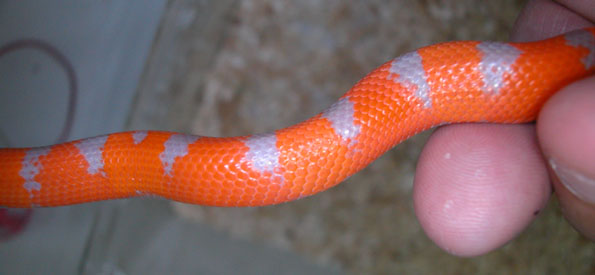
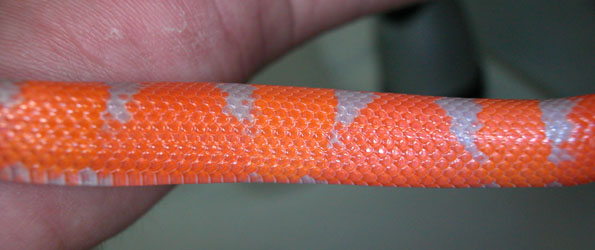
2) A hybino would be hypo AND albino. If it is homozygous for albino then it should show all the effects of amelanism--that is, all melanin should be ABSENT. Thus a hybino's formerly "black" rings should be as white as an albino's. That is not the case with jeff's snake that we're discussing here. Close, but no banana, as they say, and i can't see any reason why adding the effects of hypo--of further REDUCING melanin--would change an albino so that it showed more (however slight) melanin in an area than would show in an animal that was only albino. So the hybino conclusion just seems illogical to me. Am i missing something?
3) More substantially, here's some hard evidence to consider: I've produced i don't know how many, 20? 30? tangerine albinos that have a 25% chance of also being hypo--thus hybinos. Put another way, 25% of those--maybe half a dozen--probably WERE hybinos, according to statistical chance. Yet none had the look of jeff's snake, all of them were simply white in the rings we'd have expected them to be white in. (NOTE: None of these has yet been proven by test breeding to actually BE a hybino, so it is remotely conceivable that despite the odds, despite the probability, none of them were hybino.) Maybe, someday, we'll learn that hybinos--for reasons I c an't fathom right now--do show slight melanin, whereas albinos do not. But for the time being, that seems a very illogical theory, and more importantly, i think the odds are high that i've seen hybinos, i just don't know which ones yet for sure were the hybinos. And none had the distinctive appearance of this jeff's snake, which suggests to me that jeff's is not a hybino.
I'd like to hear others' thoughts on this issue. As we play detective and try to figure out what jeff's animal is (and what other extremes are, whether they're part of the same issue or represent a different mystery) we'd be helped by either putting to rest the hybino speculation, or coming up with a theory explaining why it makes sense.
this snake is the prettiest Hondo I've ever seen. Along with the pattern
You bring up a good point here, ZF. We need to separate the snake's beauty, and neat pattern, from our efforts to analyze the color mystery, because they really are two different things. There are pinstriped & vanishing pattern hypos on which the formerly "dark" rings form sort of crescents that are widest on the spine, narrow on the sides and never reach the venter, as is the case on this snake. (actually, if you look at "normals" you'll see that same effect on the black rings on some of them, we just tend not to notice). Jeff's snake's pattern is unusual in that those crescents are wider than most on the spine, and as they narrow quickly on the sides they've almost formed pie-shaped wedges. Unusual, but not, i think, part of the mystery here. Also, his snake is gorgeously colored....but is it colored diff in its red and orange rings from all other albinos and hypos? I'm not sure it is. It definitely belongs in the top 5% or so in terms of those colors, but i've seen the same sort of observations about other albinos and hypos: "wow, that orange just glows!" etc. And the very pale purplish gray MAY be enhancing the look of those colors when seen side by side.
So I'd be interested in people's opinions here, about whether or not it's just the effect on the "black" (white?) rings that's important to consider here, or whether there's anything about the snake's other beautiful characteristics that should be considered part & parcel of the discussion.
just think really light x-tremes go for $1000 so this can easily bring in 3-4G's since they are prettier than snows and carry more recessive traits
I think you're right, that the snake might be worth that, for a couple reasons:
1) its sheer beauty, for people who prize that
2) the fact that whatever it is, it is either
a) something new, the FIRST of something, which many people prize
OR
b) assuming it's an exceptional animal at the extreme end of the extreme hypo, it's the BEST of something, also highly prized.
Those are pretty incredible attributes. (the worst case would be if it ages, skin thickens, and it ends up just looking like an albino, then a) and b) above don't apply, and the beauty might be diminished somewhat as well. But I don't think that's gonna happen.
As for the extra genes, that does enhance the animal and its future potential even more. That's one of the reasons i like triple hets so much. If you notice the pic i posted a couple days ago (click on link below) of a tangerine albino from a triple het female, that snake has a chance of being het/hypo, a chance of BEING hypo (and thus hybino) and a chance of being het/anery. That gives the owner a lot more uses than he/she would have with an animal that was "just" tangerine albino.
I look forward to the thoughts & ideas of others. Are you out there, sherlock holmes?
peace
terry
link to pic of nice tangerine albino



 ? a super duper extreme albino ??


