Reptile & Amphibian Forums

Welcome to kingsnake.com's message board system. Here you may share and discuss information with others about your favorite reptile and amphibian related topics such as care and feeding, caging requirements, permits and licenses, and more. Launched in 1997, the kingsnake.com message board system is one of the oldest and largest systems on the internet.

Click for 65% off Shipping with Reptiles 2 You
Click here to visit Classifieds

anerythristic & axanthic discussion moved here from kingsnake forum

rtdunham Dec 10, 2004 04:30 PM

(to read the thread that prompted this you can start at:
http://forums.kingsnake.com/view.php?id=652999,652999
(it gets interesting and/or pertinent about half way down)

so here are some thoughts relative to hondurans:

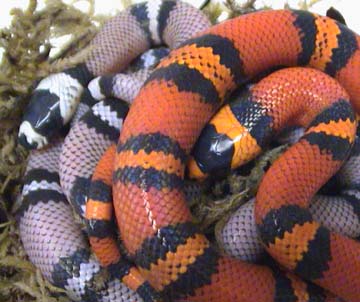
Since we're considering anery and axanthic separately, no-red, and no-yellow, the snake commonly called the "anery" hondo might be instructive because its normal coloration contains BOTH red and yellow. Of particular interest are the narrow rings in the middle of every triad (a triad = black/narrow middle ring/black): those rings vary from white, which will confuse the issue a little, to cream, to yellow, to yellowish-gold, to gold, to pale orange, etc--you get the idea, a continuum of colors.

Anyway, I'm assuming then that the belief is--going on your explanation in the kingsnake thread, tim ricks--that those narrow rings (with the exception of white) can and often do contain both "red" and "yellow", the colors contributed by erythrins and axanthophores, if i'm using those terms correctly.

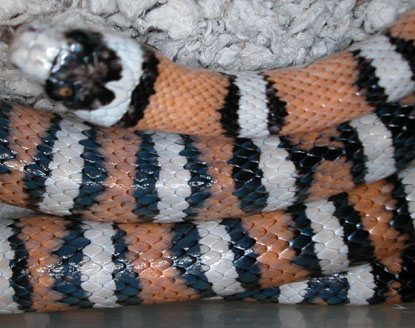
Now back to the "anerythristic" honduran. Louis Porras has already observed they're not really "AN"erythristic (NO erythrins) but rather HYPOerythristic, with reduced erythrins. The pic below shows what louis was talking about: clearly, some pink is left in the wide rings that are normally red. (Digression: many hondos gain yellow as they age, and as a result some "anery" hondos have a suggestion of orange in the wide rings, maybe the effect of the relict red ontogenic yellow?)

BUT look at the narrow rings--pure white, and that's the case with all "anerythristic" hondos...there's never been one reported with anything but white in those narrow rings--rings where, it is important to note, BOTH yellow and red pigments can and often do occur.

SO: it would appear that in the NARROW rings, the "anery" honduran is actually ANerythristic AND Axanthic--that is, wholly lacking BOTH colors.

But In the wide rings, it could be argued the "anery" hondo is HYPOerythristic as louis pointed out.

But that leads to a couple questions:
Why is red eliminated completely from some rings but only partially on others? I'd imagine the triggers for depositing red in the wide rings are altered in a different way--or to a diff degree--than those triggers for the narrow rings. It's interesting that two diff effects would always be linked on these animals--neither occurs without the other.
Are the wide, usually "red" rings on hondos, on TANGERINE specimens, which are really orange, created solely by the presence of erythrins? Can erythrins produce orange, as well as red?
Or is that orange created by a combination of the two: are xanthophores present there too, and when they're in greater concentration (or when erythrins are reduced) the wide rings look orange instead of red? (in mixing paints, or crayons, or combining color filters for photography, etc., yellow & red = orange)

In short, what we call "anerythristic" hondos may actually be "hypoerythristic on the wide rings" and "axanthic on the narrow rings"? Are there other examples of snakes showing such combined effects but never the two effects separately?

Or, since the color of "anery" hondos is pale pink in the wide rings (see photo) maybe "anery" hondos are xanthic over their entire body, but truly anerythristic only on the narrow rings, while being hypoerythristic on the wide ones.

It's worth noting that although some adult anerys show the effects of ontogenic gain in yellow, that shows only on the wide rings, whereas on albinos (amelanisitcs) it shows on all the snake's body, including the rings that would be black on a normal.

I'd be interested in others' opinions.

terry
Image

Replies (37)

Brandon Osborne Dec 10, 2004 05:57 PM

Terry, I'd have to say, that's an interesting theory. I would have to disagree with Tim's post on Brooks kings being only axanthic. Here's a pic of one of my het "axanthic" brooksi. These are typical of all het hatchlings from this line, and some have more red than this.....the one pictured is on the low end of the scale for the amount of red/orange. Notice, there is not much yellow on this snake either. This one comes from my white line, but is not axanthic. I'd ad more pics and info, but I can only attach links.

Brandon Osborne

snakericks Dec 10, 2004 10:00 PM

Brandon,Tim Ricks here,I respect your thoughts of disagreeing with my post on brooks kings being only axanthic.That is a very impressive hatchling expressing shades of orange/red that you are posting.I too,and many other South Florida King breeders produce hatchlings such as yours.What I've seen through years of breeding,the more red /orange a hatchling has,the brighter yellow or lighter tone it will be as an adult with no red/orange.I have yet to raise a hatchling to an adult that retains red.Have you or anyone you know has adult red South Florida Kings?If you are aware of any could you please work on posting some pictures.Thank You,Tim Ricks

Brandon Osborne Dec 10, 2004 11:34 PM

Hi Tim. It's great to finally see you here in the discussions. We all have our own interpretations of what is what, and to me that's what makes learning more about these fine creatures so fun. The reason I posted that pic of a het axanthic, is because these high red babies tend to turn white as adults......at least my line does. Here's a pic of an adult white phase (het for axanthic). This pic was taken last fall as the snake turned 2 years old. You can compare the degree of white with the pvc coupler in the right side of the pic. Usually by the third year, most of the orange pigment is lost and they are black and white. I've had lots of people call these axanthics, but they are indeed normals of a different color. Let me know what you think. I'll post some pics of the hypo flames I produced last year that are 3' and still red.

Thanks for this interesting debate.

Brandon Osborne

Brandon Osborne Dec 10, 2004 11:38 PM

These were originally purchased from Lloyd as normals het for axanthic. Only in the last few years, have I started to experiment with the ability to reproduce this and so far it's been good to me. We'll see in 05' if better things are to come of this. Let me know what you think. This female is around 5' and close to 4 lbs.

Brandon Osborne

Sorry to all the milk people about the king pics. What do you call an axanthic snake with no yellow pigment?

Nokturnel Tom Dec 11, 2004 12:28 AM

I love that snake Brandon. And yes it is great to have Tim talking Brooksi on the forums too. I need to snap some pics. I am up too 15 in my Brooksi colony. Love em! Tom Stevens

Brandon Osborne Dec 10, 2004 11:41 PM

Just to give you an idea of the color of the white phase. These produce some super blue axanthics. And the below post should have been worded a little different. What do you call something that is supposed to be yellow.......but is white.....but is not axanthic? Make any sense? lol. I hope so.

Brandon Osborne

Brandon Osborne Dec 10, 2004 11:44 PM

A male I produced in 97' from an axanthic male and the big white female het. This is Lemke stock BTW. I think there is more involved in these than just the axanthic gene. I'd be happy to donate a hatchling if someone were to do the pigment testing.

Brandon Osborne

Nokturnel Tom Dec 11, 2004 12:36 AM

You know Brandon, when I was a kid a pet store would once in a while get in White Florida Kings[in the 70s]. All I remember is the owner saying the White ones are always mean. I was in Florida for a month last Jan. and I asked every pet store guy and wholesaler I could find for Whites and even said I would buy as many as they could get me. I didn't score one........... I am with you that your snakes are not Axanthic but some sort of White phase. Wish I had one from way back when to breed to one from your line. Besides yours...I haven't seen any in years. Not many Greens either. Tom Stevens

snakericks Dec 11, 2004 05:11 AM

Brandon,this post will be done in two segments,for reasons unknown to me ,my computer won't send the post in its entirety.I've been at it over three hours now.So if my computer doesn't keep kicking my post out,I will be able to stay with this discussion.When I tried to have a discussion with a certain person yesturday pretaining to anery/axanthic,the only info I received from him was,talk to the doctor,check some archives,something about a buddhist teacher giving a rock to a student,Tom Cruise in some movie he wasn't sure of,and he also wanted to know if I could say red leather yellow leather 10x's real fast.It was confusing,I was lost,and I got no real valuable info from him.I am very happy that Terry and You have stepped in.I feel this discussion will be interesting and educational.
Yes,I agree that we all have our own interpretations,I also beleive we can use them as learning tools.{have to submit this and start new post}

snakericks Dec 11, 2004 05:42 AM

I have recently heard of,and have seen pics of your"white-line",absolutely gorgeous,totaly awesome,I am interested in acquiring offspring of them from you.I fully understand your discription of them.If you were to breed them into hypos and not produce any ghosts through their lineage,I would say you have found and proven a new morph of brooksi.
As for my interpretation of anery floridas,I beleive we must first have normal floridas that retain reds/oranges as adults.Offspring from this strain that does not express reds/oranges and are proven recessive carriers of reds/oranges would be called anerythristics.It is my interpretation,and I do beleive also fact,anerythristic pretains to no red.If we are to accept, what are called anerys of today as anerys,meaning no red,then normals could be called anerys also,because they express no reds as adults.{have to submit and repost}

snakericks Dec 11, 2004 06:20 AM

I too have noticed,and do agree,and have also experienced hypos retaining reds/oranges as adults.I have also experienced this in my lavender albinos and normals that are offspring from double het for snow.I do not dispute the fact that floridas DO POSESS erythophores,at this point in time it is beyond my knowledge as to why we see reds/oranges expressed in hatchlings and diminish in adults of normals.I do beleive that through years and generations of captive breeding,we may see a strain of florida that will retain reds/oranges as adults.
This discussion has been long and tyring for me so far,I feel it is worth my time due to the people involved in this discussion,I thank all of you,please keep it going with feedback, and I welcome others to join in. Tim Ricks

BobBull Dec 11, 2004 11:00 AM

at hatching then as the snake ages and gets larger the amount of red pigment will apear to lessen. In actuality the amount of pigment stays the same but gets diffused over time leading to adults with seemingly no red coloration. This is a pretty typical situation for pigments.

Bob Bull

snakericks Dec 11, 2004 02:27 PM

Hi Bob,Tim Ricks here,and very happy to hear from another person in this discussion.I do agree with what you say in your post.I also beleive that something happens beyond my knowledge that causes xanthophores {yellow}to express themselves more so,than erythophores{reds/orange} express themself,which in turn creates a more yellow appearance as opposed to a red appearance in an adult florida king.

Brandon Osborne Dec 11, 2004 11:40 AM

If these snakes weren't both anery and axanthic, wouldn't they have red as hatchlings? So far every normal hatchling from my White line have lots of red as hatchlings. That's the only reason I think there is more to it than just axanthic. Here's a pic of an adult Flame I produced a few years ago. It is a nice orange snake at about 48".

Brandon Osborne

snakericks Dec 11, 2004 03:37 PM

Brandon,Tim here,you bring up a very interesting point.Correct me if I am wrong in understanding your post."If these snakes weren't both anery and axanthic",I think you're saying they are genetically anery and genetically axanthic because if they were only axanthic,reds would be expressed in the axanthics.This is true.I can agree they are genetically axanthic and genetically anery since both yellows and reds are absent.What I can't agree on is Rainers statement that "anery and axanthic are one and the same gene and that they can and are used interchangably for brooksi".His statement is totally false.That is the statement that started this discussion.This discussion has been a pleasure,very interesting,informative and educational.I look forward to future discussions.Thank you, Tim Ricks

Paul Hollander Dec 11, 2004 04:25 PM

>What I can't agree on is Rainers statement that "anery and axanthic are one and the same gene and that they can and are used interchangably for brooksi". His statement is totally false. That is the statement that started this discussion.

These few sentences are the key to the whole discussion, IMHO. Is axanthic the same mutant gene as anerythristic in brooksi, or are there two different mutant genes? Is the anerythristic mutant gene dominant, recessive, or codominant to its normal allele? Is the axanthic mutant gene dominant, recessive, or codominant to its normal allele? What do the babies from an anerythristic brooksi mated to an axanthic brooksi look like?

Paul Hollander

snakericks Dec 11, 2004 07:01 PM

Paul, it is my belief that erythophores produce red pigment and xanthophores produce yellow pigment,therefore I would say they are two separate genes.I would also say they are both recessive to their normal allele.Your question,"What do the babies from an anerythristic brooksi mated to an axanthic brooksi look like?"I can't answer that question because what we are calling the snakes in question appear to be in posession of both mutant genes.

Lindsay Dec 13, 2004 06:01 AM

Are there reports of breeders unexpectedly hatching normal-looking brooksi/floridana? If these are separate mutations wouldn't that inevitably start happening (due to axanthic x anerythristic breedings or mismatching of "definite hets"?

Hey Terry - you managed to get a triangulum discussion on the kingsnake forum and a getula discussion on the milksnake forum.

So one more comment - in cornsnakes it was established long ago that there are two different recessive strains called anerythristic. Many of the snakes with one of these get some amount of yellow pigment, particularly forward and on the underside and increasing with age.

snakericks Dec 13, 2004 11:22 PM

Lindsay, you bring up a fine example of why the snakes in question cannot be both anerythristic and axanthic.There are no unexpected hatchings,to answer your question.If they were carriers of both anery and axanthic,we would see some normal hatchlings.With this information in mind,"I stand corrected",they cannot be genetically anery and axanthic.Thanks for bringing that question up.Tim Ricks,moving to kingsnake forum.

ChristopherD Dec 11, 2004 06:51 PM

brandon,Chris LIVE from Miami, Dude your animal is 10 years old a lot of $heit has happened in this town. in 5 years ive found 2 wild kings gave 1 to tim btw both males, if i can aquire a FEM whitey ill breed it to a(the) wild critter or i can send you this animal(breeder loan).the miami invassion is only uping the realty prices but still I hope it is almost complete ,ask your congress man no habla ,love Chris

Nokturnel Tom Dec 11, 2004 10:36 AM

It is supposedly very different than the Axanthics........but supposedly far from impressive looking when hoping it would be a dramatic attractive morph. I think Rainer has one........maybe he will chime in and post a pic? Something tells me that in Hondos a true Anery will pop up moreso resembling a Ghost as opposed to the light pink we see in many Anerys. I guess only time will tell. Tom Stevens

rtdunham Dec 11, 2004 10:44 AM

>>Something tells me that in Hondos a true Anery will pop up moreso resembling a Ghost as opposed to the light pink we see in many Anerys.

I think you're right, that that is a reasonable likelihood--eventually.

we may also see a strain of hypoerythristic hondos (what are generally now called anerys) pop up that has more red remaining than in today's version. These animals might have wide rings that in coloration are midway between today's and a normal.

For example: pic attached is of an az mtn king generally called "anery" but clearly hypoerythristic, more red/orange remaining than in the wide rings on an "anery" hondo but a lot less red than in the normal in the pic. I'll attach another pic of an adult--these two are babies.

terry
Image

rtdunham Dec 11, 2004 10:48 AM

here's the adult az mtn king...his color seems to have faded as he aged, or at least (since i didn't see him as a hatchling) he is lighter than the two babies i have produced here, one of which is shown in the pic above.

I think it's possible a honduran morph with more red remaining than in the current version (which we call anery) might occur some day.

These discussions are prompted in part by the appearance of the "extreme" hypo, and the possiblity that those extremes are really double-homozygous animals, showing TWO hypo strains--each reduces the melanin some, and the result is that the melanin is reduced more than in either strain separately. That's a theory at this time, may be able to draw conclusions about it after 2005 breedings.

terry
Image

snakericks Dec 11, 2004 01:45 PM

Hi Tom, Tim Ricks here, Rainer posted a picture on 12/9/04 when I was trying to have a discussion with him. I think it is the same picture you are reffering to. It can be seen in Kingsnake Forum under"can someone answer a genetics question". My reply to him was, "Rainer, the two snakes you posted,one,an extreme south Florida king"brooksi",and the other,a south Florida king"floridana"are both axanthics regardless of locale. What they both have in common is,they express white where yellow is exoected to be.It would stand to reason that an axanthic brooksi would be lighter than an axanthic floridana since normal brooksi are lighter thsn normal floridana".I believe they are genetically the same,{anery/axanthic} the reason for different apperances,"attractiveness"is due to locale.

ChristopherD Dec 11, 2004 06:23 PM

npnpnpnpnpnpnpnpnp

snakericks Dec 10, 2004 08:18 PM

Hi Terry,Tim Ricks here,glad to have conversation with you.I read your post,I understand what you're saying and I totally agree.I agree with your report on Louis Porras findings,I agree with all of your explanations pretaining to rings,bands,colors,your descriptions of what is axanthic, anery,hypoerythristic.
When I acquired anery hondos,I knew they were called anery because they were lacking red pigment.When I bred those anery hondos to normals,all the offspring expressed red pigment,as was expected.
In florida kings,red pigment is not expressed in adults.I do beleive floridas posess erythophores.I do not beleive erythophores are the "defected" gene that causes the anery/axanthic appearance.Yes it is true that florida offspring do express some shades of orange and red,but they deminish with age and growth.Through years of breeding experience and advancement in genetics knowledge people are looking at animals in different ways,{anery/hypoerythristic in hondos,anery /axanthic in floridana} for example.
If we breed what is called anery floridas to normals,we get offspring that change to yellows ,tans,buffs,browns as adults but no reds.I think that before we have anery floridas,we must have adult floridas that express red.If we are to accept anery floridas of today as anerys meaning no red ,then it would not be wrong to refer to normals as anerys since they do not express red either. Tim Ricks

rtdunham Dec 11, 2004 10:31 AM

Hi Tim, I think i get you: You're saying don't define a "morph" by a color change that doesn't persist to adulthood, right? In other words, if a color's not there on an adult, the fact that it doesn't develop temporarily in juveniles doesn't warrant the morph label being applied to the snake?

Makes sense to me. At best, it could be called a juvenile-stage axanthic or something like that, since--if i understand you correctly, I am NOT a getula expert--it's a color change that only shows in juveniles?

terry

snakericks Dec 11, 2004 02:11 PM

Terry,you are so very correct in what I have been trying to say.I let out a sigh of releif that neighbors probably heard.Thank you for bringing that understanding to light.Something for me to point out,it is the change of red/orange color in juveniles,to being yellow as adults.So if we have an adult with white where yellow is expected to be,it should be called axanthic,meaning no yellow.

rtdunham Dec 11, 2004 10:56 AM

according to dr bechtel (I assume this is generally accepted elsewhere too?) melanins produce both black and brown, or have the capacity to.

So some getula that look brown might still be showing only melanin, not the influence of any erythropores or xanthopores?

I'd really like to see some skin tissue analyses done too: for example, is the hypoerythristic az mtn king shown at the bottom of this thread showing merely reduced eyrthrins? wouldn't that result in a pink snake? why the orangeish-brown color? (In theory, there'd be no melanin in those rings, so no brown; and if the usual bright red is the color the standard erythrins, wouldn't a reduced amount of them just result in a pink snake? or is the actual red -- i'm drawing on print technology here -- more like magenta, and it and yellow pigments combine to make "red"?

Example: to produce fire-engine red, printers lay down 100% "red" (magenta) and 100% yellow. Orange would be a lot of yellow and a lesser percent of red. How does this relate to the orange narrow rings in the middle of triads on some hondos? How does it relate to the change in coloration on "tangerine" hondurans? Just a maintained level of yellow but reduced "red"? I'm just trying to figure out the actual effects of what we're seeing. (because i'm still confused about why, if a "normal" getula has some yellow or brown as an adult, and some of the morphs shown here are "white" in those areas, why wouldn't they be called xanthics--that seems to describe the observable color chagne in adults, though not in juvies).

does this provoke any new thoughts on the issues?

terry

Keith Hillson Dec 11, 2004 03:33 PM

Here is something Ive always thought might affect color of juveniles anyway. Notice how albino hatchling albino cal Kings scals seem translucent. As they age they go from that bright pink tp a more whiter pink. How much does a hatchling thinner scales that let skin color underneath affect how we see color. If you take a piece of a cloudy semi transparent plastic it looks milky white but slide a red or pink sheet of paper underneath and it seems to changes colo as we see it but the top layer hasnt really changed color its just the second or skin layer color showing thru. Ive noticed in Axanthic Brooksi when they eat their lips turn a violet purple from what I assume is blood flowing to the muscles etc... after a few minutes they go back to a normal pale blue or white color. You dont see that happening on normal colored or hypo brooksi hatchings. Maybe thats why Anery Hondos look more pink as juvies than as adults ??? Their scales are more translucent and or thinner Maybe Im just rambling lol.

Keith
-----

rtdunham Dec 11, 2004 04:15 PM

>>... How much does a hatchling thinner scales that let skin color underneath affect how we see color.

couldn't agree more, as albinos age their skin thickens and what's pink turns white. I think it's capillary blood showing thru the thin hatchling skin.

your observation about the snakes' lips when eating is very interesting.

I've also noticed my snow hondo adults seem "flushed" prior to shedding, maybe there's some increased capillary action associated with sheddding too. But i don't recall seeing that on albino hondos.

BUT re the pinkness of "anery" hondos remember the pink shows only in the wide rings that would be red on a normal, or wild type. the narrow mid-triad rings are always snow white on an "anery" hondo. So i don't think that see-through effect, or capillary visibility, can account for the pink we see on (only part of) "anery" hondos. does that make sense?

terry

Keith Hillson Dec 11, 2004 04:42 PM

Yeah but also notice that Albino Cal Kings have pattern as well that dont show pink i.e. the white and or yellow crossbars. The difference is that the red is affected or the black in case of the Albino Cals. The internabd color on Hondo's and the crossbars on Cals dont have red in them or black in case of the Cal. Are Anery Hondo's Tri colors or tangerines ? Ive always thought they were Tri's.

Keith

>>>>... How much does a hatchling thinner scales that let skin color underneath affect how we see color.
>>
>>couldn't agree more, as albinos age their skin thickens and what's pink turns white. I think it's capillary blood showing thru the thin hatchling skin.
>>
>>your observation about the snakes' lips when eating is very interesting.
>>
>>I've also noticed my snow hondo adults seem "flushed" prior to shedding, maybe there's some increased capillary action associated with sheddding too. But i don't recall seeing that on albino hondos.
>>
>>BUT re the pinkness of "anery" hondos remember the pink shows only in the wide rings that would be red on a normal, or wild type. the narrow mid-triad rings are always snow white on an "anery" hondo. So i don't think that see-through effect, or capillary visibility, can account for the pink we see on (only part of) "anery" hondos. does that make sense?
>>
>>terry
-----

Keith Hillson Dec 11, 2004 04:50 PM

One more thing. My thoughts are do Anery Hondo's have any red pigment cells at all ? Maybe its simply the skin coming thru hence my anology with the opaque white plastic and a red sheet underneath. This stands to reason as well why get whiter as they get older. Maybe its the same thing with your Pinkish Pyro.

Keith
-----

rtdunham Dec 12, 2004 08:02 AM

>>One more thing. My thoughts are do Anery Hondo's have any red pigment cells at all ? Maybe its simply the skin coming thru hence my anology with the opaque white plastic and a red sheet underneath. This stands to reason as well why get whiter as they get older. Maybe its the same thing with your Pinkish Pyro.
>>
>>Keith
>>-----
>>

well, being strictly subjective, there could be a genetic mutation that causes NOT a reduction over time of pigmentation in certain areas, but rather, a thinning of skin in certain areas. Seems unlikely, but we really don't know, do we. I'd bet on there being some red pigment cells in anery wide rings.

we need tissue analysis.

td

rtdunham Dec 12, 2004 08:00 AM

>>Yeah but also notice that Albino Cal Kings have pattern as well that dont show pink i.e. the white and or yellow crossbars.

excellent point

>> Are Anery Hondo's Tri colors or tangerines ? Ive always thought they were Tri's.

the early ones were tricolors but there are tangerines out there now. That can be concluded both by the babies they throw and by the pattern shift (mid-triad rings become wider) that's seen on tangerines. Much introduction of tangerine lines to anery has been the result of crossing hypos (most are tangerines) to anerys to pursue ghost hondos.

td

snakepimp Dec 12, 2004 09:00 PM

I have a lavender/anerythristic-a Corn that turns pinkish while opaque, it is very pronounced at times. He is a full-grown adult.
-----
Jeremy J. Anderson
snakepimp.com
gemstatereptiles.com
Of course it's my opinion, I said it, didn't I?
Are they using the beef to control your mind? That stuff in your cigarettes, your beer and the wine Is working its way, infiltrating your spine, Today is the day you should wake up and find That they’re using the beef to control your mind. --(excerpt from a musical I wrote...)

snakericks Dec 11, 2004 04:13 PM

Terry, this discussion has been very pleasant,I't was very interesting,informative,and probably quite educational for many.Thank you for "heading-up" this discussion.I appreciate everyone's time and concerns in this matter.Until next time,take care. I thank ALL of you,Tim Ricks

Site Tools