Reptile & Amphibian Forums

Welcome to kingsnake.com's message board system. Here you may share and discuss information with others about your favorite reptile and amphibian related topics such as care and feeding, caging requirements, permits and licenses, and more. Launched in 1997, the kingsnake.com message board system is one of the oldest and largest systems on the internet.

Click for 65% off Shipping with Reptiles 2 You
Southwestern Center for Herpetological Research
Click here for Dragon Serpents

Educating the public...

Rich_Crowley Jan 01, 2005 12:25 PM

I thought this better as a separate thread, than replying below about swapping, etc.

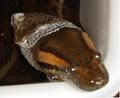
As Rob Carmichael mentioned below and numerous times before, burmese pythons are not a good typical choice for pet keepers. The photo is of a abandoned animal that has been in my care for two years. He was about 8.5ft when I first got him and now is at exactly 13ft and around 65lbs. When we do educational presentations I try to explain to people that he will continue to grow and grow throughout his life. It amazes me how many people step forward and acknowledge ownership or know of someone who owns one. Never have I encountered a fellow burmese keeper with one over eight feet at these events. They express how they had one but got rid of it or it died. They are not a disposable animal and even less so these days. We are running out of places which can take these snakes in once they get big and we are reaching a point of less acceptable alternatives.

I know I may be preaching to the choir some here. But for those who are just thinking about getting into burms really need to take a hard look at how they will manage a giant snake. What will you do if you can't get help to clean the cage, take the snake to the vet? Logistics is everything with these guys at some point. Sorry for the ramble, but I just hope people think hard before getting into them.

On a lighter side, this photo is of my friend Jenny who adores Specter (snake name I inherited).

-----
================================
Support your local herp society
www.chicagoherp.org

Replies (7)

Drosera Jan 02, 2005 12:11 AM

>>I know I may be preaching to the choir some here.

Hey, don't worry, the choir wouldn't be the choir if we didn't like the preaching!

>>But for those who are just thinking about getting into burms really need to take a hard look at how they will manage a giant snake. What will you do if you can't get help to clean the cage, take the snake to the vet? Logistics is everything with these guys at some point. Sorry for the ramble, but I just hope people think hard before getting into them.

Yup, precisely the reason the first species I'm going to get has a record of growing to a massive forty inches. LOL
Glad you're talking to the public, opening minds, warning people to have foresight, protecting snakes etc. Now where and for what audiences do you do your educational presentations and with what reptile group? What points (besides how big Burms grow and the responsibility involved) do you make during your presentation? Inquiring minds hope to know. Thanks.
-----
0.2 chickens
0.2 dog mutts (half ownership, only mine when they misbehave)
0.1 Halflinger horse
0.0 Arizona Mountain Kingsnake (coming soon)
1.1 parents
Still searching for 1.0 WC human

Carmichael Jan 02, 2005 04:59 PM

I know Rich real well and he is an excellent ambassadeur for responsible herp keeping so I'm sure he'll answer your question. As a curator of a herp museum, we, too, do many educational talks with our large burms. In addition to talking about responsible "big snake" ownership (and the realities of owning a large snake; that is, hopefully talking people out of keeping one!), I also like to focus on how giant contrictors are being persecuted worldwide for the leather industry. They are a top of the line predator that are a vital link in the overall food web. Its also nice to teach people about the incredible strength and amazing adaptations that these animals have to survive.

Rob Carmichael, Curator
The Wildlife Discovery Center
Lake Forest, IL

Rich_Crowley Jan 03, 2005 08:10 AM

"Now where and for what audiences do you do your educational presentations and with what reptile group? What points (besides how big Burms grow and the responsibility involved) do you make during your presentation? Inquiring minds hope to know."

Good questions! First of all, I support and work with the Chicago Herpetological Society and make every attempt to support their activities in my busy schedule. I usually do several shows a year at venues such as the Notebaert Nature Museum, Field Museum, Arlington Pet Show, Reptilefest at Univ of Illinois-Chicago, Reptile Rampage (Rob Carmichaels event Rocks!) and others. I work with many species of animals mostly herps and love to share bits of info with others. Dealing with the public is quite interesting. You are asked the same questions forty million times, but I never tire of answering them. I try to steer people towards more appropriate "pet herps" when asked such as colubrids, b. dragons, etc. The key bit of advice I try to impart on others is: do your homework. Knowledge about your pet selection is key.

Happy herping!
-----
================================
Support your local herp society
www.chicagoherp.org

Drosera Jan 03, 2005 05:23 PM

Thank you both! I hope to get involved with more things like that.
I have another question. I volunteer some at my local natural history museum and wonder how do you answer the classic question, "Does he bite?" Saying yes would scare people, saying no would be a lie, and I can't really think of an accurate and reassuring answer that isn't very long. I usually end up saying something like, "Only if he's scared or angry" but it's hard for the public to tell with these critters so I end up having to really elaborate on that.
Do you have any recommendations? Thanks.
-----
0.2 chickens
0.2 dog mutts (half ownership, only mine when they misbehave)
0.1 Halflinger horse
0.0 Arizona Mountain Kingsnake (coming soon)
1.1 parents
Still searching for 1.0 WC human

CrazyCodyKadunk Jan 03, 2005 06:03 PM

nice to see fellow herpers going out to the public and give some first hands knowhow on there animals. i do a couple shows a year for local schools and camps. i have a couple comeing up this april for a local high school. its not for everone u really need to have the right papers and know how for it.
when people ask if my animals bite i just say "any thing with a mouth will bite. there like people they have good days and bad."

CrazyCody
-----

I'm CrazyCody KadunkKadunk!!! I'm a herp god!!!

Kadunk was here

CrazyCody

Rich_Crowley Jan 04, 2005 08:03 AM

My response is the same as others, if it has a mouth it has the ability to bite. However, there are two types of bites: 1-Defensive ie a nip and 2-Feeding response ie grab and hold.

The trick is to read the mood of the animal and not frighten it and not to look, smell or act like food. That is why snake hooks are important and not removing the animal to feed in another enclosure.

I could ramble for hours just on these topics...
-----
================================
Support your local herp society
www.chicagoherp.org

Drosera Jan 05, 2005 11:59 PM

np
-----
0.2 chickens
0.2 dog mutts (half ownership, only mine when they misbehave)
0.1 Halflinger horse
0.0 Arizona Mountain Kingsnake (coming soon)
1.1 parents
Still searching for 1.0 WC human

Site Tools