Welcome to the Cage & Habitat Design: Live Plants Forum.
Here you may post messages or questions pertaining to issues regarding the use of live plants in caging, aquarium, and terrarium systems.
-----
_____
PHWyvern
Welcome to kingsnake.com's message board system. Here you may share and discuss information with others about your favorite reptile and amphibian related topics such as care and feeding, caging requirements, permits and licenses, and more. Launched in 1997, the kingsnake.com message board system is one of the oldest and largest systems on the internet.



Welcome to the Cage & Habitat Design: Live Plants Forum.
Here you may post messages or questions pertaining to issues regarding the use of live plants in caging, aquarium, and terrarium systems.
-----
_____
PHWyvern
Great idea! Hopefully more people will find this. I personally love to use live plants wherever possible and practical. Party of the fascination with owning reptiles is setting them up in as naturalistic an environment as I can.
Hi,
I use live plants in nearly all of my setups. I have found that for species such as rough green snakes, the moisture that live plants retain is almost required. As you can see from the photo of my reptile room, I try to make the enclosures as much like the animal's homes as possible. This is the left side. There are more vivariums on the right.

-----
DAVE
1.0 Western green toad
1.1 green treefrogs
1.0 Florida blue garter snake
1.1 Oriental fire-bellied toads
1.0 American bullfrog
0.1 Spanish ribbed newt
0.0.1 Eastern ribbon snake
1.1 red-cheeked mud turtles
0.1 Dubia day gecko
1.0 Sonoran gopher snake
1.1 rough green snakes
1.1 giant African black millipedes
1.0 Okeetee corn snake
0.1 Albino African clawed frog
1.0 Kenyan sand boa
0.0.1 Argentine flame-bellied toadlet
0.0.1 African bullfrog
1.0 yellow * Everglades rat snake intergrade
1.1 Western hognose snakes
1.2 fire salamanders
1.1 scarlet kingsnakes
0.0.1 scarlet snake
0.0.1 Argentine horned frog
1.1 Southern ringneck snakes
0.0.1 night snake
0.0.1 Florida brown snake
0.1 Pine woods snake
1.0 rough earth snake
0.1 (parthenogenic) Brahminy blind snake
0.1 Northern brown snake
Looks like my old reptile room!
I think a huge part of the fun of owning reptiles is recreating (as much as possible) a natural environment for them.
Hey there,
I know this is a bit OT, but I've been trying to find info on keeping rough greens in vivarium setups for months, and can't find any! Would you mind telling me how your rough green viv is set up, especially what species of plants you use? I'm setting up a 20 gallon rough green viv myself, and am currently debating whether or not to use local or tropical plants.
Thanks much!!!
-----
::i believe in joy > http://www.winds.org/nekomi/hope.html
::my homepage > http://www.winds.org/nekomi
My Growing Zoo:
1.0 Husband (Byron) ^_^
0.1 black cat (Shade)
0.1 Brazilian Rainbow Boa (Zia)
1.2 Cockatoo cichlids (A. cacatuoides yellow-gold)
1.1 WC Cockatoo cichlids (A. cacatuoides blue Peru)
3.3 Pygmy corydoras (C. pygmaeus)
2.0 Endlers' Livebearers (P. sp. Endlers)
Hello,
I use a screened in habitat. There is pea gravel drainage on the bottom, topped with a generous portion of sphagnum moss. I use many shelters such as cork, dead leaves, and synthetic stumps. I mostly use synthetic plants under the artificial light, but the rough greens that I have kept exhibited a fondness for succulents and ivy. I currently use small assorted ivy mixed with the artificial foliage for moisture purposes, beneath an incandescent light. I have to mist the enclosure very, very frequently.
-----
DAVE
1.0 Western green toad
1.1 green treefrogs
1.0 Florida blue garter snake
1.1 Oriental fire-bellied toads
1.0 American bullfrog
0.1 Spanish ribbed newt
0.0.1 Eastern ribbon snake
1.1 red-cheeked mud turtles
0.1 Dubia day gecko
1.0 Sonoran gopher snake
1.1 rough green snakes
1.1 giant African black millipedes
1.0 Okeetee corn snake
0.1 Albino African clawed frog
1.0 Kenyan sand boa
0.0.1 Argentine flame-bellied toadlet
0.0.1 African bullfrog
1.0 yellow * Everglades rat snake intergrade
1.1 Western hognose snakes
1.2 fire salamanders
1.1 scarlet kingsnakes
0.0.1 scarlet snake
0.0.1 Argentine horned frog
1.1 Southern ringneck snakes
0.0.1 night snake
0.0.1 Florida brown snake
1.0 rough earth snake
0.1 Northern brown snake
COMING SOON: Western worm snakes, Midwestern worm snakes and West/ Midwest intergrades, more Brahminy blind snakes!
For years I have watched the devolpment of the European's "natural style" herp keepers, the aquarium reef tank keepers, and then the dart frog people in the U.S. Philippe de Vosjoli was way ahead of his time when he first came on the scene, but maybe the rest of us are almost ready to take the plunge and go mainstream with some of the live plant vivs that others have done before us. It could open a whole new dimension for typical herp keepers, instead of just the usual plastic box racks, lol!
I would love to see more vivarium contests and discussions in places like this new forum to stimulate interest and ideas. I could see being much more involved in this aspect in the future as I tire more and more of the "plastic box syndrome".
I know that my snakes, who are kept in pretty sterile conditions, are much more active when there is at least a log or some rocks or something in their cage other than a hide and a water bowl.
Although they do not "enjoy" these things the way we think they do when we anthropomorphize them, it's gotta be good that their brain synapses do more firing while they explore a new piece of driftwood.
It's a balance I think. Kingsnakes are hard to keep in a super naturalistic setup because they poop frequently and it's usually a stinky, somewhat runny mess. Geckos on the other hand are GREAT for a naturalistic setup.

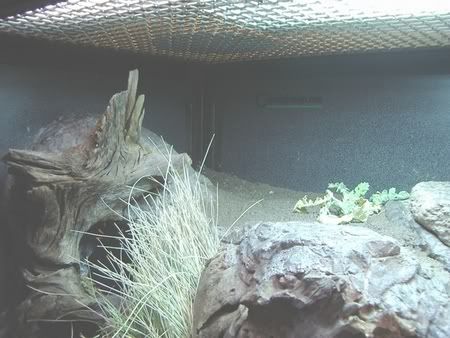
Hey! What plants could I use in a 29 gallon with a Leopard gecko? I thought that blue fescue looks good but I don't know if any harm can come from that plant. Also, fountain grass.
1.0 Corn Snake "Motega"
Any reptile and amphibian can be kept in a naturalistic vivarium.
the concerns are good one, but can be meet and overcome with some due diligence, effort and it's easy. kings, corns and garters are fun to watch in a natural habitat. the key is the nitrogen cycle, the right bacteria and micro fauna to turn things over and of course, building the burrows so that they can be cleaned and so on. it's very easy when you look at each area as it's own part then create for it's need and then go to the next part of the whole vivarium.
burrows should be vented some how, cleanable and made so that they don't hold moister, stain or get funky.
plants should be able to thrive on less water, packed durt, and with some abuse...our king is a bulldozer but our balls are gentle and conciderate..strange! don't let others say it can't be done!
learn how to compete with salimenella (sp) with bacteria and buy some virosan from pro-exotics and use that once a week on the habitat. provde the right ventilation and so on, it's easy.
Deven
Terra5Designs
Help, tips & resources quick links
Manage your user and advertising accounts
Advertising and services purchase quick links
