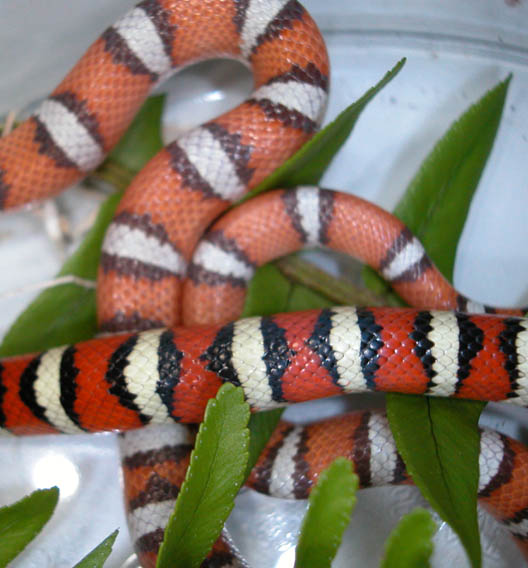
>>...that your pale hypo pyros could be hypomelanistic and also "look" hypo-erythristic, but to "label" them as hypo-erythristic would come after being able to prove the trait genetic (like has already been done with hypomelanism), correct?
>>
>>Also, would you consider those pumpkin Sinaloans (if the trait was proven genetically, and I think it has if I'm not mistaken) to be hypo-erythristic, or would you call that trait of the brighter faded orange a different name?
>>
>>Sorry if this is confusing you, but that trait of "hypo-erythristic" is a new one to me and I'm not sure of its definition. Thanks, Terry.
>>
>>Scott Ballard
SCOTT: SORRY, the email i got from you containing this content did not bear a return email address...i did not see the post here. So here's what i tried to email you:
Hi Scott,
"Hypo" is a prefix that's a RELATIVE term--it means "reduced" or "less" but HOW MUCH less? The prefix "A" or "An" on the other hand, as in anerythristic, or amelanistic, means "lacking" or "absent", no matter of degree or relativity in that prefix.
So, what we've called "AN"erythristic hondurans all along for example is technically incorrect because those snakes are clearly not totally lacking red/yellow pigment...it's a subtle distinction, but if they were WHOLLY LACKING those colors then the wide rings that are usually red would be pure white, just as white as the narrow white rings. They're not. To varying degrees, "anerythristic" hondos have a little pink or orange or yellow tint to them in those areas. (it's ALSO interesting though that those narrow rings i referred to, which on a normal or wild type can be white, yellow, orange, gold, etc--even reddish orange, on a tangerine--are ALWAYS pure white, at least in the specimens (many) i've seen.
So technically "anerythristic" hondurans are truly anerythristic on the narrow rings--they LACK or are ABSENT red/yellow (erythrins) whereas those colors are only reduced on the wide rings. So "anerythristic" is technically a misnomer and "hypoerythristic" is the more correct term. Unfortunately "anerythristic" has been used on those hondos for about a decade so it is difficult and perhaps impossible to change common usage: if i start referring to them by the correct term, for ex, no one (ok, very few) will know what i'm talking about; on the other hand, i can (and sometimes do) refer to them as "anerythristic" (actually hypoerythristic) but that's a chore so i get lazy sometimes and just use anerythristic.
Anyway, as you can see the terminology is complicated AND has consequences. So...
yes, my pale pyros are hypomelanistic and "look" hypoerythristic" and if we establish it as a predictable genetic trait then they would BE both.
As for the sinaloans, yeah, if they breed true i think they could be called hypoerythristic thought the reduction is not real dramatic, it is noticeable. HOWEVER, if we were to ever figure out the genetic basis for tangerine hondurans, they might (accurately) be called hypomelanistic (they DO display less melanin) OR "HYPER"erythristic (MORE than normal) in part of their pattern, or both terms.
So we shy it's hard to give simple answers? The definition aprt is simple, hypoerythristic means reduced erythrins and thhose are the prigments that create red & yellow. The problems are several: how big a change has to exist? when do we overlook variations that occur in the wild but can be described that way, but we just consider them part of the normal range of variation of the ssp? and DOES it matter that the effect be able to be reproduced in a genetically understood manner? I'm using that requirement but who says i have the right to, or that it's right to? So in part i'm just trying to reshape gently some of the language usage to more accurately reflect the animals in question.
terry