Reptile & Amphibian Forums

Welcome to kingsnake.com's message board system. Here you may share and discuss information with others about your favorite reptile and amphibian related topics such as care and feeding, caging requirements, permits and licenses, and more. Launched in 1997, the kingsnake.com message board system is one of the oldest and largest systems on the internet.

Click here for Dragon Serpents
Click for ZooMed
Click for 65% off Shipping with Reptiles 2 You

Amazon Peruvian Herping

rdbartlett Jul 08, 2003 05:38 AM

Patti and I have just returned from leading another 2 week herping trip in Amazonian Peru. The first week we had buterfly enthusiasts with us, the second week included tropical fish, birding, and herping enthusiasts. Our time was divided between three preserves. Many trails are available on each of the preserves. On most days we and other participants walked trails by both day and night, but we also visited some of the lagoons (in which we searched for fish, frogs, caiman and aquatic snakes) by small motor boat at night.
The preserves are all about 60 miles down-Amazon from Iquitos. Each is near a small village, but there are no roads, no aircraft, and electricity only when generators are in use. Villagers travel by dugout canoe and motor-canoes. We found 115 species of herps (some pix below), a few interesting small mammals, more than 200+ species of birds (but who is counting), hundreds of insects and tropical fish, and more plants than we could ever classify.

Villagers in a dugout near Comandancia Peru.

Replies (37)

rdbartlett Jul 08, 2003 05:42 AM

Despite seeing many species of monkeys and rodents, the mammalian highlight of the trip was an adult silky (pygmy) anteater.

rdbartlett Jul 08, 2003 05:46 AM

This adult male Epipedobates trivittatus was carrying more than 2 dozen tadpoles. This is the largest of the poison dart frogs in the region we visit.

rdbartlett Jul 08, 2003 05:52 AM

Red to yellow, kill a fellow
red to black, venom lack
doesn't work in Latin America. Many of the corals snakes have rings in triads, the black abutting the red. The two species of black-backed coral snakes are even more diverse, usually having only a single head band and one or two tail bands. The remaining spots are restricted to the ventrals and lower sides. This is Leptomicrurus narduccii melanotus, a spectacular small elapine.

Clintsky Jul 08, 2003 02:39 PM

Awesome finds and pics!!! I put on many presentations and always go over the "red & yellow... and red & black venom lack" whether the audience is 4 or 40. Now remember this is for the US coral snake ONLY, know your snakes when traveling abroad!!!
Clint
Texas Snakes & More

rdbartlett Jul 08, 2003 04:08 PM

Clint, except on the northern Florida Keys where Micrurus lack yellow. Interesting red and black rings down there. Cheers/Dick

oldherper Jul 08, 2003 04:20 PM

Hey Dick, have you seen or heard of melanistic Micrurius in LaCombe, La.? Probably 30 or more years ago, I saw a couple of specimens, both dead that were nearly solid black. The red and yellow rings were somewhat visible, but very obscured by black pigment. One was DOR near a humongous Catholic Church, the other was killed by a lady who had found it in her yard while she was planting flowers. At that time other people had told me that they had seen them, or heard of it too. I was told that most of the population in that general area were that way.

rdbartlett Jul 08, 2003 04:26 PM

No-- I hadn't heard of these. Thanx for the heads up. I'll ask Jeff Boundy, the LA state herpetologist about these. Rgds/Dick

Clintsky Jul 08, 2003 05:03 PM

The melanistic coral has been found in the US, but is also an anomaly. The Texas Coral Snake can come in some really dark colors and really look dark phased when in blue. That is also why, in my ID classes, I go over head and scale ovservation with all snake (i.e. light phased cottonmouths, and rattllesnakes without rattles). My students are not taught to handle snakes, except the ones I hand them.
Thanks again, for keeping me in line. If I can locate a picture of a melanistic coral, I will post it.
Clint

meretseger Jul 10, 2003 06:05 AM

There was one in Reptiles magazine a few months back, in the News and Views section... to prove your point, it was identified as a ringneck over the phone and then proceeded to bite someone. I'm glad I live up north where all our snakes are quite easily identified. (Hey! That's not a black rat! Aaargh!)

rdbartlett Jul 08, 2003 05:56 AM

There are several natricines of the genus Helicops in the region. Some are quite reminiscent of the snakes of the genus Nerodia. This one, Helicops polylepis, may be identified by the 5 rows of alternating spots on the back.

WW Jul 10, 2003 04:00 AM

>>There are several natricines of the genus Helicops in the region.

Actually, Helicops is a Xenodontine, not a Natricine - there are no natricines in S. Ameriac. If anything, it makes the convergence with Nerodia (and, to some extent, with some Homalopsines!) even more remarkable.

Cheers,

Wolfgang
-----
WW

WW Home

rdbartlett Jul 10, 2003 06:52 AM

Certainly Harry Greene agrees with you, and I had forgotten that.
Cheers/Dick

rdbartlett Jul 08, 2003 05:59 AM

The frogs of the genus Eleutherodactylus are abundant and varied in Amazonian Peru. This small arboreal species is E. acuminatus.

rdbartlett Jul 08, 2003 06:03 AM

Although small, Gonatodes concinnatus is one of the more spectacular geckos from the region we visit. A male is pictured here. The females are a mottled gray but have a very visible light collar. This species is most abundant in canopy forest where it is found on the boles of trees.

rdbartlett Jul 08, 2003 06:07 AM

This beautiful species Oxybelis argenteus, is a slender arborealist. It and two other species of the genus occur in Amazonian Peru. They are lizard and frog eaters. This adult female appeared to be gravid.

WW Jul 10, 2003 04:02 AM

>>This beautiful species Oxybelis argenteus, is a slender arborealist. It and two other species of the genus occur in Amazonian Peru. They are lizard and frog eaters. This adult female appeared to be gravid.
>>

Now Xenoxybelis argenteus. Amazingly, this is also a Xenodontine, and not in the slightest bit related to Oxybelis sensu stricto - anotehr amazing example of convergence.

Cheers,

Wolfgang
-----
WW

WW Home

rdbartlett Jul 11, 2003 09:23 AM

Greetings Wolfgang,
I'm less certain (at least at the moment) thn you of the correct (sub)familial designation for the green -striped vine snake. After talking with Bob Thomas, he now seems to question the significance of some of the data originally used. For the moment I'll stick with Oxybelis.
Cheers/Dick

WW Jul 14, 2003 03:19 AM

>>Greetings Wolfgang,
>>I'm less certain (at least at the moment) thn you of the correct (sub)familial designation for the green -striped vine snake. After talking with Bob Thomas, he now seems to question the significance of some of the data originally used. For the moment I'll stick with Oxybelis.
>>Cheers/Dick

Hi Dick,

I agree that the original data used by Rodrigues-Machado when she first described the genus and placed it in the xenodontines were open to question, at least on their own. However, there was a nice mtDNA study by Vidal et al. 2000 which also strongly supported the placing of this species deep in the Xenodontines, as a close relative of Philodryas, and totally separately from the colubrines, which contained the other Oxybelis. Everyone is obviously free to choose what they accept, but this one seems pretty convincing to me...

Cheers,

Wolfgang

Reference: Vidal, N., Kindl, S.G., Wong, A. & Hedges, S.B. (2000) Phylogenetic Relationships of Xenodontine Snakes Inferred from 12S
and 16S Ribosomal RNA Sequences. Molecular Phylogenetics and Evolution 14(3): 389-402. (e-mail me if you want a .pdf of this paper)
-----
WW

WW Home

rdbartlett Jul 11, 2003 09:26 AM

Greetings Wolfgang,
I'm less certain (at least at the moment) thn you of the correct (sub)familial designation for the green -striped vine snake. After talking with Bob Thomas, he now seems to question the significance of some of the data originally used. For the moment I'll stick with Oxybelis.
Cheers/Dick

rdbartlett Jul 11, 2003 09:28 AM

Greetings Wolfgang,
I'm less certain (at least at the moment) thn you of the correct (sub)familial designation for the green -striped vine snake. After talking with Bob Thomas, he now seems to question the significance of some of the data originally used. For the moment I'll stick with Oxybelis.
Cheers/Dick

rdbartlett Jul 11, 2003 09:32 AM

Greetings Wolfgang,
For the moment I am less convinced than you re the generic standing of the green-striped vine snake. Bob Thomas seems to now feel that the data used are somewhat less than conclusive. For the moment I'll retain usage of good old Oxybelis. Cheers/Dick

rdbartlett Jul 08, 2003 06:12 AM

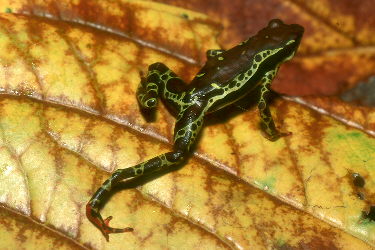
Since the species in this bufonid genus seem particularly susceptible to chytrid fungus problems, it is always a pleasure to find Atelopus spumarius on the preserve trails.

Derek Benson Jul 08, 2003 12:35 PM

That's a nice picture Mr. Bartlett. Strange how rare these frogs are and yet I just saw thme in the classifieds for $20 from a pet store. haha...
-----

P. sauvagei
derekb15.tripod.com/tropicaltreasures

rdbartlett Jul 08, 2003 02:17 PM

Atelopus spumarius seems to still come from Suriname in fair numbers. It is probably from there that those in the pet trade originate. They seem to be diminishing in numbers in Dpto Loreto Peru, as is their congener A. pulcher. rgds/Dick

rdbartlett Jul 08, 2003 06:16 AM

Although it is the largest of the geckos in the region we visit, Thecadactylus rapicaudus is certainly not the most colorful. The regenerated tail of this persistently arboreal species is often bulbous (turnip-like) in appearance.

oldherper Jul 08, 2003 08:01 AM

You always come back with the coolest pictures...thanks!

That Coral Snake was a neat find!

rdbartlett Jul 08, 2003 11:17 AM

We have a great time sloshing around in the Amazon mud.
The coral made us --- ummmmm --- quite happy.
Cheers/Dick

mayday Jul 08, 2003 11:33 AM

MUD TURTLE PICTURES??

rdbartlett Jul 08, 2003 02:21 PM

I should think you'd be tired of looking at them by now Cq. Any more turquoise headed ones? When you breed the turquoise w/the red you should get some royal purples----right? Dick

snakeguy88 Jul 08, 2003 02:25 PM

GREAT PICS! I especially love the natricine and the black backed coral...extremely beautiful. Thanks a ton for posting. Andy
-----
Andy Maddox
Houston Herp Key
The Reptizone

Who are you who can say it's ok to live through me? Alice In Chains

rdbartlett Jul 08, 2003 04:12 PM

I'll try to scare up some pix of natricines. Cheers/Dick

mayday Jul 08, 2003 03:54 PM

Are these all from slides or have you gone digital yet?

oldherper Jul 08, 2003 04:13 PM

That's a good question, Dick...tell us about the equipment you lug around in the jungle.

When I go herping for photos, I cheat. I bring the animals back to base camp and stage them and shoot them and then take them back where I found them and release them. I stage them in a big plywood box with an open front and the insides painted white (to reflect flash). I just gather "natural surroundings" and arrange it in the box to look like the animal is where I found it as much as possible. Plus I have all these reflectors and stuff and a Canon EOS3 and motor on focusing rails atop an old Slik U-212, film bags, batteries, flash units, lenses, backup bodies, etc. I know you don't lug all that sort of stuff around in the field, it would kill me to try to. So...do you stage them or do you shoot 'em where you find 'em? Some of Bill Love's photos in Reptiles are definitely staged...very high quality, but definitely staged. Right? C'mon...tell me you guys aren't shooting all these photos as you find the animals. John Shaw is the only guy that I know that does that and consistently achieves the quality of photos he gets.

rdbartlett Jul 08, 2003 04:19 PM

We take as many as possible in the field, but almost always back up with staged photos. I use only a handheld Canon EOS Elan II, Fuji Velvia ISO 50 film, and a bracket mounted (off camera) flash unit.
Dick

rdbartlett Jul 08, 2003 04:15 PM

35mm slides only. Dick

EJ Jul 08, 2003 08:29 PM

to herping in Phoenix in record heat (115 today)...
Fantastic... as usual.
One day I'll join you.
Cheers.
Ed

Terry Cox Jul 09, 2003 05:08 AM

Where ya gonna go next?

Ed, you should be herping in n. Michigan. It was only in the 70's here yesterday, and we have lots of herps. Of course, only about ten are snakes, with only one crote and one constrictor. I guess there isn't that much variety

Oh well, I'll be in s. AZ in two weeks. Then it'll be back to shoving all those rattlers off the roads, so I can look at the different kings and rats and amphibians. Don't suppose anyone will be around Green Valley then, eh?

Later...TC.

Site Tools