

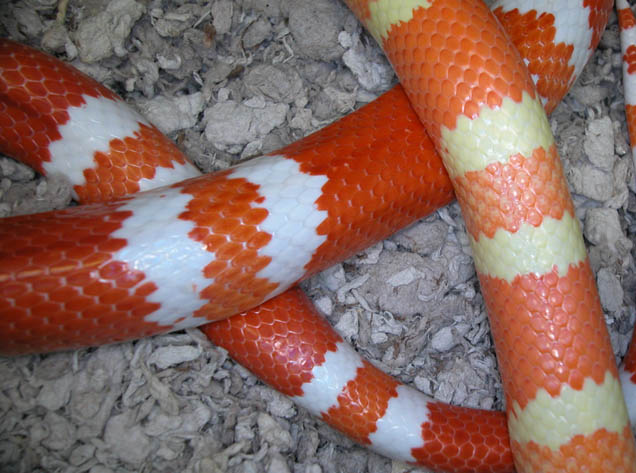
my notes inidicate i held back the "pale" animal in the pic below because it was pale--not pale orange, but pale. so it may have been pale red as a hatchling--I'm searching for old pix in case i have any.
but in the meantime i'm wondering--that "pale" snake clearly has a lot of ontogenetic yellow--lots of hondurans gain yellow as they age.
And notice the brightest yellow is where the BLACK rings would be, so yellow is not just increasing in the mid-triad, usually narrow rings that can vary from white to yellow on tricolor hondos and to orange on tangerine hondos. Presumably even where the BLACK rings occur there's a layer of skin with the cells that can produce yellows and on some specimens, as on this pale one (and on the high-yellow albino in the post linked to below) it occurs to an extreme.
My hypothesis is that on the pale animal the layer is producing more than usual amounts of yellow coloration not only in the narrow & "black" rings but on the wide rings as well: yellow red = orange, so maybe the combination of those colors results in those wide rings being orange instead of red.
Unfortunately, i can think of two problems already with that hypothesis:
1) the high yellow in the post linked below still is bright red, not orange
2) i haven't seen wild types turn from red to orange as they age
so maybe the hypothesis should be revised to: ON ALBINOS when there's more than usual yellow produced as the animal ages, that yellow not only shows up in the rings that would be black on a wild type, but also in the area where the red rings occur, and the mix of yellow and red results in the animal turning more orange with age.
terry
(now, if only i can find a hatchling pic of that snake...)
link to high yellow example

