

Reptile & Amphibian Forums

Welcome to kingsnake.com's message board system. Here you may share and discuss information with others about your favorite reptile and amphibian related topics such as care and feeding, caging requirements, permits and licenses, and more. Launched in 1997, the kingsnake.com message board system is one of the oldest and largest systems on the internet.

Click here to visit Classifieds
Southwestern Center for Herpetological Research
Click here to visit Classifieds

A reproductive husbandry question for Serpentcity and anyone else breeding for a while now......

JP Apr 06, 2005 06:08 PM

Dr. Michaels...I know with your Vet-med background you may have some particularly good insight. I would love to hear anyones opinions of course. Here's my question:

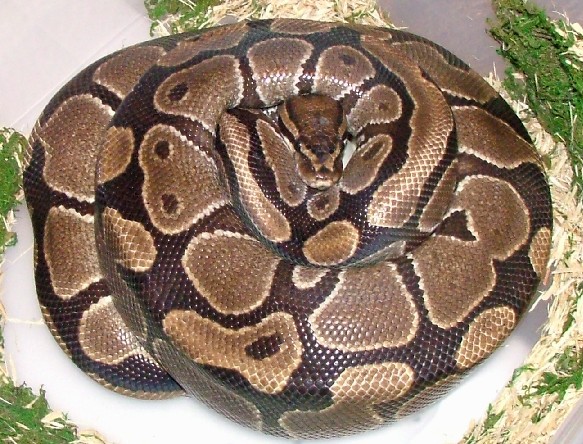
I've got a huge female (over 3600 grams before last breeding) that has been a wonderful breeder for me the past three seasons. In '03 she gave me 10 fertile eggs and 1 slug, in '04 she gave me 9 fertile with no slugs, and again this year (today) she laid 9 good with no slugs (almost 1100 grams worth). Now I know that many folks advocate giving them a year off every now and then, or even every other year. I have always incubated artificially and she has always gotten right back on food within days of laying. She eats like a frieking mule, and I seriously have to cut back in the fall so that she doesnt become obese. Since the number of eggs has been consistant over the years, I feel like shes not getting "used up" or overstressed, but I was just looking for opinions. Would you necessarily give her a year off every so often, or continue to breed her as long as she stays healthy and keeps pumping out large clutches?

Also, on a related note...do you think there is any benifit to letting them maternally incubate a clutch every so often? I always feel a little guilty when I pull eggs from a capable and devoted mother.

Thoughts on these questions.......?
Replies (8)

serpentcity Apr 06, 2005 09:46 PM

...sounds like she's quite the producer!!

She's clearly in her prime...and you can bet she wasn't first bred when she was 1500 gm...Sure would like to know her early history...sounds like an animal that was allowed to mature properly before her first breeding...and it isn't surprising she can recover and produce like she's doing...

...personally I feel it can't be a bad thing to give females a year off...females that have been given sufficient time to mature can handle it better than smaller females...I have several females in the 2000 gm range that produced last year for the first time...they had this year off...THEY decided by not banging down food sufficiently to get the weight on...the bigger the female the easier it is to get weight on...another female about this weight (2000g) is gravid...better genetics?...just a better adapted female?...whatever...depending on how she recovers she may or may not go in 06...

...there are exceptions to every rule but it is prudent to give a heavy producer a year off every 3-4 years to allow the reproductive organs to "rest"...but a female such as yours may go on to lay a clutch of slugs if you don't breed her...

...in the wild VERY FEW females produce in consecutive years...only the top few percent of females can do it...in captivity a larger % but this is largely dependent on the size of a given female...3600g is in the upper 5% of the captive population...

...as far as maternal incubation goes, I think given a choice, most females would avoid being burdened with a clutch for 55-60 days...I doubt females care one way or the other...your female seems to be responding quite well to the artificial incubation...

What is the sire of this years clutch? Sounds like some genes I'd like to add to my group lol!

Scott

Flora & Fauna Apr 07, 2005 12:32 AM

Janie and I have been bred a female that we know for sure is in her mid 20's for the last 6 years in a row. Every clutch has been 100% fertile. We did give her a year off this year, she looked like she needed it. I believe that there is no single recipe for success. Some females will go every year others will not, regardless of their care and body weight. It is an important lesson to learn with Ball Pythons that they are not all the same. To assume so will guarantee failure, be patient. Do what you believe is best for your animals and it probably will be! Rest her if you think she needs it. Breed her if you think she can. Only she really knows! Best Douglas Beard / Flora & Fauna

RandyRemington Apr 07, 2005 07:22 AM

I have a big female that first produced in 2001 and then again in 2002. She is one of these balls that thinks she is a burm and will eat most any time and several rodents if you let her. In 2003 I put her with an unmotivated male (a 66% het caramel that didn't get any of the many females he was placed with gravid until he was 5 years old in 2004). I blame the male for her not producing in 2003 but of course I really don't know. However, with no clutch in 2003 and her being such a good eater she was very fat by 2004 and again didn't produce. Again it was an unproven male (50% chance het clown) so I don't know who's fault it was but I tend to suspect the problem might have been her being so fat (I've heard several reports of fat girls not producing before). So now I'm worried that giving this particular good feeder a year off (due to a lame male) actually got her out of condition to breed again. Of course I could have just feed her less after missing and that is actually what I finally did in preparation for this year and she was seen breeding so hopefully she is back on track.

I have another one that I think I got too fat before first breeding. She she is my other garbage disposal type (i.e. NOT your typical balls) and was offered the first couple years to the same unmotivated possible het caramel male. Without clutches she also got very fat looking and continued not to breed even with other males in more recent years. She is out on breeding loan now but I think also slimmed down some this last year and was finally seen breeding so I have hopes that she will produce eggs in time for what I think will be her 8th birthday.

I guess my point is that with some super good eating girls with a tendency to get fat giving them a year off might put them at risk to become obese without special care (i.e. avoid the temptation to use them as a garbage disposal). Of course an underweight female shouldn’t be bred and perhaps even an average one could benefit from a rest from time to time but maybe with those really piggy ones it's best to keep in the rhythm of a clutch every year since they are building up the reserves.

I do have a more moderate sized girl that is a very good eater after her clutches and she has produced 5 years in a row with her biggest clutch being in 2004 (no bad eggs yet either). I’ve considered giving her a year off but she got back to her pre-lay weight very quickly so she was bred again for 2005. I consider her one of the “average” girls as far as tendency to get fat but perhaps she would with a skipped year. I’ll keep an eye on her and if she seems even a little slow on gaining weight back one of these years I’ll give her a rest.

I’ve only tried the maternal incubation once but for what it’s worth she ate very well after and produced the next year while another one that I removed the eggs from didn’t produce the next year. Too small of a sample size to really draw any conclusions other than that it’s possible for a maternal incubating female to recover and produce the next year.

JP Apr 07, 2005 07:25 AM

.

coldthumb Apr 07, 2005 11:48 AM

Good feedback.
Thank you Randy.
-----
Charles Glaspie

RandyRemington Apr 07, 2005 10:52 PM

Keep in mind I’m talking about a very small sample size so take it as a data point and not gospel.

coldthumb Apr 08, 2005 07:22 PM

........
-----
Charles Glaspie

JP Apr 07, 2005 07:20 AM

Thanks both of you for your input. I don't know a great deal about her history. I was told that she was a pet that could no loner be cared for and returned to a pet store. She may well have bred for the first time under may care. I'll include a few pictures of her below. The first is her "bee-hiving" last years clutch, the second is the clutch after she was removed, and the third is a picture of her from early last summer. My wife in the picture is about 5'8", and the snake is easily as long as she is. As far as there being a genetic component to her size and reproductive abilities, I think there very well could be. Her offspring have been wonderful eaters and growing well. The sire of this year's clutch is my reduced pattern male that is pictured in my previous thread below about my reduced project.

Site Tools
