If your thinking about hatching monitor eggs, I would not recomend the previous two types of incubators. They do not work well.
Unfortunately, when asking questions on this forum, its the blind leading the blind. Please do not take offense. But often your questions are answered by someone who heard it yesterday and thinks because someone told them, its right.
In this case, thats exactly the case. Normally, its not much of a problem, but with eggs, its a matter of life or death.
The person who repeated from a website, on how to build an incubator, forget to read about how many eggs that website person hatched with such a tool(the incubator)
Of course, if all you want to do is build a box and call it an incubator or buy a bubble and call it an incubator, then both responces are great. But if your interested in hatching eggs, thats another question.
You must understand that reptile incubators are not really incubators at all. They are merely a box that raises the temp to a set level. They have no ability to lower temps or control humidity.
So, if you have a room thats in the mid eighties, then all you have to do is put the eggs on vermic or pearlite, in some container at a set mixture, usually 1 part water to 1 part dry substrate, by weight. Poke a couple small holes in the container and your off and running.
If that is not available, then you can put a heater in a closet or small room. Or, find an old snake cage and put the lites or heating element on a thermostat and there you go.
Or you can build a insulated box and put shelves and the same heating and controls.
With monitors, there is one small difference they share with torts and Chams, and not snakes, which is what most reptile incubators are designed for. They can take some very long times to hatch. Up to and over a year. Even the little ones take three months. Which means, they can go over two to four, seasonal changes. Which causes problems.
Monitor eggs, do not like changes, specially fast ones. Like changing substrate or adding water.
Why I say these things is simple, The boxes previously mentioned, are too small and cause lots of changes. Its simple, its all about mass, large mass changes slowly and small mass changes quickly.
Please don't get me wrong, I am not blaming the people who are trying to help you. I blame you for not asking the proper questions. You should ask them, why, where, what, how and when and how many out of how many. That is, ask what success they had in doing what an incubator is suppose to do, that is hatch eggs.
I know Pam has hatched a few ackies and I congratulate her on that. But she has not had enough experience to actually comment. As I said above, you can hatch them on a shelf. Or even leave them in cage, we have hatched several clutches that way. I would not recomend it thought.
The other person seems to be quoting a website where the person has lots of problems hatching eggs. Remember monitor eggs are designed to hatch, they are suppose to hatch if they do not, you killed them. You know, its our responsibility.
So Please, ask better questions, find out the complete history of the methods recomended to you.
Often these incubators will work in one season, or in one part of the country and not the other. Or, even in one room and not another. The reason, is type of heating and amount of change.
So what I recomend is making your own, and the bigger the better. For $800 you could build a really big really nice one.
Again, if this were any other product, you would ask far more questions, like how many eggs does it hold, those little ones don't hold any. Which is a huge problem with monitors, its seems once a monitor starts laying eggs, and if you merely keep feeding them, they don't stop for a while. How much maintainence, what problems have you seen, What conditions do they work in. What kind of eggs, etc, etc.
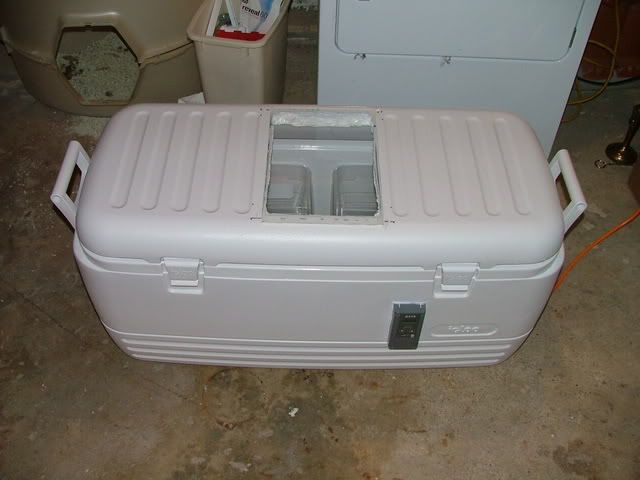
Heres a pic of a incubator(that worked well) I built. But now I no longer use, as a room is soooooooooooo much better(and bigger) FR