


Reptile & Amphibian Forums

Welcome to kingsnake.com's message board system. Here you may share and discuss information with others about your favorite reptile and amphibian related topics such as care and feeding, caging requirements, permits and licenses, and more. Launched in 1997, the kingsnake.com message board system is one of the oldest and largest systems on the internet.

Click here for Dragon Serpents
Southwestern Center for Herpetological Research
Click for 65% off Shipping with Reptiles 2 You

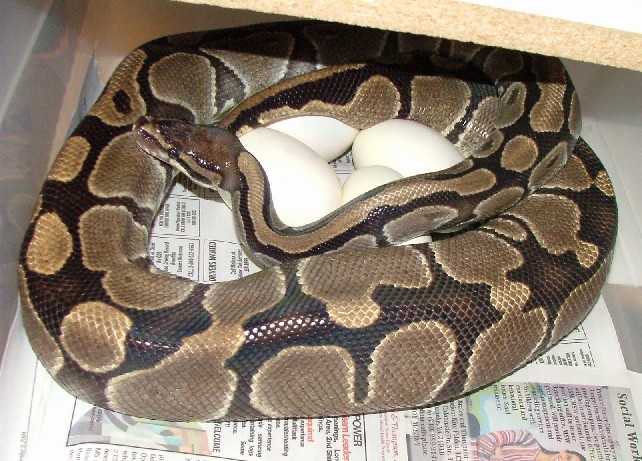
Our big female laying....during and after pics.

JP Apr 11, 2005 07:36 PM

Well...I wrote a couple of days ago about our big egg laying machine....28 fertile eggs over the past three seasons. Her offspring have all been great feeders and growers. This year she was bred to our reduced pattern male. Between this clutch, and the one he sired with our nice reduced pattern female, we should learn alot about the genetics of our reduced project.

The first pic is of her just finishing off pushing out egg number 4...the second picture is of all nine eggs in the incubator. The eggs were laid last Wednesday. Enjoy the pics!


Joe Pociask - my site

Replies (6)

jmartin104 Apr 11, 2005 07:39 PM

.
-----
Jay A. Martin

speedingbandit Apr 11, 2005 08:08 PM

what is that, vermiculite or perlite??? and whats up with the grid theyre on????

Philly_nr Apr 11, 2005 08:41 PM

Perlite and a zero-substrate method to keep the eggs off the medium.

speedingbandit Apr 11, 2005 08:45 PM

can they hatch that way, i thought ya had to cover them with the medium.....

Philly_nr Apr 11, 2005 09:17 PM

As long as the temps and humidity is OK, zero medium is fine.

JP Apr 12, 2005 07:02 AM

Philly is correct. That is perlite and I do use what is commonly called the "no substrate method". What I've got under the grid is soaking wet perlite. If the eggs contacted the medium it would be far to wet and kill the eggs. The point of this method is to keep the eggs completely dry while the humidity in the egg chamber (once the lid is snapped on it) is near 100%. Works like a charm. Since converting to this method, I've lost only one egg during incubation out of 5 or 6 clutches.

The beauty of the no-sub method is that you never have to worry if your medium is too wet or too dry, and you never have to add more water.

Site Tools