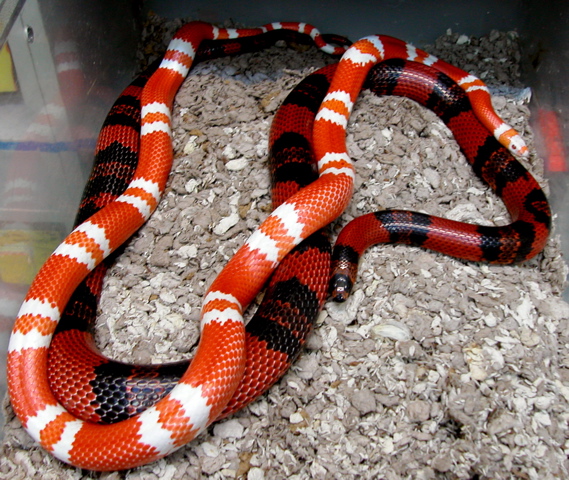
>>I think we are on the same page here except that I think your 50% total includes "hybinos" which look like albinos.
yes, you're right, it does. remember, they don't just look like albinos, they ARE albinos. "hybino" (or snow or ghost) is merely a handy name we've come up with for an animal that IS TWO diff things, in this case, for snakes that ARE albinos and ARE hypos.
>> Since we have not gotten to that stage yet of what a hybino looks like (even though it is similarly close to an albino), I am not including the 12.5% chance hybino as part of my total 37.50% albinos. That is why in my breakdown, I specifically labelled it as on my last item breakdown "visually hybino" (whatever that may look like).
understood. but remember, it is almost a certainty that we've SEEN hybinos--1/4 of the albinos i've produced from my project are also hypo, by genetic projection, and i've produced at least a couple dozen of them. So in theory perhaps half a dozen hybinos have moved thru my hands. Unfortunately, with the exception of a few tricolors (which COULD also be hybinos) they all looked generally the same--like beautiful tangerine albinos. So we're just trying to figure out what the characteristics might be that would distinguish that half dozen that were hybinos from the other 18, roughly speaking.
I thought once an exceptionally bright tangerine albino that hatched might be a hybino. But i test bred it and it turned out to be albino HET/hypo. Second hypothesis is maybe the paler ones are the hybinos, and i'm doing my first test of one of those this year.
It is CONCEIVABLE, at least, that the natural range in appearance of hondurensis will exceed any visual clues to homozygous hypo, in which case we'd be able to ID hybinos in only two ways:
1) test breeding an albino that's a possible hybino x hypos and producing enough babies (all of which MUST be hypos) to "prove" the albino is also hypo;
2) offspring from pairings that can ONLY produce hybinos--this year i'm testing hypo/albino x hypo/albino--ALL the babies will be hypos, so the 1/4 that are albinos will of necessity be both albino and hypo and thus hybinos. Will they look different from the tangerine albinos? That's one of the things to look forward to learning. And even if they do--are those diffs due to their being hybino? Or just to the natural variation in hondurensis, including even diffs that can occur from one set of parents of the same genotype to another? think how much the offspring from two diff pairs of albinos can differ!
>>I see now that you are assuming that your male is an albino visually and not a hybino visually.
yes, i guess so, except that with our current animals that's not an assumption, it's an observable fact, and that's perhaps the key to our discussion: 1) hybinos ARE albinos (and they are hypos); 2) that an animal is albino can be observed easily; 3) that an ALBINO is also hypo is not readily apparent; 4) albinos are albinos, and hybinos are albinos--that's the point, i guess. And it's the part that makes these discussions challenging. I know however hard i try, i'm sometimes not specific enough to be completely clear. sorry bout that!
>>
>>At any rate, isn't this a lot of fun
absolutely!
reminds me of almost ten years ago when we first had both anerythristics and albinos and began speculating about what snows would look like (we were sorta right and sorta wrong, i don't remember anyone at that time factoring in the ontogenic yellow that appears on some albino hondos as they age, in the areas that would be black on a normal--so we anticipated pink and white, but not the pink, yellow and white that characterizes most snows).
>> I think in the long run, when the offsprings are visually the same as both parent (i.e. ghost x ghost will show all ghost offsprings, or snow x snow will produce all snows ) that when a honduran thought to be hybino is bred to another honduran also thought to be hybino and these 2 adults looks the same or extremely super close and they produce offsprings like them (as in my ghost and snow examples above) that we can rest and know that the community has finally seen a real hybino. Don't you think?
unfortunately i don't think that will prove anything. both animals could simply be albinos (if hybinos simply look like albinos, if the effects of hypomelanism have no visual effect on animals that are already lacking melanin (amelanism). If that's the case, in the example you just gave both animals could simply be albinos, not hybinos: they WOULD also produce all babies that look like them (albinos) and the next generation the same would be true (more albinos). So until we know some way to distinguish hybinos visually, that test wouldn't prove anything. And when we DO know how to distinguish them, the test wouldn't be necessary! It would be as logical that hybino x hybino would produce hybinos as that albino x albino would produce albinos. I still worry about the wide range of hondo coloration precluding us from ever linking a visual diff to hybinos, but hey!
With the snow projections it was sorta obvious to say, "well, black will become white because the snow is an albino, and red will become very pale pink the way it does on anerys". The diff with hybinos is that both Amelanism and HYPOmelanism most significantly alter the appearance of the animal in the same places--places where black occurs. And on albinos, black becomes white--even black tipping is white tipping instead. So in theory it's hard to know how the added feature of being hypo will affect appearance.
That's why i wonder if we won't eventually learn we can distinguish hybinos only by the "pairing can only produce hybinos" or "test breeding proves the animal is hybino" methods.
>>
>>Thanks again and have a great day !
thanks Ray, i'm enjoying our discussion.