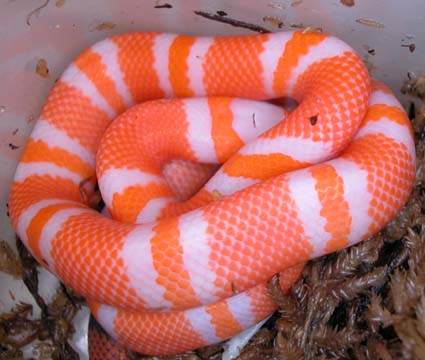
I found this clutch of 10 good eggs this morning with one of my double het for hybino (het/hypo and het/albino) females. She was bred x my tangerine albino het/hypo male. So she'll produce some real nice tangerine albinos, hypos het/albino, and double hets for hybino. The pic at the link at the bottom of this post is one of last year's tangerine albino babies.
terry

2004 tangerine albino baby from this project
Reptile & Amphibian Forums
Welcome to kingsnake.com's message board system. Here you may share and discuss information with others about your favorite reptile and amphibian related topics such as care and feeding, caging requirements, permits and licenses, and more. Launched in 1997, the kingsnake.com message board system is one of the oldest and largest systems on the internet.


kind of clutch I like to see
rtdunham
Jun 06, 2005 11:33 PM
Replies (10)
sutorherp1
Jun 07, 2005 04:39 PM
Beautfil 10 eggs, I'd love to see the babies. Those are quite rounded eggs; I've seen some weird honduran eggs, and some very round. Most recently, I had a firsy breeder lay a clutch of 4 very large, long, sausage like eggs (which produced very large babies). What determines the shape or size of the egg? I would think a larger, more experianced breeder would lay more eggs, but would the shape and size change at all?
-Sean
reiding@nettally
Jun 10, 2005 08:28 PM
Tery;
Those should be some real nice hatchlings! I'm new to this forum and had a question for you. I have a 2004 Tangerine Hypo Honduran pair and a 2004 Nelson Albino pair. Have you ever bred a Nelson Albino to a Tangerine Hypo and would there be any reason for not breeding the two together(In 2007 I was thinking)?
Thanks,
Rob Reiding.
rtdunham
Jun 11, 2005 05:16 PM
>>Tery;
>>
>>Those should be some real nice hatchlings! I'm new to this forum and had a question for you. I have a 2004 Tangerine Hypo Honduran pair and a 2004 Nelson Albino pair. Have you ever bred a Nelson Albino to a Tangerine Hypo and would there be any reason for not breeding the two together(In 2007 I was thinking)?
>>
>>Thanks,
>>
>>Rob Reiding.
Hi Rob,
Without introducing a whole bunch of rhetoric let's just say that what you're proposing is called hybridising. Some people love it. Some people (i'm in this camp) hate it. Pluses: It can produce some beautiful specimens, and you can feel like playing god or master laboratorian. Minuses: the snakes you produce don't represent anything that can/has existed in the wild, and you can never--never ever--get back to pure stock from those hybrids: they and ALL their young forever are mutts. You can never sell anything that descends from them as hondurans, or as nelsoni. That's a lot of price to pay for the experiment, imho. But like i say, there are others here who would defend the practice. There's a separate hybrid forum so i guess if you want to pursue it you can learn more there. I'd ask you think long and hard about the consequences before deciding to proceed.
Just as an aside, the hypo x albino cross eventually produces animals we'd call "hybinos", and we may produce the first definite hybino hondos this year * (they've been rpdouced before but no one can point to a snake and say "that's one" because we don't know how to distinguish them from "regular" albinos--the albino removes all melanin so how is the snake's appearance altered if it is homozygous for a trait that also reduces melanin--what's the effect of reducing what's already eliminated? So while hybinos are intellectually interesting -- and MAY someday be identifiable if we figure out any visual clues -- they're not dramatic double-morphs like ghosts or snows.
terry
* -- how, then do we propose to produce definite hybinos? eitherr of two ways...
1) as in the past, produce albinos that MIGHT also be hybinos but can't be sure. you have to test breed these (x hypos, getting lots of hypos and ONLY hypos) before you can conclude one IS also hypo and thus a hybino
OR
2) do a breeding that can produce animals that have to be hybinos (hybino x hybino is the obvioius example, but how do you get those first hybinos?) So what we're breeding are hypo het/albino x hyp het/albino. See what happens? ALL the babies are hypos because both parents are hypos. 1/4 of the babies are albinos (becuase het/albino x het/albino = babies 1/4 of which are albinos). So all the albinos out of such a pairing are also hypos & thus hybinos. So the babiers that LOOK like albinos will BE definite hybinos. That's why hypos het/albino are in particular demand right now.
td
reiding@nettally
Jun 11, 2005 06:18 PM
Hi Terry;
Thanks for your response and the reason I was asking about breeding a Nelson Albino to a Tangerine Hypo is that the Tangerine Hypo pair that I have is offspring from one of your line of double het hybino males and a female Tangerine Hypo, making them 50% het for Albino. If one of the Tangerine Hypos actually is a het for Albino but not the other one then I will never know which is which if I breed them together and that is where the Nelson Albinos come in. If I would breed the Nelson Albino pair to the Tangerine Hypo pair (the male Nelson Albino to the Female Tangerine Hypo, and the female Nelson Albino to the male Tangerine Hypo) and an Albino is produced from that, then I would know which one of the Tangerine Hypos is het for Albino in case one of the of them is (or both of them). So it would be a test breeding and I was wondering if Nelson Albinos and Tangerine Hypos would be compatible to breed together for this reason. If no Albinos are produced this way then the offspring would be hybrid het for Albinos, like you said, "Tangerine Hypo X Nelson" 100% het Albino and 100% het Hypo? Not sure what an Albino would be called, Albino "Tangerine X Nelson" 100% het Hypo?
Genetics sure is interesting!
Rob Reiding.
Conserving_herps
Jun 13, 2005 09:21 AM
I agree with you Terry that "hybridizing" is pretty much like playing God and does not do any service to the honduran species nor to the nelsoni species. I'm involved with a lot of conservation projects with my volunteering at the zoo and all of the zoo keepers also strongly discourage cross breeding of snake species. So, please, whoever is reading this segment of disccussion to, as Terry said, think long and hard because you may be doing some serious damaging than good in the name of "creating" your own hybrid.
Thanks,
-----
RAY 
reiding@nettally
Jun 13, 2005 05:52 PM
Oh, I totally agree with the both of you about hybridizing but since the Tangerine Honduran and the Nelson's are both Milk Snakes, namely Lampropeltis triangulum hondurensis for the Honduran, and Lampropeltus triangulum nelsoni for the Nelson's my question to Terry initially was if there would be any problem physically in breeding a Tangerine Honduran 50% het for Albino to an Albino Nelson as a test breeding to test the Honduran for the actual presence of the Albino gene. I was asking this because I have two Tangerine Hypos 50% het for Albino and there is not really a way that I know about to find out if either one of them actually is het for albino except by test breeding (unless both of the Tangerine Hypos are actually het for Albino and I would breed them to each other). For me personally the most economical way to test breed for the Albino gene would be with a Nelson's Albino for $100 versus an Albino Tangerine Honduran for probably about $700.
On a side note, where does the HYBINO fit into the discussion about hybridization, since there are obviously no HYBINO's in the wild? I may be wrong, but didn't the Tangerine Honduran get it's Albino gene from the Tri Color Hondurans initially and that cross was later outbred?
Maybe we could expand on that a little?
Thanks,
Rob.
phflame
Jun 13, 2005 09:45 PM
but in cornsnakes and in great plain rats (emory), the gene is not the same one. So if you breed those two (corn and great plain ratsnakes) together with the hope of getting an albino, it won't happen. And these two snakes are very closely related, also. Like I said, don't know if it applies to the honduran/nelson breeding. I am pretty sure that with all the very knowledgeable milksnake breeders on this forum, at least one can help us out with this question about the compatibility of that albino gene in the two milksnakes.
-----
phflame
reiding@nettally
Jun 13, 2005 10:16 PM
That is very interesting and not something I had thought about.
Maybe there is someone with first hand experience with Albino genes in different Milk Snakes that are not compatible?
Rob.
rtdunham
Jun 14, 2005 01:27 AM
>>Oh, I totally agree with the both of you about hybridizing but since the Tangerine Honduran and the Nelson's are both Milk Snakes, namely Lampropeltis triangulum hondurensis for the Honduran, and Lampropeltus triangulum nelsoni for the Nelson's my question to Terry initially was if there would be any problem physically
You're persistent! no, just to answer your literal question, i don't think there'd be any problem physically if they're roughly the same size and/or you watch them closely while they're together. Different species and subspecies have different shaped hemipenes but i don't think there'd be anything between these two ssp that would preclude their breeding, other than good judgement.
in breeding a Tangerine Honduran 50% het for Albino to an Albino Nelson as a test breeding to test the Honduran for the actual presence of the Albino gene. I was asking this because I have two Tangerine Hypos 50% het for Albino and there is not really a way that I know about to find out if either one of them actually is het for albino except by test breeding (unless both of the Tangerine Hypos are actually het for Albino and I would breed them to each other). For me personally the most economical way to test breed for the Albino gene would be with a Nelson's Albino for $100 versus an Albino Tangerine Honduran for probably about $700.
not so: you could get a tricolor albino for $200 or less and then you'd be testing without hybridizing AND all the resulting babies would still be pure hondurans. whether they're tricolor or tangerine is irrelevant to testing to see whether or not they are het/albino.
>>On a side note, where does the HYBINO fit into the discussion about hybridization, since there are obviously no HYBINO's in the wild? I may be wrong, but didn't the Tangerine Honduran get it's Albino gene from the Tri Color Hondurans initially and that cross was later outbred?
>>Maybe we could expand on that a little?
to clarify what sounds like a little misunderstanding, tricolor hondurans and tangerine hondurans are all hondurans, they're just different color phases...neither is a recessive trait, they're just endpoints on a continuum, sort of like dark-skinned and light-skinned people or German Shepards of two different colors. Yes, the first amel hondurans were tricolors, but it's no sort of hybridizing or cross to transfer that trait to tangerines, you just breed to tangerines and then again until you get good tangerines. It's no different than, for example, if the first amels had been hondurans with high triad counts, and someone eventually selectively bred from those to produce some with low triad counts--there's no cross involved.
peace
terry
>>
>>Thanks,
>>
>>Rob.
reiding@nettally
Jun 14, 2005 08:23 AM
Terry;
Thanks for taking the time, and those are some good points you have. I was not planning on keeping any Tangerine Hypo X Nelson Albino offspring from a testbreeding so any next owner will probably breed them and the line of hybrids I would start this way would probably continue on. I already have the Nelson Albino's, but I should probably buy the Honduran Albino's ( either Tri color or Tangerine) so then I could continue working with the offspring in the breeding project.
The question was raised whether Honduran Albino and Nelson Albino genes are compatible. Do you know?
Thanks,
Rob.