My FL king over 5 feet has laid 13 eggs and still has several left. The next one has been in front of the vent for over 24 hours. Its as if the vent is sealed shut. What should I do? I don't want to lose her (11 yrs.)
Reptile & Amphibian Forums
Welcome to kingsnake.com's message board system. Here you may share and discuss information with others about your favorite reptile and amphibian related topics such as care and feeding, caging requirements, permits and licenses, and more. Launched in 1997, the kingsnake.com message board system is one of the oldest and largest systems on the internet.


Help. My FL King can't lay last eggs
bobinsd
Jun 18, 2005 01:29 AM
Replies (5)
rtdunham
Jun 18, 2005 01:07 PM
there are a number of things you can do or have done for yhou.
1) wait.
sometimes a female lays a couple eggs after the larger group has been deposited. how long to wait? no simple answer. I worry after about day 13 post-prelay shed; i have a friend who's much more patient & who's had females lay their last few eggs a couple weeks after the rest. the problem of course is that the longer you wait the greater the probs might be if she doesn't eventually deposit them.
2) express.
this means pushing the eggs out. you need a gentle but firm touch. you apply STEADY pressure, not intermittent hard pressure. you just press a thumb "upstream" from the egg and gently push against the egg--if it doesn't move, that's ok--just hold the pressure. I expressed one from a western hognose a week or two ago that didn't budge for several minutes, then moved a couple inches, didn't budge again, then moved on to just before the vent, then wouldn't move for about 5 minutes before it finally slid out...the impression was the female finally relaxed the muscles that were blocking its exit. but slow, steady, and gentle are the keys.
3) expirate.
you put a large needle through the side of the snake into the egg and suck out the contents. the theory is that the snake can deposit the collapsed shell more easily than the puffed-up egg. it often works. with basic sanitary methods there's seldom infection.
4) have a vet surgically remove the eggs.
if you have a good vet this can be done and NOT ruin the snake for subsequent years. one theory my vet and i have is that the females produce eggs in subsequent years from the OTHER oviduct. but another possibility is that the surgery might be done so well that even the affected oviduct can heal and produce in subsequent years.
the debate between intervention and "benign neglect" is always a tough one. the problem is that retained eggs can become infected; they can become adhered to the oviducts; etc. I bought a snake a couple years ago that arrived in the spring with a couple hard lumps mid-body; the seller conceded yeah, he thought she'd retained a few eggs the prior year (he MIGHT have mentioned that!) anyway, she died and i had the vet post her, one of the eggs the site of an infection that killed her. perhaps other eggs encapsulate and never become a problem, other than obstructing passage of other eggs in the oviduct they're in. I'm speaking as a layman and sharing what i've learned from a very capable vet. bottom line, there's still a lot we don't know precisely so plenty of judgement calls are involved.
good luck!
terry
>>My FL king over 5 feet has laid 13 eggs and still has several left. The next one has been in front of the vent for over 24 hours. Its as if the vent is sealed shut. What should I do? I don't want to lose her (11 yrs.)
rtdunham
Jun 18, 2005 01:14 PM
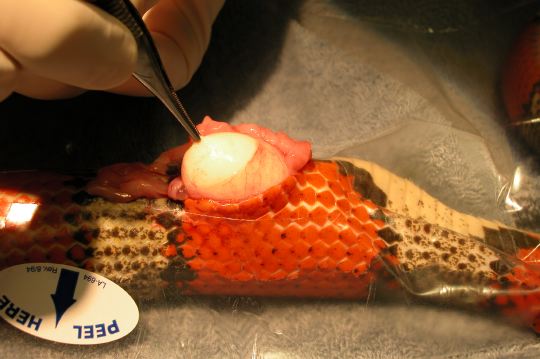
this is one of a series of 34 pix i have of my vet removing a clutch of eggs from an eggbound Honduran Milksnake. It was fascinating to watch the process. We're eventually going to publish an article around the series of pix.
if you're fortunate your snake won't require this degree of intervention. and no, the eggs removed this way have never proceeded to develop & hatch. perhaps that's a function of the delay between when they should have been deposited and are eventually removed. again, there's lots we don't now. and my experiences may not be typical.
terry
idaviss
Jun 20, 2005 11:47 PM
;
bobinsd
Jun 18, 2005 03:03 PM
Terry,
Thank you very much for your all-encompassing list of options. I think I'll wait since she came out this morning for some sun and did not seem distressed. These eggs are fat, about 2/3rds of the length, not like the long ovals I've seen before. I lost the FL male years ago and used a CA king as a surrugate. I know many frown on this but these are for my own enjoyment and that of the kids in the neighborhood that want to own a great pet, Thank again for you help...fingers crossed.
BobinSD
BobS
Jun 24, 2005 02:13 PM
np
