Reptile & Amphibian Forums

Welcome to kingsnake.com's message board system. Here you may share and discuss information with others about your favorite reptile and amphibian related topics such as care and feeding, caging requirements, permits and licenses, and more. Launched in 1997, the kingsnake.com message board system is one of the oldest and largest systems on the internet.

Southwestern Center for Herpetological Research
Click for 65% off Shipping with Reptiles 2 You

Anyone else working with locality amaura?

DeanAlessandrini Aug 15, 2005 03:37 PM

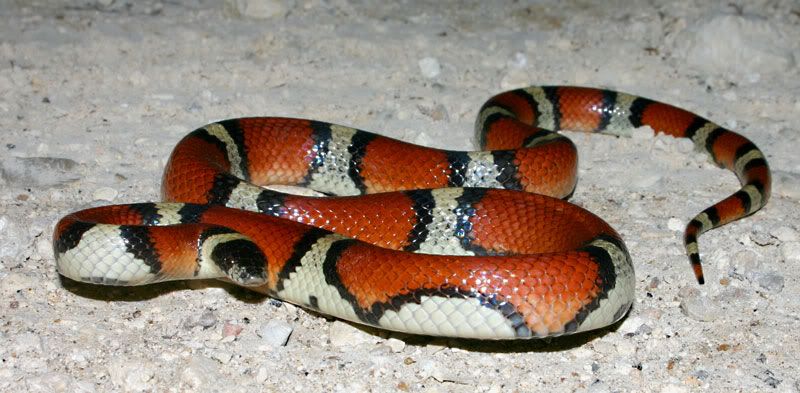
A buddy of mine in E. TX recently scored this 20" male for me in Montgomery County, TX in an area that is being rapidly developed...I hope to get a female from the same region very soon.

This guy is cool!
He's wormed and already feeding on f/t fuzzies!
Image

Replies (12)

snake_bit Aug 15, 2005 05:01 PM

.

Nathan Wells Aug 15, 2005 06:08 PM

Hello Dean,
Very nice coloration on that specimen. I actually keep a few locality pairs myself..easy since I am a resident here in The Woodlands, located in southern Montgomery County, Texas. I have some beautiful animals from the eastern portion of the county and a few from the College Station area in Brazos County.
There is quite a degree of variation within a given locality and some of these found down here are really very nice.
Nathan Wells

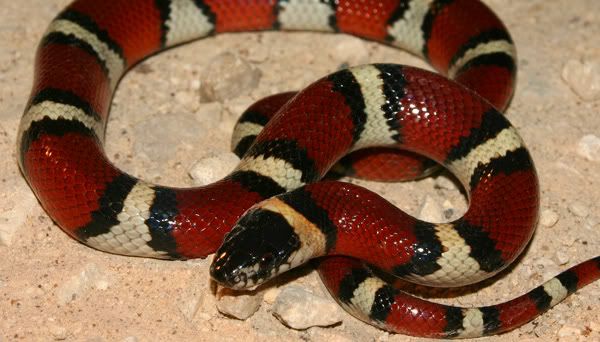
Here is a nice male from College Station, Texas. Picture courtesy of Rob Klockman.
Image

Erik - NM Aug 15, 2005 07:16 PM

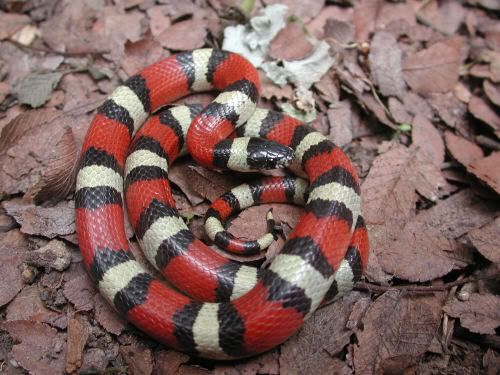
Found two that day, but they don't sit still for photos very well.

DeanAlessandrini Aug 16, 2005 07:39 AM

Although both of those counties are smack in the middle of amaura range, Nathan's Mongomery county snake looks almost as if it has sypila influence (red does not completely encircle body)
Whereas your Liberty county animal looks very much like annulata to me.

Mine seems to be somewhere between the 2.

It's cool how extremely vatiable the NA milks are.

Nathan Wells Aug 16, 2005 12:14 PM

The aberrant patterned Brazos County animal from the previous post is a pretty unique specimen. Most that are found here in Montgomery County are wide-banded, lacking the saddles and strongly resemble the one pictured in Erik's post. There are always exceptions however.
Nathan Wells

rak Aug 16, 2005 04:28 PM

Working with several of these guys, mostly black bellied individuals.

Found this guy crossing the road right behind Nathan, LOL

One that did not make it

DeanAlessandrini Aug 16, 2005 06:13 PM

The snake in the forth pic has a pattern almost like a campbelli!

kisatchie Aug 16, 2005 06:45 PM

Being a locale specific enthusiast (corns, milks, kings, etc) it is really neat to see these animals. The annulata influence is easily seen in those first couple of animals. Most of the amaura right around here are 2 or 3 way integrades with syspila and elapsoides (or would those be hybrids now?)and being so are highly variable.THanks for the post. Keep um coming.
Jim

DeanAlessandrini Aug 17, 2005 03:57 PM

I didn't catch where you were from where those 3 subs would integrade ?

kisatchie Aug 17, 2005 05:16 PM

I'm from Baton Rouge. The flooding Mississippi has influenced the milksnakes around here. We have pure elapsoides coming in from the East just North of here and pure amaura to the West of the Mississippi flood plain and the syspila influence comes from S.Ark and Northward, I would quess from rafting in flood waters.
I have had pure amaura from extreme Southwestern La right from the coast, but they aren't real attractive........a lot of dark tipping in the white bands. The ones around here are quite variable and interesting including some red-headed ones.
Jim

DeanAlessandrini Aug 18, 2005 07:36 AM

JC's opinion in the talk I heard was that anything that enters the Mississippi down there gets washed into the gulf of Mexico and eaten by sharks! Therefore there would be no mixing of genetics of the animals west and east of the Mississippi.

Sounds like it's happening.

kisatchie Aug 18, 2005 04:19 PM

Well, that's not exactly true. Driftwood gets pushed up along the levees and the snakes can leave from there. Even though there are a lot of sugar cane fields, there still are some deep woods. The parishes along the river in S. LA support large populations of these integrades. It is amazing the variation that you see, i.e. saddles, red heads, checkered bellies, black bellies, white bellies, etc,etc. The slowinski cornsnakes from W. LA are clearly a relict population about midway in type between the emoryi to the West and the guttatus to the E. LA. has the greatest variation than any state except maybe TX.
LOVE THOSE NATURAL INTEGRADES !!
Jim


Site Tools