I was cleaning cages and could not resist taking a couple more shots of this one....He has an awesome attitude and great colors to boot....

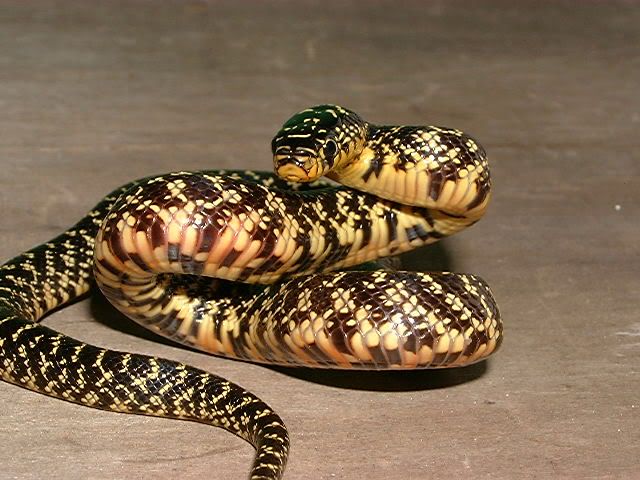
Thanks for looking,
John Lassiter
Welcome to kingsnake.com's message board system. Here you may share and discuss information with others about your favorite reptile and amphibian related topics such as care and feeding, caging requirements, permits and licenses, and more. Launched in 1997, the kingsnake.com message board system is one of the oldest and largest systems on the internet.


I was cleaning cages and could not resist taking a couple more shots of this one....He has an awesome attitude and great colors to boot....
Thanks for looking,
John Lassiter
,
-----
http://home.bellsouth.net/p/s/community.dll?ep=16&groupid=173260&ck=
But I still am having problems with this intergrade thing. Are the rest of the snakes where this one came from like this??? Then why would you call them intergrades?
To intergrade, a normal of one type has to breed a normal of another type to produce intergrades. There needs to be both types in close proximity.
If this individual is within the normal range of the general population in this area, then its not an intergrade. It simply has an intermediate pattern between two patterns you recognize as two subspecies.
For instance, calkings contain a wide varity of colors and patterns, Splendida, contain a wide varity of colors and patterns, eastern kings the same, and fla. kings the same. Each range of patterns represents the type. Not one pattern, that you or your friends think represents a subspecies.
Intergrades rarely occur, and is why its not considered valid anymore. Intermediate patterns commonly occur. In fact, the line that divides subspecies, is sort of arbitrarily draw by range.
Just something to consider. FR
If what you're saying is true, then there are no subspecies anymore. What ever happened to the intergrade zone bt. two subspecies, where there's gene flow from both ssps, resulting in various intergrade forms? I kinda like the idea of subspecies. To me a Cal king is a different snake than a desert king, etc, and where they meet the snakes show characteristics of both ssps. I'd call those intergrades. Just my opinion 
TC
Well I read that and got something a little different.
Remember Frank is trying to make us think here, so with that in mind, what Frank asked is this....
1) Do we find both typical spelndida types and typical holbrooki types in the area where this snake was found?
The answer is no. All the kingsnakes from there look just like that. You have to go further east to find snakes that exhibit "classic" holbrooki phenotypes and further west that exhibit "classic" splendida phenotypes.
So you are still thinking that this is indeed an "intergrade", but is it really if the snakes have a "continuous" range and slowly exhibit different phenotypes over a broad geographic range? Wouldn't you need to be able to find "classic" splendida phenotypes, "classic" holbrooki phenotypes, and intermediate types like this one all in the same locality to qualify as a true "intergrade"?
This is actually a very astute question Frank has raised. He's trying to beat us over the head with it but we still don't seem to get it
The exact same scenario exists with the triangulum in Texas. The range is continuous throughout the state, with a little hole in Bexar county (durnit). At what point can you "really" with authority say this snake here is an "amuara x annulata" intergade or do the snakes just exhibit a gradual phenotypical variation throughout a continuous range (i.e. they are all the same)?
With some species the boundaries are a little more "clear" and some may be able to say with a little more authority that indeed intergration is taking place. With other species, there is a lot more gray area over a much broader range.
???
>>Well I read that and got something a little different.
>>Remember Frank is trying to make us think here, so with that in mind, what Frank asked is this....
>>
>>1) Do we find both typical spelndida types and typical holbrooki types in the area where this snake was found?
>>
>>The answer is no. All the kingsnakes from there look just like that. You have to go further east to find snakes that exhibit "classic" holbrooki phenotypes and further west that exhibit "classic" splendida phenotypes.
>>
Of course, if both ssps, holbrooki and splendida, both occured in the same area, then I would guess they were separate species and if there were some crosses I'd probably call them hybrids
>>So you are still thinking that this is indeed an "intergrade", but is it really if the snakes have a "continuous" range and slowly exhibit different phenotypes over a broad geographic range? Wouldn't you need to be able to find "classic" splendida phenotypes, "classic" holbrooki phenotypes, and intermediate types like this one all in the same locality to qualify as a true "intergrade"?
>>
No, I don't think so.
>>This is actually a very astute question Frank has raised. He's trying to beat us over the head with it but we still don't seem to get it
>>
>>The exact same scenario exists with the triangulum in Texas. The range is continuous throughout the state, with a little hole in Bexar county (durnit). At what point can you "really" with authority say this snake here is an "amuara x annulata" intergade or do the snakes just exhibit a gradual phenotypical variation throughout a continuous range (i.e. they are all the same)?
>>
Milksnakes, I love it. A milksnake subspecies will gradually change phenotypically as it nears the outer boundaries of it's range, because it is under the influence of the changing environment. As two subspecies' ranges approach each other, each ssps will gradually change towards the other as they near the central location bt. their respective ranges. I believe the point is, "Do we call these snakes with mixed characteristics bt. the two good ranges intergrades?" If we don't then which ssps are they?
>>With some species the boundaries are a little more "clear" and some may be able to say with a little more authority that indeed intergration is taking place. With other species, there is a lot more gray area over a much broader range.
>>
>>???
I agree. There are many different examples. But I think it boils down to whether you agree to have subspecies or are against the concept. It wasn't that I didn't understand what Frank was saying, but more like I thought he didn't like the subspecies concept.
I like this example pertaining to the idea you just proposed. In the Great Plains there are two subspecies of Pantherophis guttata (ratsnakes). In the northern part of the Plains there is P. g. emoryi and in the southern part P. g. meallmorum, according to the latest literature. In between the two ssps is a broad intergrade zone around 100 miles wide. In that zone the two typical ssps cannot be found, just mixtures. A lot of workers think the intergrade zone is too large and the change too gradual, so the snake should not be split into two ssps. However, the snakes in s. TX/MX are quite different from the snakes in Nebraska/Kansas. It's a matter of opinion and I for one like the two ssps. Remember these snakes are all one species with a very big range and there's going to be gradual changes.
I think you either want subspecies or you don't. If you want subspecies, then there's got to be intergradation, imo.
Thanks for the reply, which I thought was quite good.
Terry
>>Of course, if both ssps, holbrooki and splendida, both occured in the same area, then I would guess they were separate species and if there were some crosses I'd probably call them hybrids
I think we're on the same page for the most part. But re: the above is why I brought up triangulum in Texas. In both Val Verde and Terrell counties in Texas you can find both "celaenops" and "annulata" sympatric, yet clearly they are the same species. I'm sure I could cite more examples as well.
While I don't have a problem with "subs" I don't think it's fool proof either (not black and white), especially given the dynamic nature of species over time. Our classification is simply a snapshot of (proposed) relationships right now. Not only am I interested in how they relate to each other today, but I'm fascinated with the origin of species as well.
Forks
>>>>Of course, if both ssps, holbrooki and splendida, both occured in the same area, then I would guess they were separate species and if there were some crosses I'd probably call them hybrids
>>
>>I think we're on the same page for the most part. But re: the above is why I brought up triangulum in Texas. In both Val Verde and Terrell counties in Texas you can find both "celaenops" and "annulata" sympatric, yet clearly they are the same species. I'm sure I could cite more examples as well.
>>
There's always a reason for everything. To get a better picture you need to look at a lot of examples.
For instance, in some areas the scarlet king occurs sympatrically with the Eastern milksnake, and they do not intergrade. Are they separate species or is something just keeping them from breeding?
In AZ the desert king gradually takes the form of the Mexican king, nigrita, as it moves south into n. Mex. Is nigrita truly a ssps of L. getula, or is it just a variation of splendida. If you look at the ecology aspect, splendida is a grassland ssps, and as you enter the range of nigrita you start to get some elevation, which could account for tendency towards melanism.
I also think there's little difference bt. splendida and holbrooki. The answer could be that the habitat has little variation, maybe just enough to make some color/pattern variation. Maybe there shouldn't be a separate ssps. in this case or with nigrita?
In the case of L. t. caelenops and annulata, could there be a habitat difference. Maybe annulata is living in lower, more xeric conditions, and caelenops is living in higher, more montane conditions. I suspect they aren't coming together, except in the general sense. They may also have behaviors that keep them apart.
>>While I don't have a problem with "subs" I don't think it's fool proof either (not black and white), especially given the dynamic nature of species over time. Our classification is simply a snapshot of (proposed) relationships right now. Not only am I interested in how they relate to each other today, but I'm fascinated with the origin of species as well.
>>
>>Forks
Well said, and I agree. I think subs are somewhat arbitrary. There are good cases and poor ones. I'm kinda fascinated with relationships in general, taxonomy, and evolution of species
More later....TC
I love species, subspecies, and even more, local morphs, as in specific local types. If I had a wish, I would wish they changed the way S.N. is decided and make it more useful to the whole world, not just the current interpitation of the current form of biology.(so they can talk amoungst themselves)
But that is not the case.
The point is clear, in order for there to be intergrades, they must intergrade and that has not been shown to occur to darn often.
For instance many of these intergrade populations do not border two subspecies, they border normal of subspecies of one type and the other intergrade parent, is many many miles away.(to far to crawl) That is indeed a problem.
To me it seems more about human captive paradigns of what is called what. If a speckled kings has blotches its an intergrade, which is wrong, many, if not most populations of speckled kings have some degree of blotching or another. Or if a splendida, has some degree of speckling, then its a holbrooki intergrade, but that is not true either. Please, these are just examples.
First, one needs to understand the abilities of getulus, they can be speckled, striped, blotched, shifted side bands(chain pattern) banded, melanistic, patternless, or abberant, etc. These characteristics can occur in all subspecies, or not. These characteristics are tools for the survival of getulus. Not necessarily difintions of a subspecies.
Again for instance,
Do calkings have a chain pattern, the answer is yes it occurs naturally.
Can eastern chainkings be banded, the answer is yes, that occurs normally. etc etc.
Now the real question and problem, gene flow does not occur between most populations of any kingsnake, that is, they live in isolated localities within a species range. Thanks FR
>>I love species, subspecies, and even more, local morphs, as in specific local types. If I had a wish, I would wish they changed the way S.N. is decided and make it more useful to the whole world, not just the current interpitation of the current form of biology.(so they can talk amoungst themselves)
>>
>> But that is not the case.
>>
>> The point is clear, in order for there to be intergrades, they must intergrade and that has not been shown to occur to darn often.
>>
>> For instance many of these intergrade populations do not border two subspecies, they border normal of subspecies of one type and the other intergrade parent, is many many miles away.(to far to crawl) That is indeed a problem.
>>
>> To me it seems more about human captive paradigns of what is called what. If a speckled kings has blotches its an intergrade, which is wrong, many, if not most populations of speckled kings have some degree of blotching or another. Or if a splendida, has some degree of speckling, then its a holbrooki intergrade, but that is not true either. Please, these are just examples.
>>
>> First, one needs to understand the abilities of getulus, they can be speckled, striped, blotched, shifted side bands(chain pattern) banded, melanistic, patternless, or abberant, etc. These characteristics can occur in all subspecies, or not. These characteristics are tools for the survival of getulus. Not necessarily difintions of a subspecies.
>>
>> Again for instance,
>>
>> Do calkings have a chain pattern, the answer is yes it occurs naturally.
>>
>> Can eastern chainkings be banded, the answer is yes, that occurs normally. etc etc.
>>
>> Now the real question and problem, gene flow does not occur between most populations of any kingsnake, that is, they live in isolated localities within a species range. Thanks FR
Frank, I'm not exactly sure how to agrue this with you, but I feel like I agree with some things and disagree with others. If you read my other posts with Forks you'll see the things I agree on. What I mainly disagree with, I think, is the gene flow idea.
I know there's examples of isolated populations, but I think, in general, a species tends to be continuous through its range. Anyway, I think there is gene flow throughout a species range. Once a population is isolated, then a process of speciation can begin. But it probably takes a few thousand years, or whatever, before significant changes occur. Some slight variation could probably get the isolated pop a label of a subspecies.
Some of my ideas are pretty controversial also. For instance, few people think there is gene flow throughout the combined range of Pantherophis guttatus guttatus (corn snake) and P. g. emoryi (GP rat). I believe there is gene flow from one subspecies to the other, and thus I see them as one species, guttatus. Others see them as two species, P. guttatus and P. emoryi.
So much of what is going on is arbitrary, but these are good ideas to throw around and we can learn a lot from them. I think you need to look at each case individually and make an informed decision.
Thanks for bringing up the questions for the strand...
Terry Cox
Please understand, I am not arguing anything. I have my beliefs and you can have yours. We are here to think, and ponder these snakes.
First, I disagree on continous gene flow. If that were so, there would not be locality types, But hey, there are locality types. You mention corn snakes, they are a great example on this. Every county has its own morph of corn snake. While they are all corn snakes, they all have unique local qualities. Just look at them. If they outbred, this would not be so prevalent. This occurs with kingsnakes as well as many many kinds of snakes.
Let me ask, do you fellas just step out your door and collect, or just stop the car and collect? No sir, you go to a particular place, Why??????? why there and not anywhere? Does every acre of south texas have getulus????? I don't think so.
I think the problem is understanding range maps, in the old days, they used site maps, that is, there was a dot for an individual snake. These dots were not space evenly over the range, but in clumps. Then someone decided to draw a line around the outside dots, and call that their range. But that is false, the dots are the range and not the areas inbetween. Now what that really says is, is their perferred habitat continious, again that answer is no, their perferred habitat is fragmented. Now because its fragmented, geneflow is also fragmented.
I would bring up behavior, but that would do no good here. But I will say, behaviorally snakes are territorial and inbreed by nature. One would have to ask why a snake combats some males and not others. In all the groups I have studied, there are many males and they never combat. Yet on a very rare occasion, you see two males combating and on even rarer occasions, you can find females combating. They combat, individuals that are not of their group. Even if this is absolutely correct, it still does not prevent occassional outbreedings or even mass outbreedings for particular events. Take the gulf coast, if the colonies of reptiles were all clean cut and set, after the flood, it certainly changes the whole dynamic. This is most likely how outbreeding(geneflow) occurs.
Snake populations are never static, they are either expanding or contracting. In a very wide view, this happens over tens of thousands of years as well on a year by year basis.
When a reptile is rapidly expanding its range, there is rapid geneflow, when they are contracting their range, there is no gene flow. This develops locality types.
Now with time, and another expansion, they out breed again, then are isolated for thousands of years. This is a better picture of how it works. They do not have continious anything. Its all a matter of history.
What I find odd is, why people think its one or the other, and not all of the above and more. Mostly whats misunderstood is time. Man has been on earth for less time then it takes a snake species to migrate. Again, just something to think about. FR
>>Please understand, I am not arguing anything. I have my beliefs and you can have yours. We are here to think, and ponder these snakes.
>>
Frank, thanks for hanging in there with me. I don't want to argue either. I just meant discuss, etc. Hard to get the right word in that context. I agree about thinking and pondering on these snakes. I tend to have sort of a global view over time. I don't pretend to be an expert, just giving my opinion. I just like the debate and will never try to tell someone what to believe or think. But I do think there's education and science going on here.
>> First, I disagree on continous gene flow. If that were so, there would not be locality types, But hey, there are locality types. You mention corn snakes, they are a great example on this. Every county has its own morph of corn snake. While they are all corn snakes, they all have unique local qualities. Just look at them. If they outbred, this would not be so prevalent. This occurs with kingsnakes as well as many many kinds of snakes.
>>
Right. There are locality morphs. But this is a snapshot in time. When we put a snake in a collection it is dead to the species. There's no more gene flow from that snake. It will remain the same now and produce babies that are genetically like itself or what you breed it with.
Example: last year we talked about Brazos Island ratsnakes from se. TX quite a bit. Some people pondered calling it a new subspecies, but it is just a Great Plains ratsnake, or part of the "meahllmorum" ssps, if you recognize that. Yet, it is distinctive enough for folks like me to want a pair. That does not mean there's no gene flow in the wild. It shares 99.9% of the same genes as the rest of the species.
>> Let me ask, do you fellas just step out your door and collect, or just stop the car and collect? No sir, you go to a particular place, Why??????? why there and not anywhere? Does every acre of south texas have getulus????? I don't think so.
>>
>> I think the problem is understanding range maps, in the old days, they used site maps, that is, there was a dot for an individual snake. These dots were not space evenly over the range, but in clumps. Then someone decided to draw a line around the outside dots, and call that their range. But that is false, the dots are the range and not the areas inbetween. Now what that really says is, is their perferred habitat continious, again that answer is no, their perferred habitat is fragmented. Now because its fragmented, geneflow is also fragmented.
>>
Preferred habitat is good scientific info, but remember, over time the land is always changing. The group we go to today, like Brazos Island, for instance, may not be there a hundred or a thousand years from now. That's a temporary situation. Over time that group will be connected to the species and have gene flow. I'm not saying snakes don't have the morphological differences you're pointing out.
>> I would bring up behavior, but that would do no good here. But I will say, behaviorally snakes are territorial and inbreed by nature. One would have to ask why a snake combats some males and not others. In all the groups I have studied, there are many males and they never combat. Yet on a very rare occasion, you see two males combating and on even rarer occasions, you can find females combating. They combat, individuals that are not of their group. Even if this is absolutely correct, it still does not prevent occassional outbreedings or even mass outbreedings for particular events. Take the gulf coast, if the colonies of reptiles were all clean cut and set, after the flood, it certainly changes the whole dynamic. This is most likely how outbreeding(geneflow) occurs.
>>
I agree, snakes interact with other snakes in their local population. Gene flow happens over time. Sometimes populations don't have to be connected to have had gene flow recently.
Another example: There's a population of Great Plains ratsnakes in western CO and eastern Utah that is separate from the main population, and they look quite a bit different from the average G P rat. Recent studies have determined that genetically the pop. is identical to P. g. emoryi, however, and currently they are just seen as G P rats, "emoryi". They used to be seen as P. g. intermontana, my preferred designation because of their looks. My point is they are still G P rats in spite of the isolation, and not even different enough to make ssps a permanent designation.
>> Snake populations are never static, they are either expanding or contracting. In a very wide view, this happens over tens of thousands of years as well on a year by year basis.
>>
>> When a reptile is rapidly expanding its range, there is rapid geneflow, when they are contracting their range, there is no gene flow. This develops locality types.
>>
>> Now with time, and another expansion, they out breed again, then are isolated for thousands of years. This is a better picture of how it works. They do not have continious anything. Its all a matter of history.
>>
I understand. We have some problem with each other's wording. Gene flow doesn't have to happen very quickly. It's like water, eventually it'll seep into the cracks and all the places on the correct elevation. I agree with what you're saying, except I think of gene flow as continuous because all the snakes of a species have basically the same genes even though some things are changing over time and space. You're saying populations of the same species are isolated where there is no gene flow, which is a temporary thing.
There's also the fact that gene flow can be very slight between two sister groups, like corn snakes and G P rats, and maybe not even noticeable for a lot of folks. I believe two populations should be the same species no matter how small the gene flow, if the two populations share basically the same genes.
>> What I find odd is, why people think its one or the other, and not all of the above and more. Mostly whats misunderstood is time. Man has been on earth for less time then it takes a snake species to migrate. Again, just something to think about. FR
Thanks for the great strand and I agree with most of what you're saying. I think we're looking at gene flow differently, but we can work that out. Probably most folks don't think about it at all.
I would mention that there's certain areas that are very dynamic because of the meeting of different habitats and related subspecies, etc. One of those places is se. TX. I feel there's got to be some intergrading going on along the Gulf Coast. Could be fodder for another day, as I'm off to work now.
Later....TC
A biologist, that is, these animals are something, its a matter of figuring out what. Or an Ethogist(sp) these animals were something and are on their way to being something else???
Remember you said, the habitat is always changing, this is true, But you neglected to add, the animals are always changing to exsist in that new enviornment. An ethologist once told me, species, subspecies, piffffff, it is of no matter, what is important is behavior, this makes the animal. The problem here is, biology knows nothing of these snakes behavior.
About genetics and DNA, first, these studies are not so good, the reason, no one will set exactly what genes to use, or set how long these populations need to be seperated in order to be something else. So basically, DNA studies are quicksand. They are indeed accurate, but not consistant and usefull across the board. The genetic markers used for a rattlesnake study are the the same ones used for a kingsnake study or that of a ratsnake study.
Also, I am sure your aware that kingsnakes are not ratsnakes, therefore your apples to oranges, or better yet, lemons to oranges. Their population dynamics may or may not be the same.
All in all, we probably agree on most of this. Cheers FR
>> Remember you said, the habitat is always changing, this is true, But you neglected to add, the animals are always changing to exsist in that new enviornment. An ethologist once told me, species, subspecies, piffffff, it is of no matter, what is important is behavior, this makes the animal. The problem here is, biology knows nothing of these snakes behavior.
>>
It's true, snakes and other animals will change to adapt to changes in the environment, but if that environment stays basically the same over a long period of time, there isn't much change in a species. In other words, a species can retain its identity for a long time, if it's not forced to change.
I think we see that with subspecies, where the form keeps a look, a color/pattern, etc, in the main part of its range where conditions don't change much, and is somewhat variable on the periphery of its range. I've been looking at kingsnakes, milksnakes, and ratsnakes for a lot of years in the north central part of the U.S.
Interesting that you brought up behavior. That usually isn't talked about on these forums. I think behavior is important too. If you look at wild living snakes you can see that different species have different behavior which has something to do with the environment they're in and when, and thus has something to do with how they look, etc. I think it's a good point. Behavior is very important to a species.
>> About genetics and DNA, first, these studies are not so good, the reason, no one will set exactly what genes to use, or set how long these populations need to be seperated in order to be something else. So basically, DNA studies are quicksand. They are indeed accurate, but not consistant and usefull across the board. The genetic markers used for a rattlesnake study are the the same ones used for a kingsnake study or that of a ratsnake study.
>>
>> Also, I am sure your aware that kingsnakes are not ratsnakes, therefore your apples to oranges, or better yet, lemons to oranges. Their population dynamics may or may not be the same.
>>
>> All in all, we probably agree on most of this. Cheers FR
I agree that genetics aren't as helpful as we'd like. Maybe someday they'll be a lot more useful. I think you need to look at all the aspects of a snake, not just dna, before making judgements, that taxonomists make for instance.
I am very aware that kingsnakes are not ratsnakes. I have most of my experience with ratsnakes, but I also think kings and rats are quite closely related. As a matter of fact, I've been studying Old World ratsnakes mostly through the years, and they are more distantly related than kingsnakes to New World ratsnakes, according to current understanding. I'm getting more and more interested in kingsnake and plan to retire in three yrs and move to AZ. So, the nature of my collection and studies are changing.
One thing we never got back to much, and which started this thread, is the idea of intergrades. Whether ratsnakes or kingsnakes, the same principles should apply. I think we can agree on a lot of things, but in the future there's probably still going to be some confusion about genetic flow and how intergradation works. I don't mean to be argumentative and I appreciate all your comments, I'm just talking and thinking how we might handle this. Right now I'm sort of talked out and have to get back to work. Thanks for your insights and patience on my slow responses. Talk more later...
TC
""But I still am having problems with this intergrade thing. Are the rest of the snakes where this one came from like this??? Then why would you call them intergrades?""
The only other one I know of from this exact locale (within meters)is a nearly perfectly speckled adult. Now I don't know if these hatchlings will speckle out more as they mature, but I suspect they will. What I do know is this.....Pure Holbrooki are found to the north and east of this locale and Pure Splendida are found to the south and west of this locale. My assumption is that this area has gene flow from both species, thus the title intergrade.
John Lassiter
""But I still am having problems with this intergrade thing. Are the rest of the snakes where this one came from like this??? Then why would you call them intergrades?""
The only other getula found at this locale (with in meters) was a nearly perfectly speckled adult. Now...I don't know if these hatchlings from wild collected eggs will speckle out like this adult, but I suspect so. I also know that pure forms of Holbrooki are found to the North and East of this locale and pure forms of Splendida are found to the south and west of this locale, thus my assumption it has gene flow from both Holbrooki and Splendida (intergrade).
What do you think it is Frank? It looks way more Holbrooki to me, is it Holbrooki? or Holbrooki intergrade?
John Lassiter
It will speckle out, I'd bet on it.
It's interesting to note that splendida description includes a black belly and 23-25 scale rows at mid body.
holbrooki description includes 22-23 scale rows at midbody and a yellow ventral surface with black blotches or checkers.
Also the UT Web site indicates a "hybrid" zone. Hybrid being a poor choice of words no doubt 
http://www.zo.utexas.edu/research/txherps/snakes/lampropeltis.getula.html
http://www.zo.utexas.edu/research/txherps/snakes/lampropeltis.getula.html
Thanks for that range map and info Joe. The range boundaries to the south are almost exactly what I had imagined without wondering too far from this area of South Texas.
I think that the "hybrid" range should include places like Aransas and Nueces Co. as well since there are degrees of Holbrooki "looks" with the getula in those areas. Or should I say the Splendida have Holbrooki influence????
John Lassiter
John,
Remember that pair of Jim Hogg County Splendida I had at the Expo?
They are clearly Splendida but not like the El Paso specimens I have. The Hogg Co. snakes look to have some Holbrooki influence. In fact, if you put the Nueces I got from you next to the Aransas also from you, and then put the Hogg Co next to the Nueces and finally the El Paso you would see a progression in influence. The Travis Co. specimens Tim Cole has would fit in there too. Of course this is the "neat" way it works. When you look at the pictures Joe Forks adds above, the "neat" progression gets all blown to heck. And isn't that what Frank has been trying to get all of us to understand?? That the snakes don't necessarily fit our preconceived notions or our desire to make things tidy for us??? Just a thought. And I sure wish I could afford a Camera!!!!!
Pat G-C
John, those are great pics of a nice looking snake. I have a female splendida myself, w/c, from sc. AZ. I agree yours is an intergrade, btw, as we talked about last year. The area you live in is very interesting and a crossroads of various ssps, imo.
Sorry I got off on a tangent with Frank about intergrades, etc. One of these days I'll post some pics of my splendida and maybe my new Cal kings. I've been really busy the past week and haven't had much time, but will catch up with you guys in the near future. Hope all is well with you and your charges
Terry C
Thanks Terry....
Maybe next Spring we can go find some Meahllmorum, Slowenskii, Emory and Splendida intergrades together......
Can't wait for pics....
I got some DH for ghost, DH for snow and DH for hybino tha are all decendants from Arizona Splendida....I will post pics of them again.
I posted some pics a few days ago and got no response whatsoever.....LOL
John Lassiter
John,
I saw those pix the other day, but I'm not into morphs in the kingsnakes, yet. I'm still working out what basic stock I want to work with. I think I'm going with Cal kings and splendida. Oh, I guess I've got some hypo morphs in Cal kings, but I'm not sure they're hypos, yet
I hope we can get together next spring or summer. I think the IHS is in San Antonio, where my sister lives. I don't know the date, yet, but I might make a trip at that time. I'll start planning in the next couple months. Already have reservations for the Chiricahuas in Aug.
I like the splendida and intergrade pix. Keep 'em coming.
Terry
Well fellah's, I don't know what to tell ya' other thanthe literature says both subs occur in the area where I found these snakes, and the range map clearly shows Calhoun co. to fall into the integration zone, and the big female I caught doesn't have a speck on every scale, she has a checkered belly, and I don't care anymore. She was an awesome snake, I think these hatchlings will be just like her and I hope to make some. As to what they really are, I was calling them deckled kingsor splesert kings! I think this shows some kind of mixing of genetic material over a broad range. A Naturalists Guide: Aransas byWayne and Martha McAlister relies on Tenent, Conant, Dixon, and Raun for the claim that both species are found here, albeit in slightly different habitats of the same area. Joe, aren't you calling the snakes you photoed splendidas and holbrooki? I can see a little of both in all, some more of one than another, some less of one than another. Bexar county is supposed to have more kinds of snakes than any other county in Texas, so why is it that with both species in the county, no intergradation? How could that be? They recognize and don't interbreed? AWWW, they are all one snake, kingsnake!

Again, refer to
1) checkered belly
2) faint but distinct circle pattern on dorsum
3) not every scale has a speck (dorsum, top, at spine, i.e. pattern)
4) never seen a splendida with orange sidewalls!
More holbrooki with slight splendida influence is my opinion, but hey, I'm with Frank, why does it have to be anything but a kingsnake? "cause people demand to know what is that so the monicker I have chosen if someone wants to buy one from me is captive born kingsnake from wild collected eggs showing more holbrooki influence than splendida...intergrade. At least the history of said snake will never be misrepresented by yours truely! LOL! Wheeeeeeeee! Having some fun now!
Todd Hughes


Hi, Todd.
I agree, yours looks like holbrooki, maybe with a little splendida influence. Beautiful animals. Down in sc. Arizona our splendida look like...

They tend toward melanism and the lighter color is usually whitish. When you get more east, like in Cochise Co, the lighter color is a little less white and a little more yellowish, and slightly more abundant. The venter is usually quite black, but with some banding. Here's an example of that from the Santa Cruz River Valley...

These are great little snakes and fun to work with. I think splendida is a good subspecies, but also that it tends to have some variations in color/pattern from west to east. Holbrooki seems to have a different color/pattern, but is definitely the same species, so they look somewhat alike. I think the intergrades and/or crosses are great looking snakes also. If one wanted to cross a nice splendida with a nice holbrooki, I think the babies would be really cool looking too. As far as the intergrades from the TX Coast, I would probably say holbrooki with splendida influence, or just call them natural intergrades.
With our group from sc. AZ, I call them splendida with nigrita influence, or a natural intergrade. However, in my mind, they are splendida. Whether there is influence from nigrita, or whether nigrita is even a good ssps, is in question. I don't care, they are great snakes and I like them, whether anyone else wants them, or not
Terry
-----
Ratsnake Haven...researching ratsnakes since 1988
Ratsnake Haven Group...an information providing list site.
Sympatico! All said is agreed upon in my book! Now if I can get a great looking speck from an area of no influence and a great looking splendida from an area with no influence, I would try to breed the two and start a project from there, to see if the patterns I am experiencing can be made, or if they are habitat influenced.
Todd
Help, tips & resources quick links
Manage your user and advertising accounts
Advertising and services purchase quick links
