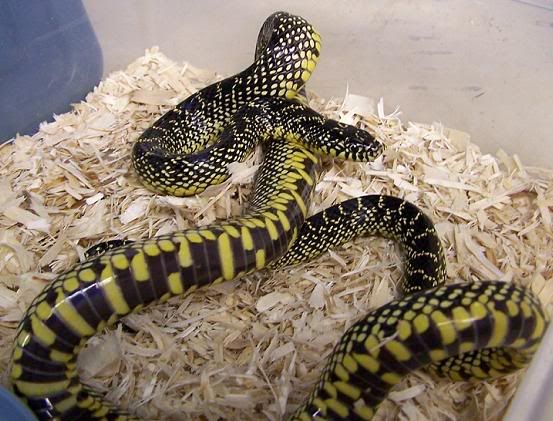
...here's a not too good pic of a really pretty king.
I have always called it an intergrade holbrooki X splendida.
What would be correct in your opinions?
It is a wc from TX but I do not have county data right in front of me.
I really like seeing what I assume are the two ssp. influence in it. If intergrade is not the best moniker then what should I call him?
Thanks for the input.
Reptile & Amphibian Forums
Welcome to kingsnake.com's message board system. Here you may share and discuss information with others about your favorite reptile and amphibian related topics such as care and feeding, caging requirements, permits and licenses, and more. Launched in 1997, the kingsnake.com message board system is one of the oldest and largest systems on the internet.



More on the intergrade kings....
crimsonking
Sep 19, 2005 09:08 PM
Replies (26)
snakesunlimited1
Sep 19, 2005 09:19 PM
I'd call him something tough like Spike. He is pretty though so the ugly kings will probably pick on him and call him pretty boy and stuff like that. 
later Jason
Joe Forks
Sep 19, 2005 09:38 PM
here's what we know.
1) it's not a goini 
2) It's got a checkered belly. But I don't know how much credence to give this. Bexar county is just west of the proposed intergrade zone, and the county where I live. I've probably found 100 kings that have bellies and dorsums just like that, and they are "supposed" to be "splendida".
3) Your snake does not have a speckle on most ever black scale
4) something intangible about the face does look holbrooki
5)given the above "intergrade" would probably suit it
5b) dorsal scale rows and county info "could" help decipher
Forky
crimsonking
Sep 19, 2005 11:05 PM
Not a goini????
Dang! was hoping to "unleash" to the public this new morph!!! lol!
Anyway, your observations sound right on Joe. I will get the counts and hopefully I can get in touch with the guy who found him to give me more precise locale info.
Thanks.
:Mark
jlassiter
Sep 19, 2005 09:58 PM
I would call it a Splendida with Holbrooki influence.
The circle back pattern is characteristic of Splendida as well as the somewhat checkered ventrals.
The speckles on the head screams Holbrooki influence to me. Splendida from the middle of its range have no yellow/white on the head. And....the massive speckling on the sides are Holbrooki-like.
Also....Depending on what locale it was collected in Texas would help.....It IS a big state you know.....LOL It looks as though it came from a South coastal region of Texas, but I am just speculating and using my own, single experiences.
But....It is still an intergrade in my book (whatever book that is) since it shows characteristic traits of both Holbrooki and Splendida...more Splendida though....
I wonder if that helped?.....LOL
John Lassiter
Here is a pair from South Texas (Nueces Co.) that are heavy on the melanism, but the offspring were not as dark....I wonder if it is some kind of ontogenetic change....Maybe not?


antelope
Sep 23, 2005 01:15 AM
Most "splendies" show that darkening with age in my obs. Looks like you could narrow it down effectively as per Joe's suggestions. The Aransas wildlife Refuge is part of the eastern border of splendida, but both specks and desert are found there. Maybe it is one snake in the area showing several colors/patterns? All I know is the closer I get to nailing 'em down, the further I get, LOL! Nice yellows and I would guess more holbrooki less splendida despite the circle patterns on the dorsum. Checkered bellies tend toward holbrooki. Check out Joe's black belly posted above. Never see a live adult any more, just neo's and yearlings. Splendidas are more secretive in my opinion, but that is all it is. They live in the dunes around here, but can also be found in undisturbed areas with a.c. The only live adult I found was unearthed under a railroad tie. @ dor's on the crawl, one in spring, one in fall. Just looks more splendy to me. One of the coastal areas above Calhoun co. would be my guess.
Todd Hughes
Todd Hughes


antelope
Sep 23, 2005 01:20 AM
Notice the slight cicle pattern on the dorsum and checkered belly? I call this an intergrade, more speck than desert, but the books say both individuals are found where i got her. Books also claim the circles to be difinitive of splendida, but look at all them specks, orange sidewalls, and checkered belly. Who knows? FRANK!
Todd Hughes


ratsnakehaven
Sep 23, 2005 10:45 AM
Todd, those are beautiful animals.
I believe you are in the intergrade zone and that those are intergrades, although it looks like the holbrooki influence is stronger on the first speciman. The intergrade zone is narrower along the Gulf Coast than it is in the northern plains. That means that there is probably a mixture of habitats. You said splendida occupied the dunes. I would guess you'd find them in more desert-like habitats and holbrooki in more wooded and mesic habitats. That whole area is a mixing bowl for all sorts of species because it's the meshing of a couple large ecosystems. More later...
Terry C
antelope
Sep 24, 2005 11:28 AM
Yeah, that's what i believe Terry. Also, I think those two kings have been together so long in these zone changes that they are really not one or the other. True intergrades if such a thing is possible. That Calhoun animal is as close as it gets to speck this far south, and time will tell what these 2.2 John and I have turn out to be. Trouble is, when you make field observations on this forum, you open yourself up for a lashing! LOL! My hide is tougher for participating on K.S., and I have learned a lot. All these are just observations, and just my opinions, but a somewhat educated one. I have loved snakes all my life, starting very early, but only seriously started observing them a few years ago. I can usually find something when I go out, but targeting a species or two is a bit more difficult. I admire the work you are doing on our local rats, and hope you find those Texas corns and S.P.rats zone. Interesting Island stuff, too. I want to do some research on Matagorda Island as well, as Mex. milks and others have been documented there.
Todd Hughes
chrish
Sep 19, 2005 11:08 PM
If intergrade is not the best moniker then what should I call him?
Intergrade is the correct term for a cross between two different subspecies and that snake is certainly an intergrade between the two subspecies. Holbrooki and splendida intergrade over a large area and many of the snakes that people call "splendida" in cnetral Texas are intergrades IMHO.
-----
Chris Harrison
San Antonio, TX
Joe Forks
Sep 20, 2005 09:36 AM
Chris,
You just made that way too easy LOL
For the sake of discussion, even though I agree with you in principle....
Is Intergradation really what is taking place here? Is this an example of two subspecies with expanding ranges that are coming together and providing gene flow? Or is this an example of a wide ranging species that exhibits geographic variation and is in the process of speciation?
The only reason I ask is because even though I (we) use the term intergrade, and generally accept it, it really has a very specific meaning, at least IMO, that can not accurately convey what is taking place with every population because of the multitude of different factors at play with various populations.
Or maybe I'm just making too much of the term "intergrade" and it "only" implies that the population exhibits traits from two generally recognized subspecies, and has no implications regarding mode of speciation? If so I'm still interested in your take on the getula population in Texas.
Forks
ratsnakehaven
Sep 20, 2005 10:44 AM
Joe, I think we need to define some terms. When I talked with you and Frank in a previous thread I think we may have misunderstood each others' meanings of the terms, such as intergrade, subspecies, speciation, etc.
You ask some good questions here which I'll let Chris answer, but I'm very curious too. The getula species is widespread in the US and Mex, for sure, and I think we'd all be disappointed if no subspecies were recognized. I think we need to look at each subspecies to see how closely related they are to each other and decide if we think speciation is really taking place. I mean with all our species, because it's different with each case...kingsnakes, milksnakes, corn snakes, etc.
Thanks for listening. Be back later....TC
Joe Forks
Sep 20, 2005 12:14 PM
>>Joe, I think we need to define some terms. When I talked with you and Frank in a previous thread I think we may have misunderstood each others' meanings of the terms, such as intergrade, subspecies, speciation, etc.
Terry,
We just may be able to continue this topic forever without getting anywhere
My Definitions
Speciation: This process can be thought of as being analogous to the process of genetic assimilation of individual phenotypes.
Species:Most usable definitions converge on two major principles
• species are real entities of nature, forming natural groups
• species are evolutionarily independent units; they form a boundary for the spread of alleles — different species have independent evolutionary trajectories.
subspeciesa geographical race, a population with distinctive traits occupying part of the range of the species.
These are very basic definitions on my part intentionally so as not to derail the thought process with tangents
Where I'm getting "my" definitions:
www.life.uiuc.edu/ib/201/lectures/SpeciesSpeciation.pdf
and this one
www.omniscellula.net/simposi/articles/speciation.pdf
and I particularly enjoyed this one:
www.goodrumj.com/Wilson.html
Joe Forks
Sep 20, 2005 12:29 PM
basically I have implied a meaning already in the post you replied to above.
To me, an intergrade is the product of a breeding from two forms that are at least slightly divergent from each other (i.e. subspecies).
However, IF splendida and holbrookii are just natural variants of getula and can not be separated by distinctive traits, then those "intermediate forms are not true "intergrades".
This premise is basically the reason for our whole discussion here and below. And again, even if it holds true in this case, it's not "black and white" and may not be applicable in other species groups.
Or on the same note. Was Burbrink really justified to sink all those subs of guttata, bring back New world "Elaphe" and recognize three species "emoryi", "slowinskii", and "guttata"?
It was very pertinent that you brought the guttata group into the discussion, a group that ranges from the Jalpan Valley in Queratero, NW to Utah and east to (New Jersey?).
Forks
Joe Forks
Sep 20, 2005 12:38 PM
for those that may wish to review it...
163.238.8.180/~fburbrink/Research/Publications/Elaphe%20guttata%20Burbrink.pdf
ratsnakehaven
Sep 20, 2005 01:11 PM
>>To me, an intergrade is the product of a breeding from two forms that are at least slightly divergent from each other (i.e. subspecies).
>>
Joe, no problem with your defintions, but the idea of intergrade is confounding me. I agree that if two subspecies mate with each other the product would be an intergrade. But normally two subs don't get that close to each other because there's an intergrade zone bt. them, an area where a mixture of their genes creates a somewhat intermediate form.
Because I believe there's gene flow from both subs into the intermediate form and mixing of genes, I believe this to be an intergrade.
If you take two subs in captivity and cross them, then I would call this a "cross", not an intergrade because they wouldn't mix the same way in the wild. I know this idea causes concern and confusion for breeders. And then there's the people who breed and don't even know what it is that they're breeding. Yippee!!!
>>However, IF splendida and holbrookii are just natural variants of getula and can not be separated by distinctive traits, then those "intermediate forms are not true "intergrades".
>>
>>This premise is basically the reason for our whole discussion here and below. And again, even if it holds true in this case, it's not "black and white" and may not be applicable in other species groups.
>>
>>Or on the same note. Was Burbrink really justified to sink all those subs of guttata, bring back New world "Elaphe" and recognize three species "emoryi", "slowinskii", and "guttata"?
>>It was very pertinent that you brought the guttata group into the discussion, a group that ranges from the Jalpan Valley in Queratero, NW to Utah and east to (New Jersey?).
>>
>>Forks
I'll answer the rest later when I get some time.
Terry
ratsnakehaven
Sep 20, 2005 02:05 PM
>>basically I have implied a meaning already in the post you replied to above.
>>
>>To me, an intergrade is the product of a breeding from two forms that are at least slightly divergent from each other (i.e. subspecies).
>>
>>However, IF splendida and holbrookii are just natural variants of getula and can not be separated by distinctive traits, then those "intermediate forms are not true "intergrades".
>>
How true. That's why we need to look at each case, and determine how strong the subspecies is. For example: splendida meets nigrita, supposedly, along the border of Mexico and Arizona. But is nigrita really a good subspecies? I personally think it's just a melanistic splendida, not a strong subspecies. But others think a snake in AZ that is black is nigrita. I have to argue that it's an intergrade, otherwise we could be having to protect all the kings in s. AZ as nigrita someday.
>>This premise is basically the reason for our whole discussion here and below. And again, even if it holds true in this case, it's not "black and white" and may not be applicable in other species groups.
>>
>>Or on the same note. Was Burbrink really justified to sink all those subs of guttata, bring back New world "Elaphe" and recognize three species "emoryi", "slowinskii", and "guttata"?
>>It was very pertinent that you brought the guttata group into the discussion, a group that ranges from the Jalpan Valley in Queratero, NW to Utah and east to (New Jersey?).
>>
>>Forks
Bringing up Burbrink, now that's a can of worms, ahaha. Don't agree, don't agree! I think he has real problems, especially trying to justify "slowinskii" as a full species. I think most of us look at it as a subspecies of corn snake. I do believe slowinskii intergrades with meahllmorum along the Gulf Coast, however, allowing some genes to pass back and forth from G P rats to corns, etc.
Boy, what fun! Keep it up
Terry
-----
Ratsnake Haven...researching ratsnakes since 1988
Ratsnake Haven Group...an information providing list site.
Joe Forks
Sep 20, 2005 02:35 PM
>>Bringing up Burbrink, now that's a can of worms, ahaha. Don't agree, don't agree! I think he has real problems, especially trying to justify "slowinskii" as a full species. I think most of us look at it as a subspecies of corn snake. I do believe slowinskii intergrades with meahllmorum along the Gulf Coast, however, allowing some genes to pass back and forth from G P rats to corns, etc.
I need more time to digest that paper, not that I will ever understand that mtDNA work! However, I do see one huge glaring omission. Not a single sampled specimen from Mexico! How could he expect that work speak for the specimens he has included in Mexico when he didn't include them in the samples??
Forky
ratsnakehaven
Sep 20, 2005 03:17 PM
>>I need more time to digest that paper, not that I will ever understand that mtDNA work! However, I do see one huge glaring omission. Not a single sampled specimen from Mexico! How could he expect that work speak for the specimens he has included in Mexico when he didn't include them in the samples??
>>
>>Forky
Good point about Mexican specimens. I'm not sure any literature I've read included Mex. specimens. If you include Mexico in the range of the Great Plains rat, the range is huge, certainly enough space for two subs, northern and southern form, even though the intergrade zone is very wide. I gotta believe there's two ssps there.
Of course, the layman can't ever do genetic testing himself, so we rely on the pros. But how strong is their evidence? Heck, they can't even agree amongst themselves, one of the reasons scientific names are changing all the time. And I don't care how much lab testing they've done, if two subspecies are intergrading, then they're part of the same species.
In cases where the population is isolated from other populations, then we have to guess how strong the relationship is with the parent species. If real strong then maybe the isolated pop. isn't even a subspecies, like with the western "intermontana" rats. If it's a distant relationship then maybe the isolated pop. is a distinct species, like the Western and Eastern fox snakes. I can't believe that "intermontana" gets no designation and "gloydi" gets species status. Some workers just don't want any subspecies at all.
TC
chrish
Sep 20, 2005 10:15 PM
shows me another real sampling problem...
He has a total of 1 (!) snake from east Texas and that is from Angelina county. And the closest emoryi he sampled were from Medina and McMullen counties. And of his small sample (3 snakes) of SoTex emoryi, one of them falls out with the guttata group.
Clearly a larger sample from central/eastern Texas would add a little more credibility to the specific distinction of slowinskii and emoryi. (I'm not saying I don't believe it exists, just that this paper doesn't seem to present compelling evidence based on my 2 minute perusal. To be fair I probably should actually READ the paper!).
I am also unconvinced as to the size of that disjunction in the range in east central Texas.
And what happens down on the central TX coast near Matagorda/Port Aransas? There is an obvious contact zone. Do they hybridize there? Hmmm,....no data.
He could have ground up this big monster "slowinskii" from Grimes county, I wouldn't have missed this psychotic terror for a second,

although he did make a decent sperm donor -

-----
Chris Harrison
San Antonio, TX
ratsnakehaven
Sep 21, 2005 06:52 AM
Nice pix, Chris, and good two min. analysis of the paper
I hope that new paper comes out soon, that's going to look at the slowinskii and those Gulf Coast forms that might be intergrades (or hybrids). Also hope someone looks at the Mexican forms.
Later...TC
Joe Forks
Sep 20, 2005 01:15 PM
decided that I really messed that up, so let me rephrase the questions.
1) Do you believe splendida and holbrooki are valid subs?
and the reason I ask.....
The characters that decipher holbrooki from splendida are
a) Black belly in splendida and checkered belly in holbrooki -
this character does not hold up. my Brewster county splendida has a checkered belly.
b) Dorsal scale rows - does not hold up because there is overlap, and other species have proven clinal variation in ventrals and or dorsal scale rows (mexicana, alterna, triangulum)
c) spots on every scale in holbrooki - a variable pattern even on a consistent basis alone is not enough to warrant sub specific status.
I honestly don't know what to believe in regards to splendida and holbrooki being being valid subspecies?? Has mtDNA work been done on the group? As in the Burbrink example it could lead to "lumping" rather than "splitting".
Forky
Dobry
Sep 20, 2005 03:50 PM
I think I may have to submit a phD application to UT to resolve this debate. I'm doing my pop genetics on Crotalus oreganus right now but you southerners are all hopped up on this holbrooki splendida thing sounds like I could get more funding down there. LOL
Jason
Joe Forks
Sep 20, 2005 04:36 PM
you took the easy way out, should have gone for the lutosus, concolor, nuntius group! haha
Forky
Dobry
Sep 20, 2005 08:41 PM
I live in Eastern Washington so I gotta deal with the local brand. Practicality issues.
Jason

chrish
Sep 20, 2005 10:00 PM
Is Intergradation really what is taking place here? Is this an example of two subspecies with expanding ranges that are coming together and providing gene flow?
You have to remember that our taxonomy is a snapshot in time based on what we see today and what we can infer about the past relationships from the patterns of variation we see today. You can't predict the future nor base your taxonomy on such prognostications.
So what we see today is two "recognizable" morphs of common kingsnake. One appears to be centered along the gulf coast (not necessarily of TX) and another that appears to be a Chihuahuan desert animal.
What led to their isolation? I don't know. But it appears that in relative isolation they have diverged into two pattern morphs and that this isolation has been lost and now they are interbreeding and there is gene flow between the two formerly isolated populations.
So yes, I think this is an example of two subspecies coming together and losing their identities in the zone where there is gene flow.
Of course, absolute isolation isn't altogether necessary for these types of things, just restricted gene flow for a period of time.
Or is this an example of a wide ranging species that exhibits geographic variation and is in the process of speciation?
I don't know that I can envision how these patterns would evolve in the presence of the current amount of gene flow that would appear to exist between the taxa.
Sure I could envision genetic drift in the somewhat sparse, low density Chihuahuan desert kingsnakes where there is reduced gene flow from the east and west, but I don't know that there is any more data to support that model than the "standard" isolation model. And I'm not sure it is saying anything different anyway.
The only reason I ask is because even though I (we) use the term intergrade, and generally accept it, it really has a very specific meaning, at least IMO, that can not accurately convey what is taking place with every population because of the multitude of different factors at play with various populations.
Agreed. But when I use the term, I am simply inferring that there is gene flow between two recognizable morphs of the population that I believe warrant taxonomic recognition. But of course, there are no "pure" specimens of ANY subspecies. That gives some people trouble. I sleep at night anyway !
If you can put up a good argument that the two populations are diverging rather than coming back together doesn't really matter to me. At this moment in time, there is gene flow between two recognizeable populations and that is intergradation for me.
Or maybe I'm just making too much of the term "intergrade" and it "only" implies that the population exhibits traits from two generally recognized subspecies, and has no implications regarding mode of speciation?
You can't look into your evolutionary crystal ball (unless you have one - if you do, I'd like to borrow it!) to try and foresee where they are going to decide if the term fits or not. Your taxonomy and its associated terminology only apply to this moment in time.
And you have to have a terminology that isn't teleological. I see lots of discussions of these patterns where divergence and subsequent speciation is proposed as some sort of goal. There is no goal, no endpoint.
As for Texas, I think any splendida east of the Pecos is an intergrade. Why? Because I like those El Paso/Hudspeth county animals and anything that doens't look like them must be made to feel inferior - LOL.
And BTW - having found a lot of splendida in EP and Hudspeth counties, many of them do not have solid black bellies. In fact, the best "sock-headed, perfect pattern" splendida generally don't.
I've hatched clutches from the Hueco Mts and from the Ft. Hancock area that included black bellied and checkered bellied babies.
On a different note - in south Texas you have to factor in the effect of the other big Lampropeltis as well. Blaney (1977) points out that where you find getula, the milksnakes are small. Where you get big milksnakes, there aren't any getula. Maybe that competition is influencing their distribution (although not their appearance)in SoTex as much as anything else?
-----
Chris Harrison
San Antonio, TX
antelope
Sep 23, 2005 01:50 AM
Chris, I agree with most of what you layed down, but the last part I ain't bitin' on! These mex milks are as big as they come down around Orange Grove-Freer-Clegg, and we got splendidas and uncommonly calligaster. Not the biggest of the kings but certainly not smaller than annulata. Just my obs. Shes 38'' long from Clegg.
Todd Hughes

