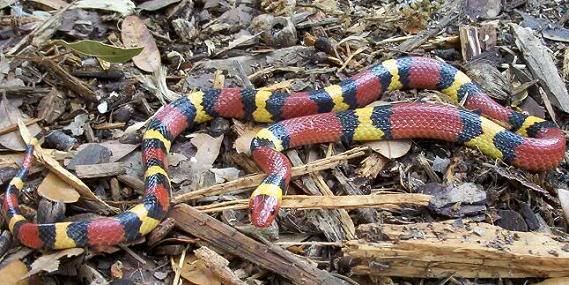
Hello, I ,ve watch a lot of photographs and after watching these photos I don´t know how to difference a coral snake and a kingsnake. There are yellow bands that don´t touch red bands in micrurus surinamensis and this snake is a coral snake, i don´t understand.
Reptile & Amphibian Forums
Welcome to kingsnake.com's message board system. Here you may share and discuss information with others about your favorite reptile and amphibian related topics such as care and feeding, caging requirements, permits and licenses, and more. Launched in 1997, the kingsnake.com message board system is one of the oldest and largest systems on the internet.


how to difference a coral snake and a milksnake and kingsnake
comar
Oct 23, 2005 12:09 PM
Replies (11)
antelope
Oct 23, 2005 12:55 PM
The red touch yellow saying only works in The United States, maybe Mexico, and it reverses itself in southern latitudes, kind of like water flowing counterclockwise down a drain in the northern hemisphere and clockwise in the southern hemisphere. I have seen pictures of south american coral snakes with no yellow at all. So red touch yellow is for the United states corals.
Todd Hughes

TobyEKing
Oct 23, 2005 01:22 PM
Red on black friend of jack
Red on yellow kill a fellow
And as Todd stated it only applies to the good ole U.S.
Maybe others have some too........
Toby
-----
http://home.bellsouth.net/p/s/community.dll?ep=16&groupid=173260&ck=
crimsonking
Oct 23, 2005 02:59 PM
Learn the snakes (WITHOUT any "sayings" in the area you are concerned with BEFORE you go into the field. If it is just a casual interest then you need to read up on as much as possible anyway.
First rule: there are NO hard/fast 100% rules!
There are eastern corals with red so dark they may appear bi-colored in the keys of FL.
Identifying the snakes should be fairly easy using head shape, body shape, etc.(without using any color at all)when you are only trying to determine if the snake is a coral, a milk, or a scarlet king...if you've read up and studied them a bit.
Good luck.
:Mark

-----
Surrender Dorothy!
www.crimsonking.funtigo.com
FR
Oct 23, 2005 10:40 PM
?

antelope
Oct 24, 2005 12:32 AM
I really like those as they are very clean looking.
Todd Hughes
crimsonking
Oct 24, 2005 08:30 AM
Nice, Frank. I'd love to see a wild one someday...
:Mark
-----
Surrender Dorothy!
www.crimsonking.funtigo.com
chrish
Oct 23, 2005 09:27 PM
I once heard Whit Gibbons sum this up better than anyone else. He said if you were using the red against yellow to tell these snakes apart, you had no business going near them.
This rule does generally work in the southeastern US. However, in the western US there are snakes that have the red bands touching the yellow that are not venomous. In the US, there is no venomous snake with the red bands touching the black.
And, as you have correctly pointed out, many of the coralsnakes that occur in central and south America don't follow this rule. There are coralsnakes with no red, coralsnakes with no yellow, coralsnakes with double bands, coralsnakes with no bands, etc. Then there are harmless snakes that have perfect "coralsnake" patterns and every other pattern a coralsnake can show as well.
The point is, this is not a reliable way to tell coralsnakes from non venomous snakes. There are much more reliable ways. Head shape is a good place to start for milksnakes vs coralsnakes.
However, some of the central American snakes in the genus Pliocercus are shaped and colored exactly like coralsnakes!
-----
Chris Harrison
Central Texas
Rick Staub
Oct 24, 2005 01:49 AM
>>I once heard Whit Gibbons sum this up better than anyone else. He said if you were using the red against yellow to tell these snakes apart, you had no business going near them.
>>
Great line. And yes that banner was annoying! 
-----
Rick Staub
R&R Reptiles
comar
Oct 24, 2005 04:28 AM
Hello again, thanks everybody, then, if color doesn´t work in this case, how can i difference these two kinds of snakes, kingsnake and coral snake using shape head or other characteristics?, thanks.
crimsonking
Oct 24, 2005 08:36 AM
here's the eastern coral up close w/ a drop of the bad stuff on his chin.. (He bit the stick)
:Mark

-----
Surrender Dorothy!
www.crimsonking.funtigo.com
FR
Oct 24, 2005 10:21 AM
Your task is to learn the differences by looking at the snakes. And now you have some pics of THE SNAKES, to compare to eachother. Sir, there is no better way to learn, other then looking are the real snakes in nature(in nature, somehow, its different then in a cage)(adrenalin and such)
Consider, all you can do is look at typical individuals, as that is what your most likely to see. For instance, occasional individuals of western corals lose the red and are black and yellow.
What everyone is trying to tell you is, learn their physical differences by seeing the different types of snakes. If you cannot tell the difference by sight, do not go around picking up tri-or-bi-colored snakes until you can. If you have to be told what to look for, when the pics of the snakes are right in front of you, then thats a strong sign, you should be very careful around these types of snakes. Good luck FR
