For those who saw the other mpg file of the two boys getting it on, now I give you a short video clip of a pair of virus infected adders hamming it up.
The boy is 2 year old, the girl, adult size is a year old.
Go to:
http://www.smuggled.com/AAA101a.mpg
to see the video clip
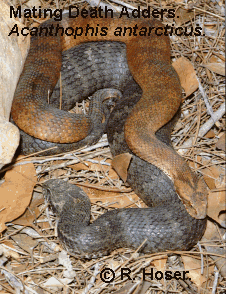
Mating Acanthophis
Reptile & Amphibian Forums
Welcome to kingsnake.com's message board system. Here you may share and discuss information with others about your favorite reptile and amphibian related topics such as care and feeding, caging requirements, permits and licenses, and more. Launched in 1997, the kingsnake.com message board system is one of the oldest and largest systems on the internet.


Death Adders having hankie panky
rayhoser
Jul 22, 2003 03:40 AM
Replies (7)
creep77
Jul 22, 2003 09:49 PM
.
rayhoser
Jul 23, 2003 07:33 AM
Tests via EM are ongoing and we had a tentative diagnosis of the former and now seeking confirmation via more slides.
Go to:
http://www.smuggled.com/OPMV6.htm
for the state of play as of 23 July 2003
Virus disease in Death Adders and other elapids
cressm3
Jul 23, 2003 10:37 AM
Having had a round of Paramyxovirus decimate the bulk of my viperids, and crotalids, I know what the nature of the desease is, have researched it. If it was in a captive collection like a zoo, reptile park, this would have virtually wiped out the existing collection, as to my knowledge, there is no meaningful treatment for this horrendous disease, coupled with nearly a 100% fatality rate, and being airborne pathegen, this is as close as possible to the death knell to a collection. If ai am mis representing this god awful disease please correct me. how does this relate to this thread---with the infectivity capability and fatality rate of this dreadful disease, I would expect to hear about the entire collection of the park ( see Para doesn't infect only viperids and elaphids--it attacks most all reptilian life, just snakes are particularly adversely effected ) to have been almost entirely wiped out, something I haven't read as of yet--or did I miss that. IBVD and Stargazer to my knowlegde are not infectious or atleast not hardly to the extent of Para. Something to consider when reading claims.
Barry
rayhoser
Jul 23, 2003 06:55 PM
Yes you (previous correspondent) are near the mark.
The details of my own infection and those related to it (others in the line of infection) are at:
http://www.smuggled.com/OPMV6.htm
The report is very detailed will take you at least 2 hours to read is 20,000 words (= 1/3 of a book) and summarises what's known.
Please send me via e-mail to:
adder@smuggled.com
as much information you have on hand in relation to your own infection, including if possible why you think it was airborne transmission in your case.
My interest is that in collections here this has not been the case, in spite of what the literature said to date.
All the best
Virus infections in Australian snakes - including mass deaths
cressm3
Jul 23, 2003 11:12 PM
http://www.vetmed.ufl.edu/sacs/wildlife/Pmyx.html
This is the website that will tell you all you ever needed to know about a horrid infectious virus.
creep77
Jul 23, 2003 11:06 PM
stargazer? Does anyone have a scientific name or a resource? I've posted similar questions in the past and gotten no viable responses.. any shred of info youcould pass along would be greatly appreciated.
Thanx,
creep
rayhoser
Jul 24, 2003 07:25 AM
To the earlier people, in answer to your questions.
1/ The site:
http://www.vetmed.ufl.edu/sacs/wildlife/Pmyx.html
and it's author Elliott Jacobson
was referred to by me in my paper on OPMV published by the Macarthur Herp Soc and others recently.
He appears to be "the expert" on this sort of stuff.
I'm up to speed with most what's known about OPMV and the like in terms of the literature, etc.
Clinically, the various viruses present differently in different snakes (even if infected with same virus) and hence known symptoms tend to be along certain common lines as in neurological, respiratory and the like.
There are however general trends in same species of snake of same age and size classes. Stargazing is a neurological/encephalitic response to IBD, paramyxo and other viruses of sorts. It is usually an early sign of infection and decline and snakes that stargaze never have a good prognosis.
Stargazing also includes simple resting in unnatural positions, failure to properly thermoregulate, etc.
Refer to the draft paper at:
http://www.smuggled.com/OPMV6.htm
for what you are likely to see in situ in collections.
As for treatment??? - er, well, we really have little to go on at this stage, but the previously referred to paper
(http://www.smuggled.com/OPMV6.htm) gives some pointers.
ALL THE BEST
snake viruses
