Reptile & Amphibian Forums

Welcome to kingsnake.com's message board system. Here you may share and discuss information with others about your favorite reptile and amphibian related topics such as care and feeding, caging requirements, permits and licenses, and more. Launched in 1997, the kingsnake.com message board system is one of the oldest and largest systems on the internet.

Click here to visit Classifieds
Click for ZooMed
Click for 65% off Shipping with Reptiles 2 You

Yesterday was the coldest day so far. a few hours in the bush

FR Nov 13, 2005 09:14 PM

Yesterdays high in Tucson was 71(airport) The low last night was low 40's.

At the site its a bit higher so the the lows were in the high 30's which is still to hot, heres why.

I got a late start, got there at 10am of course there are a huge range of temps, its the dang desert for goodness sake.

As you can see here, in the cracks temps are nice for snakes.

Now heres a temp six inches to the right.

As you can see, 30F degrees in six inches. Remember, these temps were taken a few hours after near freezing low temps.

About an half hour later, heres a temp at the entrance of a gila burrow. You can see the gila tail tracks.

Now heres the gila at the same entrance, again notice the tail tracks. As you can assume, some assumptions are better or more educated then others. There is no reason for a gila or snake to be sitting at 116F.

Today I am not really interested in seeing snakes, I am more interested in taking temps and seeing general activity. On the way in there were 7 fresh snake tracks, 4 adults and 3 juvis or small snakes. And of course still a fair amount of lizard movement.

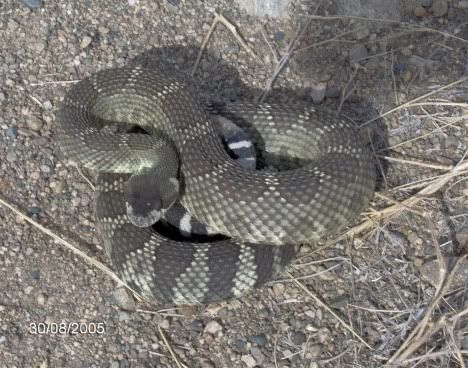
I did visit where some diamondbacks winter then breed. I visited three places, all three had a female viewable. But they were "down". The pics are a bit deceptive as I have to use trickery to take the photos of them when they are back in.

Here is the first female,
I have watched this female and her group for many years now, you will see more of her in the spring(if your interested) Some of the adults are in their winter refuges. She will stay here all winter. But, and heres the key, she will move all about this refuge.

Heres female #2

This female is in the refuge that does not face or is close to any sun exposure any time of year. But as you will see, there is no need to be anywhere else.

The reason I ask you fellas, what are they doing is simple, its because I did not understand what our snakes were doing until I actually quit guessing and started watching. They do not sit in the exact same place all winter, they move here and there, sometimes next to a male sometimes not. To be clear, they do not leave this area until after the females breed in middle spring. But they do move all about, underground. So far, I have not seen any of these breeders come out on the surface in the winter(yet) And yes, this place gets covered in snow and is exposed to very cold temps, from the low teens or less. But inbetween those cold spells, there are normal days of sunny and 60 to 70F. The funny part is, they will stay close to these windows even in cold weather.

Now consider, these females are skinny now, but do contain ovum. Heres the funny part, once they emerge in early spring, they will be full of enlarged ovum and ready to breed. How on earth does that happen when they are torpid and inactive?????????

You may want to entertain the thought, they are doing something even when cold. This something may be very important to reproduction.

An apples to apples comparison is there to make. Rattlesnakes in dens in the northern areas will be doing the same and the females will contain enlarged ovum in the spring, just like these.

Please understand, I do not know what your northern snakes are doing, but I have seen these and they compare well you yours in overall function. That is, the time they gather, the time they spend together and they time they emerge and breed. So I ask, what are yours doing?

For Forky, my quad and truck

I bought the truck new in 79, I am sure Forky will recognize it from Bakers crossing area. And the quad new in 85, both are in excellent condition and still finding snakes. That truck has even found lots of mexicana all over mexico. Cheers FR

Replies (31)

Phil Peak Nov 13, 2005 10:04 PM

Great series of pics Frank. I really like that sort of thing. I also like being in the field on those days when the night time lows are at the freezing mark followed by a mild sunny day. Its amazing how even on a day in which the temps are only in the 60's cover objects can become too hot to harbor snakes in the middle of the day. I like a high in the low 50's coming off of a freeze. On days like that we sometimes see 60 or more snakes throughout the day. There was a few days like that this past April. On one of those days we turned up a dozen kingsnakes, rattlesnakes and a bunch of other neat stuff.

You mentioned the rattlesnakes there breed in mid spring. Here they (horridus) breed in late August into September. Do your atrox breed every year? Ours breed usually every other year. A different set of snakes at the rooks each year. Thanks, Phil
Snake Hunting in Kentucky

FR Nov 13, 2005 11:22 PM

Ours breed in the spring, the summer and the fall, I do wonder which fertilizes the ovum. My bet is spring in most cases. Hmmmm, I did already mention that rattlesnakes seem a bit Randy(breed at every oppertunity). Also, our rattlesnakes are about the same, most breed every other year. But some do several years in a row, but rarely more then two. This can be based on not the snakes overall, but the age and health of a particular colony.

For instance, I wonder how the snakes we study(harass) breed at all, much less every other year.(sorry for the editorializing)

To help the above statement, young females tend to produce few offspring but make up for it by producing on a more regular basis. Old adults(common in dens) do seem to produce every other year.

To change this up a bit, we in the desert can have many years of drought and this seems to effect the larger females more then the smaller females. The larger females may not produce for many years. To editorialize again. I would imagine(assume, hypothesomething) that there is a basic reproductive approach which includes small females and large females. Using the advantages of each, such as, small females consume/require far less energy to reproduce then large ones. As you can imagine, small females can continue to contribute in bad/poor years, and large females(consume/need larger amounts of energy) on normal and good years.

This model fits many many many types of reptiles including monitors, tortosie, lizards, etc.

There is a basic trend that females become reproductively active at about 1/2 the large old adult female lenght. For an example. A female corn snake can reach over five feet total lenght, but females become reproductively active around 30 inches total lenght. Also varanids do this, Spinytailed monitors normally reach lenghts of 24 to 30 inches TL, yet normally start reproducing at 13 to 14 inches TL. Again those are just a few examples of many.

Lastly, small females do not have the mass to endure long periods of adverse conditions, large females do. They have the reserves to outlast small females. I feel this stradgy is very important and commonplace. It insures recruits in many types of conditions. Cheers FR

Phil Peak Nov 14, 2005 12:30 PM

Good observations on reproductive strategy Frank. I have thought it interesting to note that gravid females are frequently found in the field that would be considered to be too small to reproduce by common herpetoculturalist standards. I guess in nature where species survival is the paramount issue things work themselves out. Phil

snakesunlimited1 Nov 14, 2005 05:52 PM

It really just shows how bad we suck at keeping snakes. LOL I have found WC corns gravid at 24-26 inches to be common and depending on what stage of the cycle they are in when found the eggs are either good or not. If you get them in their pre-lay crawl and they lay within a week of capture they eggs are almost always good. BUT BUT BUT if you get them earlier and it takes them three weeks or better to lay the eggs are usually bad. This is small snakes not all snakes. Large snakes laid almost all good eggs.

I used to think that the problem was they where to small or they never got fertilized or something else went wrong with the snake but now I blame myself. I mean how can a smaller snake that I had for 3-9 days lay good eggs repeatedly but a larger snake that I had for almost a month lay bad more times than not. I believe that for the smaller females the temps are paramount to their success and how they use their bodies resources. This is a situation that I saw a lot when I was collecting more than breeding.

In nature the smaller snakes had all the options and food choices they needed to succeed. In captivity they got a mouse a week and temps that suited me and my ideas. In retrospect I think I had them to warm. Anyway just a thought.

Later Jason

HKM Nov 13, 2005 10:06 PM

To add to Frank's observations for yesterday...

About 10 miles north of where he was, at about 9:30 a.m. Upper 60's air temp after the cool night he talked about. Found a few sidewinder tracks, young of the year, and 6 other trails of colubrids and adult Crotalus. The night before at dusk, none of these tracks were there. My wife joked that we had missed their morning movements...

Mark Banczak Nov 14, 2005 06:48 AM

Frank, you have more guts than I. After seeing the outlandish number of hunters, I decided to forgo the hiking and just burn a few hours of gas. I didn't see any live snakes but did find 2 DOR Patchnose and a large DOR Lyre snake from morning movement. Next weekend I'll sget out the blaze orange and get back in the hills.

FR Nov 14, 2005 12:05 PM

When we were there last, HKM, scared these deer, and then we heard all this yelling down in the canyon. Later are the corral, we were loading up the quad and this fella drove up and told us about some fella in a white truck scared his deer, he had the dang thing in his sights. I was wondering, here we are loading the quad in a white truck. Some of those hunters are not all that smart.

Yesterday, while at a different site, I came across a group of hunters(4) that were near the top of the hill, they were scanning the valley. I popped in on them and said, Hi Humans, and they jumped out of their shorts and said, where did you come from. hahahahahahahahaha hmmmmmmmmmm I should have said, from over there by those big bucks, hahahahahahahahaha.

It actually is a bit scary, but nothing like back east. Here you can see long distances. Back east, they hunt from deer stands and its all thick foliage. I stay away from that.

Hey thats a dang good reason easterners do not hunt snakes at this time of year. hahahahahahaha FR

Phil Peak Nov 14, 2005 12:43 PM

< Hey thats a dang good reason easterners do not hunt snakes at this time of year. hahahahahahaha FR >

I hear you. Those deer hunters are freaking crazy. Gun season started Saturday here and as always I'm a little nervous stepping out in the woods at this time of year. I did get out for a few hours both yesterday and today and checked some AC and natural cover. As expected no snakes. Just a variety of Ranids and Eurycea. Most years we still see a few snakes up until late Nov but with the dry late summer and early fall it may be over for us for a while. Good thing for us we enjoy seeing salamanders until the snakes come back out so its not all bad. Phil

ratsnakehaven Nov 15, 2005 07:37 AM

Today is the opening day of rifle season in n. MI. That's why I'm sitting here at my computer. We get opening day off from school. Most of the guys go hunting, but I'd rather stay home and take care of chores here. If I wanted to shoot a deer I could easily do that as we have dozens that live on our 20 acre hobby farm. But it's dangerous going out there at any time today. People hunt on their own land and stray bullets are not uncommon. Every year we have several people get shot and/or killed by hunters. We've had a couple even get shot in their homes by bullets coming through the walls. There's no guarantees of safety.

The last few days we've gotten heavy rain and lots of wind. Gusts have gotten up to 60mph. Sunday my computer was down all day because of power outages (you didn't have to put up with me for awhile, haha). The rain was good because we've had a very dry fall. Three of our ponds (cattle tanks) were drying up and needed recharging for the herps living in them. I've heard a few spring peepers and seen a few green frogs, but that's about it for November, so far. Everything has been down under for at least a month.

Although this fall has been pretty warm as far as humans are concerned the herps don't exactly like temps in the 40's and 50's, at least not for surface activity. Last Sat. it even got up to 60*F, not a single snake was seen, not even an Eastern garter, the most likely to take advantage of a warm day in fall. I've seen garters in every month of the year in MI.

I think we need to consider the low temps, as well as the high temps, when looking at fall/winter activity, and also the ground temps. Once we start getting frost where I live, the snakes (in general) tend to stay down underground and not be surface active. I think they fear being caught on the surface and freezing, so they give up surface activity, except for a few natricines. Also, the ground gradually cools to where the best temps a snake can get are around 55*, or so. Right now the ground surface temps are in the high 40's in most places at our place (Afton Farm). I don't think there's any reason to be surface active under conditions like these, even when the day temp suddenly rises to 60*, or more.

The questions I have right now on this topic are, "Can snakes find temps anywhere underground in n. MI that are above 55*F, at this time of year?" and "Does the 55*F temp range exist throughout the winter in any locations accessible to any of our snakes, here?" This is quite difficult to actually measure, but I will try to get some temps this year.

TC

FR Nov 15, 2005 08:54 AM

The reason you cannot absorb this is your a teacher and you seem regimed into a corner(paradigned) You have to be. You see, in order to be a teacher, you have to accept what your teaching is right. There is nothing wrong with that. But that paradign eliminates you from being a researcher/investigator. To be an investigator, you must question all things and need to see proof, no matter who wrote or said it. Nothing against the "who's" its just part of being an investigator, sir, your guilty.

Now of course I am inflicting a paradign on you, as I indicate all teachers are like you, but I will admit, its only a generalization, and there are other pramatic teachers that will teach evolution, that is, that all things change, even really good reports on snakes. Its not so much the data changes, but instead, our ability to understand that data. You do understand, the ability to understand is also based on the readers experience, yes?

Now, what scared me was, you just mentioned you have seen garder snakes every month of the year. Yet earlier you stated that, "Snakes" in WI. hibernate. Wow, that is conflicting, as garder snakes are included in the word "snakes". You must have forgotten that.

But Please do not take those gardersnakes you see all months of the year as, THAT strong of proof, or that something is amiss. BUT indeed they are only evidence that you fail to understand snakes. As garder snakes are snakes and have the same basic limitations as other snakes(or they wouldn't be snakes). So possibly a better approach would be to find out what the rest of the garder snakes are doing during winter, then with the understanding that they are snakes, but only very slightly different then other snakes, think about the other snakes are doing the same only very slightly different. You see, seeing what any type of snake in an area does, is evidence that leads to the understanding of what, other types of snakes are doing, in the same area. Also consider, it is known that in many cases, garders, hole up with other species.

Now to the expression of your paradigns. You keep making your own rules about what constitutes hibernation. First both you and Phil, make up the rule that it means not feeding and shedding. Unfortunately, snakes only shed a few times a year, so most of the year they are not shedding, so are they hibernating in those other non shedding times of the year? They also do not feed at other times of the year, same question there. Also, normally a shed in included before snakes leave a denning or a congregation/gathering area. Sheds are often evidence of such a place. So, if they shed before they leave a hiberniculum, then they shed while hibernating. Wait, I am hiperventilating. Now you say, they need to be 55F to be something. You are now looking for a 55F place. Is this a new rule?(who made it?) Or something to restrict you even more.(another false paradign)=(a restricting confined train of thought)

So let me get this strait, you now say, they do not feed, or shed, and have to be 55F. Is that correct? ok, ok, ok, where do you get this stuff? Sir, the point is, find the dang snakes then take temps. Find the dang snakes and look for feces or food bolus, or signs of feeding. Find the dang snakes and look for fresh sheds or shedding. Not predict the results first, that sir is not investigating or research, that sir is simple confirmation. Sir, report what you see, not predict what you do not see. Do you get that? thats why its required that you actually see what they are doing.

Now please let me mention more on why I do not call what they do hibernating.
(A) they are at a temp, where they can physically function(crawl)
(B) they move about, of course in a rather small area.
(C) There movements are prejudiced(intentional)
(D) They are engaged in physical processes(formation of ova and viable sperm.
(E) When they emerge(leave this area), they emerge at temps consistant with what you call hibernation temps.

So I say again, without you actually watching what your snakes are doing in winter, you are actually ignorant of what they do. Snakes is plural. As in, not what one does. That you keep making up rules and situations of what they are doing, is not helping your cause.

You see Terry, you said you want to study Greenrats, yet to me, that only means you want to catch them. Because up to now, you have not showed me anything that suggests you know or understand what, study means. In your case, you have a perfect sitiuation to study, you have snakes, you have land, and you have the unknown, to study or research/investigate, would be to solve that mystery. To see what there doing.

Now as you have seen, I post events/obervations, but you do not seem to understand that each day I do so, is only representative of that day. As the days go by, the events change. The data of all these days form patterns, its these patterns thats important, not the events of one day. You need to learn patience too. You see, these obervations and events will indeed change thru out the winter, its how they change thats important. FR

ratsnakehaven Nov 15, 2005 10:53 AM

Thanks, Frank, good points.

I am a teacher, but I don't believe everything. I do question and investigate. I don't believe everything you say, but trust your observations are accurate. I do try to rationalize the "why's" of things until I can investigate myself. I am an evolutionist and know a lot about the subject, and I try to teach that to evolve is to change. I try to be a good investigator, but sometimes data is impossible to get.

I figured you'd react to the garter snake thing. I've only seen a garter in Dec once, and I told you of the event I witnessed in Jan one yr. A fast moving warm front brought the temps up to 55-60*F for two days in mid-Jan. Not only did I see a couple live E. garters crawling across the snow and barren terrain, but I also saw a fair number of dead garters (young and subadults) flushed out of rodent burrows in the terrain. The warm temps had melted some of the ice and snow.

Garters are our most hardy and opportunistic snakes in Michigan (MI, not WI). The literature says they can be continuously active if the proper conditions exist. Not all snakes are like that, right? I believe they are resting below the surface, but move into surface activity when the temperatures change to the better. I think other species are much less likely to become surface active until the proper time and are less hardy, based on observations I've made through the years. I'm not going to use the term hibernate because I don't know what the garters are doing in the subterranean realm. I'm trying to find out what the conditions are like down there. Being a teacher has nothing to do with my ability to investigate something if I want to.

I'm not saying I know the snakes don't eat or shed while they're in their winter retreats, I'm suggesting that in n. MI they don't because it doesn't make sense and there is some evidence for that. I'm trying to make my case, and I'm not trying to put words in your mouth. MI is a lot different than KY or AZ as far as climate goes. What happens in AZ is not necessarily what happens in MI, as far as specifics, but some things are alike, in general...my opinion.

I'm looking for a 55*F place (or 53-57* place) because that's the info I got about the spot underground snakes usually go to from the literature a number of years ago. These are not my measurements and I never verified it, just trusted it was right. There's supposed to be a place that stays basically the same temp year 'round, unless we have a really deep frostline in a year. The frostline could drive the 55* thermocline down, or eliminate it, I don't know. I'd like to know. That's the reason for the question. I think a lot of snakes in n. MI are inactive in winter at temps in the low 30's underground, based on the little evidence I have and old literature notes. I know they can survive temps that low.

FR>> Now please let me mention more on why I do not call what they do hibernating.
>> (A) they are at a temp, where they can physically function(crawl)
>> (B) they move about, of course in a rather small area.
>> (C) There movements are prejudiced(intentional)
>> (D) They are engaged in physical processes(formation of ova and viable sperm.
>> (E) When they emerge(leave this area), they emerge at temps consistant with what you call hibernation temps.
>>

I agree with that. When they emerge at temps like 53-57*F, it is because the climate is changing for the better, the surface activity is necessary, and they can find ways to warm up even more. Also, they tend to hang around their dens for a week or two, when chances of frost at night are then at a minimum, near the end of May in n. MI.

FR>> So I say again, without you actually watching what your snakes are doing in winter, you are actually ignorant of what they do. Snakes is plural. As in, not what one does. That you keep making up rules and situations of what they are doing, is not helping your cause.
>>
>> You see Terry, you said you want to study Greenrats, yet to me, that only means you want to catch them. Because up to now, you have not showed me anything that suggests you know or understand what, study means. In your case, you have a perfect sitiuation to study, you have snakes, you have land, and you have the unknown, to study or research/investigate, would be to solve that mystery. To see what there doing.
>>

I might be ignorant of what they are doing as far as data goes, but I can think about what they "might" be doing. My cause is to try to get better ideas of what's going on, thus I have to set a goal. Unfortunately, I have no way of seeing underground in winter at this time. I have to gather other evidence.

Haha, Frank, of course I want to see green rats. You have to see them first before you can study them. I don't necessarily want to catch more than one or two, which I've already done, and then let them go. Once I'm in AZ I plan to study their habitat and behavior anyway I can and I'll need to investigate what they are doing year 'round. I believe in conservation and have no intentions of doing any harm to the snakes or their habitat. Hope that helps

I'm patient. I believe I can learn from you and vice versa. Gotta go out this afternoon. Thanks...TC

FR Nov 15, 2005 12:35 PM

Or you would be serving a life sentence.

First, do not worry about putting words in my mouth, I will spit them out, hahahahahaha. The problem is, your putting them in your own mouth, and I will add, without realizing it.

Lets take evolution, you say you know what that is, but do you really, you know the difinition, but do you understand how it applys here with this subject. This is what I question about your understanding. How does it apply here? One step farther, you constantly state, that Az. is different then MI. Sir, that is obvious. Unfortunately, thats not the questions is it. The question is not whether Az is different or better yet, parts of Ariz are different, then parts of Mi. THE QUESTION IS, are the snakes different? Sir, thats an important difference. Of course there are species or subspecies differences, but are the life requirements for all these snakes different? I am thinking not, at least not to any important degree. That is, your snakes will die at about the same temps ours will, both hot and cold. And your snakes will function normally at about the same temps ours do. Are you going to argue that? So in the sense of usable and lethal temps, our snakes are very close to the same. Is that true? My guess is they are the same, or at least within a very few degrees. Now if you compare the actual temps available, those couple of degrees become meaningless. Lets see

If over a year, you experience temps from -40F to 150F(surface temps. and we in ariz. experience, -20F to 190f, now lets look at the snakes requirements. They will all die is expose to constant temps below 25F low, and 110F high, for any extented lenght of time. Thens be a little more accurate, how about, snakes need 40F to 95F to function properly. If you agree with this, and I hope you do. You now see, do the snakes requirements fit nicely in both sets of temps, yours and ours. Yes, this is so.

So sir, whats so different about the snakes? I hope you understand, the snakes are about the same, but what they are exposed to is very different, In fact, in Ariz our own snakes face this same problem. You do understand that in ariz, we often the both the nations high and low, on the same day. That is, the temps along the lower colorado river basin(yuma, blythe, Bullhead city) are consistantly the highest, while Flag and more specifically, San Fran. Peaks are often the lowest in the nation. So if you want to talk about different conditions, we do not need MI, we have Ariz that contains all manner of different conditions. Kinda why we have so many different species of herps.

THe point, back to the point. ITS BLOODY BEHAVIOR, sir. Thats why I ask, what are they doing?

ALso you are so darn confused, you said, I do not believe you. I hope not, because I have not said anything, I ask you questions. I do show observations.

I also think there is nothing to believe in those observations. Those are merely shown to allow you to ask better questions. Maybe to have an apiphany. Oh, I have said to believe the animals. But the animals are not the problem. Its you, that you believe and its you that is causing you, all your problems. But that is just common sense.

The point remains, you put words in your own mouth, like, lets take this paragraph
Garters are our most hardy and opportunistic snakes in Michigan (MI, not WI). The literature says they can be continuously active if the proper conditions exist. Not all snakes are like that, right? I believe they are resting below the surface, but move into surface activity when the temperatures change to the better. I think other species are much less likely to become surface active until the proper time and are less hardy, based on observations I've made through the years. I'm not going to use the term hibernate because I don't know what the garters are doing in the subterranean realm. I'm trying to find out what the conditions are like down there. Being a teacher has nothing to do with my ability to investigate something if I want to

Lets see the problem. The first sentence you state Garters are the most hardy and oppertunistic, How are they more hardy then any other species exsisting in an area? consider, because they exsist, means they are all hardy and what does oppertunistic mean?

Then you state literature states they are active when proper temps permit, then you saynot all snakes are like that? are they? Why wouldn't they be. Evidence shows they are, but different species behave differently and use different habitats(taught in school) an epiphany would be, not all habitats are viewable without digging. Many species of snakes do not or rarely surface any time of year, so why would they surface in winter to meet your demands for hibernation?

Then you make a horrifying statement. You stateI think other species are much less likely to become surface active until the proper time and are less hardy, based on observations I've made through the years. Now your basing hardiness on whether they use the surface or not. That is wrong, the surface may not be part of their habitat. Hardiness is not how they perform out of their design. That is very egotistical of you. So you see, you make difinitions to suit you and your thoughts, without regard to the snakes real requirements or designs.

So yes, I do question your understanding of evolution and use of habitat. IF YOU WANT TO UNDERSTAND THEM, please look where they are designed to be, not where you want them to be. And please do not judge them on conditions you invent to suit your expectations. Sir there are many things us old dudes can say, like, Only a _______ does the same thing over and over expecting different results. My suggestion is, change the way you think and try again, consider, for you its only thoughts, for the snakes its function/design and reality. As in, they are not thinking, they are being. Your thoughts are much easier to change. Thats kind of evolution, some things are easy to change and do so quickly, others are not so easy and avoid change. Hmmmmmmm which one is hardy? FR

ratsnakehaven Nov 15, 2005 03:54 PM

FR, I'm not going to repeat everything. I don't know why I'm so confusing for you or why I frustrate you so much, but I tried.

My point is I don't know what is going on underground in winter, so how can I check their behavior then? That's what I'd like to find out, but it's all but impossible here in MI, to see what snakes are doing there. I know what I've observed at other times and tried to relate that here.

I'm surprised the terms "hardy" and "oppotunistic" didn't make sense to you. They've been used a lot before. We often refer to hardy snakes as ones that can stand the extremes better, like low temps. Opportunistic has been used a lot referring to snakes that will take advantage of a break in harsh conditions to be surface active. Other snakes won't leave their retreats until a set time they're used to no matter what the conditions. In context would be the winter conditions I was talking about.

The first snakes I see every year are the Eastern garters. The first decent weather that allows them to bask and be surface active, they are about, and sometimes can be seen in pairs. Sometimes I see them as early as March, but always by early April. I rarely see any other snake in April. I can count on others, like the milks, hognose, fox snakes, browns, even Butler's garters to wait until late May before they become surface active. That's not to say they aren't active underground. That's not what I was referring to.

Late May is usually the time I'm seeing gravid E. garters, long before Butler's and other snakes. What does that tell us?

I never meant for our conversations to be adversarial, but it seems I'm not able to avoid that with you. I think we speak a different language in spite of trying to find common ground. Have a good week.

Cheers....TC

FR Nov 15, 2005 10:02 PM

You do not frustrate me. Why would you? Again, it does not matter to me, if you, get it, or not. What you believe is your joy or your problem. You forget, your the one asking me. I am not trying to figure out why you think like you do, I already know that.

All you have to say is, What you just said, you do not know what they are doing underground. Thats the answer, to my questions. Then I add, so then you do not "know" exactly what your doing down there or even if they are down there. So until you do, you are ignorant on how active they are.

That sir is the point. So, find out what they are doing.

For instance, the milksnakes are the entrance of burrows is great, no problems. But where did they come from? could be down the burrows. How far down, what temps were they picking? were they doing anything of importance. Those are the questions, not they are down there. If they are down there and cannot move because of cold temps, then fine, I would say they are hibernating. But if there are down there moving about, picking different temps, choosing mates, etc. Then they are not hibernating. That is the question. Consider, in winter they are forced to use a small part of there range. That happens at other times as well. FR

HKM Nov 14, 2005 12:15 PM

Blaze Orange!!! Too funny.

I wear a BRIGHT Orange tee shirt at this time of year. It is even herp related (ask FR): An original teenage mutant ninja turtles shirt!!! My son just laughs!!!

ratsnakehaven Nov 14, 2005 04:57 AM

Great post, FR. I really like all your pics and gear. I have to leave for work in a few minutes, but will comment more later tonight. One think I would think your snakes are doing is moving around to get the best temps. Of course, they wouldn't be able to sit in the sun for long at those temps and there's a whole host of temps to choose from which I'm sure you'll demonstrate. How that applies to the northern states I'm not sure. Do you think the snakes up here can move up and down in the Earth's strata to keep the best temps all winter? Thanks...

Terry

ratsnakehaven Nov 15, 2005 06:05 AM

FR, as to your statement that I am assuming things, from below, yes, where we live we have to assume some things, but there is evidence too. In this frozen north we have to take what evidence we can get, like I've said before. Nobody is answering these questions for us here.

Let's see, what have I assumed. I showed an E. milksnake hibernaculum with milksnakes lying together and coming out of holes in the spring. Evidence is, they are mating at this site in May on the surface. Juveniles are somewhere else. There are a large number of adults at this site. They are spending the winter here. What am I assuming, that this is a hibernaculum? My black kingsnake sites are very similar. I haven't been there in almost twenty years, but I'd bet I could still find a couple.

Why would finding hibernaculums be a bad thing, especially if they were colubrid hibernaculums? I don't think we should focus on just crotalid hibernaculums. I've seen an Eastern fox snake hibernaculum on Point Pelee, Ontario, Can. We caught and examined five adult fox snakes and two adult, melanistic, E. garters on one day and have seen many others coming and going from holes entering this site. It was the last week in April. I'm not going to say they were mating in the hibernaculum, but it's possible, and I will say adults are congregating there. Why not?

Another one of my hibernaculums contained dozens of Eastern garters and a few E. massasaugas. It was in s.e. Michigan near a lake and every spring the male garters would come out and bask in the sun and wait for the females to appear so they could breed there. I saw what I saw and that's evidence. There was also an occasional massasauga at this site basking. The earliest I saw snakes there was Feb 28th one year when temps were unusually warm.

At this lake in a different location was another hibernaculum, this one had mostly blue racers in it. It was a small area about twenty feet long and ten feet wide and the racers would all appear within a couple days of each other and start basking together in a little pine grove, sometimes on the ground and sometimes up in the trees. I saw many individual snakes coming out of the ground and basking in other places around the lake too.

I know of other places I consider hibernaculums too, as well as some places my hunting partner has found near his home near Ann Arbor, MI. I don't see why talking about hibernaculums would be a bad thing, like the fella who found a bunch of snakes overwintering in the cellar. I think we should consider these observations as a type of evidence. There's a lot we could assume too, like they might be breeding underground, like these snakes are all adults. I understand that, but lets look at the stuff that's evidence too. I think herpers should look at and report areas they think could be a hibernaculum. What do you think?

TC

assumptions

Phil Peak Nov 15, 2005 09:10 AM

Interesting info on northern hibernacula Terry. One of the aspects of this conversation that has not been brought up to my knowledge is the amount of sunny days an area sees on average. I did a search for weather conditions in Ariz and found this link that gives seasonal averages for Phoenix. I know that there are other places in Ariz that are going to differ to some degree and I'm sure that altitude is going to play a role as well. According to this link though Phoenix receives something like 325 sunny days per year. Even though the average night time low in Jan is in the 30'sF the highs are in the 60'sF. This coupled with lots of sunshine gives its snake inhabitants a broad spectrum of potential thermal conditions throughout the winter. Its no wonder that the snakes there are active at this time! I don't know how things are in your neck of the woods but I can assure everyone that we don't have no where near 325 sunny days each year in Ky. This is especially true in the winter months when there can be days or even weeks in a row where there is no sunshine at all. Interestingly enough when its cloudy here in the winter the temps are usually at their mildest comparitively speaking. When we have clear sunny skies in the winter it is usually bitterly cold. No amount of sunshine on rock outcrops will make them warm at this time. I need no portable temp gun to tell me this when I can place my hand on a rock and it feels like a block of ice! I have seen entire breeding groups of such cold hardy amphibians as Jeffersons salamanders dead in vernal pools when heavy Jan rains with mild temps turned to iced up ponds overnight when the skies cleared and the temps dropped. Not the sort of place a snake wants to be caught out in. I think these conversations all come down to possibilities. I am convinced the possibilities for extensive winter activity for snakes in my area is very limited. When I start seeing kingsnakes again in March they clearly do not have the look of snakes that have been feeding and shedding. They are generally a little thin and their skins look weathered and worn. By early April just about every snake we see is preparing to shed. I think this synchronisity is not coincidental but rather an indication that the snakes are clearly in tune with the environmental conditions and are beginning the active season together. Thanks for your insights Terry. They are always appreciated! Phil
Weather info on Phoenix

ratsnakehaven Nov 15, 2005 11:26 AM

HI,Phil.

In my recent post to FR I mentioned I thought there's a possibility of a 53-57*F, or therebouts, thermocline underground where many snakes might go in our n. MI winter. At those temps they could be active all winter, even if they weren't eating or shedding. Whether or not those temps hold up at a depth the snakes can get to, I'm not sure, but plan to investigate somehow. I understand what you're saying, but I think Frank and I are talking about subterranean activity in n. MI, whereas, it could be surface activity in AZ. I think the subterranean activity would apply in KY too, by what you're saying. Look at FR's take on activity, as opposed to hibernation. We have to define our terms

Have to go out of town for the afternoon. Will be back tonight.

Terry

PS: From about Thanksgiving to mid-Feb we hardly see the sun and days are very short. MI is one of the cloudiest states in the U.S. next to Washington. The ground starts freezing, usually with snow cover around the beginning of Dec. Feb is a somewhat sunny month and you start to see the days lengthen, but it is usually bitter cold. We can top your cold..haha

Phil Peak Nov 15, 2005 04:56 PM

Hi Terry,

I was wanting to be very clear about the surface activity aspect so we could get past that one and move on. Frank has asserted that perhaps we were not seeing snakes active on the surface in winter because we were not looking. I felt that this needed to be satisfactorily resolved before we moved on. What I have done in some of my prior posts is to detail some of what I do in the winter months and it doesn't involve watching TV on the couch lol! The same places I visit in the spring, summer and fall looking for snakes I frequent in winter searching for salamanders. I would be looking for snakes too but they are not out. Frank had mentioned in an earlier post that the months of May and June are horrible times to be looking for snakes on the surface in Ariz. Well guess what. May is the BEST time to see surface activity for all species of snakes in Ky. Once again I will assert that all snakes are not doing the same things at the same times in all places. This is due to environmental constraints. The snakes are able to adapt and work around this thus they survive. A snake forced to be surface active in the withering heat of the Ariz desert in June would soon desicate and die. A snake that was forced to be surface active in Jan in Ky would soon become a ophidian freezer pop! Fortunately the snakes are not forced and do have options thus their behavior. If one is to believe that snakes choose not to be surface active in Ariz in May and June it should not require a dramatic leap of faith to think that its quite possible that snakes in Ky are not surface active in Jan and Feb but for different reasons though in both instances its environmentally related.

Thanks for the info on the weather conditions (cloudiness) in Mich. That confirms what I suspected may be the case. Something else that has not entered the discussion is the flora. Even in the winter Ky is a very shaded state with oodles of trees and brush obscuring sunlight penetration to the surface. This being said I can see why highs in the 60's on the open rocky surface of Ariz in Jan = decent conditions. A daytime high in the 30's with filtered sunlight penetration in Jan in Ky = poor conditions. The reason I mention all this is it transcends the discussion on surface activity and relates directly to subterranian activity as well. Frozen earth with little or no sunlight penetration is not a fertile ground for advanced snake activity on or below the surface! I do believe that important things are occuring beneath the frozen surface though. This would be the maturation of sperm and ova and the all important task of moving occasionally through the thermocline to avoid being a casualty of the winters cold. Thanks for the snake talk Terry! Phil

ratsnakehaven Nov 16, 2005 10:36 AM

Hi, Phil. Thanks for the great post, and sorry for being somewhat unclear yesterday. I was a little hurried and most of the day was out of town. I agree with what you're saying about conditions on the surface. There's definitely not much surface activity in winter in the north. When we do see an E. garter, or other, it's generally because of very mild temps. I've only seen a herp in Dec or Jan once each, due to extremely warm (for those months) temps. That is in n. MI and just talking snakes. I usually don't even look until end of March, except when I go out of state.

I go to AZ every year in the winter and it's very different there on the surface. I can easily see why there would be occasional surface activity, and when you realize there are certain spots that warm up even better than the level ground, there's really a lot of possibilities. Obviously, in MI, it's nearly impossible to see into the world of the snake where it spends the winter resting, etc. In a couple weeks the ground will start to freeze and will be too hard to even dig a hole in. There needs to be some other way of looking into hibernaculums. One thing I've thought of is old wells, but I'm not sure I can find one with easy access. Snakes are known to overwinter in wells because they can move up and down to find the best conditions. Hopefully, we'll come up with lots of good ideas this winter

Thanks for the input...TC

markg Nov 14, 2005 03:50 PM

FR
A day before you posted this, I took a temp gun to a small canyon close to where I live in So Cal. This is coastal scrub area, what is left of it.

Anyway, I was shocked at how the temps measured varied so much in a very small area. It also depended on the material and how high up the incline I went (talking steps here, so just a few feet.) I can see how a reptile could choose a wide range of temps while not moving more than a few feet.

Where: Palos Verdes, CA in a small canyon
Time: 11:30 AM Sunny
Air temp: 75 deg (warm day after about 4 cool gloomy days)

Uncovered shaded burrow at base of small hill (south facing): 57 deg
Grass-covered burrow right next to it: 64 deg
Burrow in sun-lit area: 70 deg
Base of shrubs, lizard basking there: 91 deg

5 steps up the hill, uncovered burrow in dirt: 75 deg
Burrow in rock same place: 85 deg
Surface of rocks same place: 115 deg

Went up the trail to a place with lots of loose dirt on a near-vertical cliffside with no plants. This is where you find baby lizards when they hatch. Amazingly, the exposed surface of the loose dirt in the sun was a few deg cooler than just under the surface. Fence lizards lay eggs here year after year, even though the soil is unstable and crumbles down alot.

Surface soil: 77 deg
Made a 1" depression with my finger into the loose soil: 81 deg
Found 2 hatchling lizards in the loose dirt. Found a subadult too.

HKM Nov 14, 2005 08:33 PM

Outstanding that you did this. Seeing for yourself is critical.

Now go back and test some dead wood and a whole bunch of individual rocks in piles. See what you find there, apply it to specific behaviors, and see what you come up with???

Cheers, Hugh

markg Nov 14, 2005 08:51 PM

After all this discussion, I feel as if I know almost nothing about wild snakes. Yet 6 months ago, I thought I knew everything.

Looking for snakes will be different from here on out. I will be armed with a temp gun and a notebook.

Mark

>>Outstanding that you did this. Seeing for yourself is critical.
>>
>>Now go back and test some dead wood and a whole bunch of individual rocks in piles. See what you find there, apply it to specific behaviors, and see what you come up with???
>>
>>Cheers, Hugh

boy_wonder Nov 15, 2005 02:34 AM

I also really enjoy reading the thought-provoking discussions with FR and the guys. They come up with some awesome points but I never have anything productive to add.
I live in British Columbia, Canada and I recently was near the Okanagan and got a chance to see TONS of snakes.
Yellow-bellied racers, Gophers, and rattlers. It was the end of september (the month is wrong in the pics. Buddy's cam must not be set right.)and I had figured we wouldn't see much as I thought we were a bit late in the year. Boy was I wrong. It was a great trip. I did not have a temp gun but all next season I'll be out there with a temp gun, camera, and pen and paper.
I live in the lower mainland where all we can usually find is garters but this area of BC's southern interior (about 4-5 hrs away depending exactly where you go) is SUPER NEAT. I love it and can't wait to get out there this spring..
Here are a couple rattlers from the trip at the end of september.

HKM Nov 15, 2005 10:41 PM

Good for you.

I used to think I had great answers for most behavioral questions related to the wild snakes I observed...

That was back in the seventies!!!

Today, I pride myself in looking at options and always asking new questions about things that I thought I understood. While I understand a lot about "the system" that begets more snakes out of a population every year, I have realized some other very humbling facts.

I have one study area where FR and I have studied montane rattlesnakes together since the late 70's, and have had an applied mark recapture project in progress for two species since 91. I feel like I have learned a lot, but when people ask me what is the most improved part of my understanding, I always say: "I am asking better questions today then way back when."

Today, I question how social are they? (very) How smart are they (way smarter than most herpers give them credit for) and just how individual are the individuals in a population (very individual). There is so much we don't understand that I believe we need to re-think how we go about the study of behavior and communication, and numero uno, that we must open our minds to the possibility that they do an awful lot of stuff that has been thought, or is thought, to be not possible (and they do as far as I am concerned). Snakes are so damn good at what they do it is simply silly that we try to pigeon-hole them into corners with grandiose all inclusive statements. That is why Frank is ALWAYS saying: "This is what I saw" "This one did this" He knows where to draw the line.

You keep going out there with your thermometer, notes and most importantly, an open mind. You may be posting the next epiphany!

Hugh

Joe Forks Nov 14, 2005 09:51 PM

you have that same truck! I saw that Truck brand new in 79!
I first saw it in Tucson. I remember you had an extra gas tank in the bed?

Amazing Frank! Have you painted it since then?

Forky

HKM Nov 15, 2005 10:43 PM

Forky, that sucker would out drive new paint!!! It is one awesome little truck, and we have one hell of a time out in the great wide open in it. Hugh

Joe Forks Nov 16, 2005 09:16 AM

Hugh,
What's your prediction for spring 06 wildflowers? Anything close to what it was in 05? I really need to do some Landscape photography in southern AZ.

Forky

HKM Nov 16, 2005 09:34 AM

hey Forky,

We had the summer rains to make for a good spring 06, now we need the winter rains, and so far, we haven't had a drop. I'll keep you posted on how it shapes up.

hugh

Shane_OK Nov 17, 2005 02:30 PM

I hope you aren't giving them too much credit! They only measure what they "see." It seems that you are doing the same thing. The next time you play with one, how about taking a surface reading, and then sticking your finger into the soil. They are a useful tool, but the results are incredibly misleading if you don't know the limitations. Do you know how they work?
I've enjoyed this thread. I can easily guarantee you that TC can get a 100* reading on a sunny, winter day in MI, and Phil can get a higher reading on the same sunny day in KY (granted they take the IR reading on a hard road). Once again,....do you really know a damn thing about the variables of thermoregulation? I think not.
Shane
-----
Shane's Herp Lifelist
http://www.geocities.com/shane77@sbcglobal.net/my_page.html

Site Tools