I will be securing a pair of pakistani saw scaled vipers in august, I am very much aware of how very aggressive they can be, or rather how defensive they are, and how incredibly toxic they are, these guys are expected to be about 10 inches long or so, so not really that big, in theroy size makes them easier to control( not really but looks good on paper doesn't it ) I quess what I am looking for here is their rate of growth knowing that they will almost certianly not exceed 2.5 ft irregardless of age or feeding levels.
anyone know?
thanks
Barry
Reptile & Amphibian Forums
Welcome to kingsnake.com's message board system. Here you may share and discuss information with others about your favorite reptile and amphibian related topics such as care and feeding, caging requirements, permits and licenses, and more. Launched in 1997, the kingsnake.com message board system is one of the oldest and largest systems on the internet.


Echis Carinatus
cressm3
Jul 22, 2003 11:54 PM
Replies (11)
budman 1st
Jul 23, 2003 04:21 AM
Use the midwest gloves they work good with small hots.
I dont know why anyone would own sawscales?
let alone pay good money for them.
also stock up on a batch of sawscale antivenom.
cressm3
Jul 23, 2003 08:55 AM
lol, I as I have said previously, have worked with Echis before, as for antivenin I am finally in contact with SAVP, know that african saw scaled vipers ( how many ssp of echis are on African contentient ),are not pakistani saw scaled vipers, but am also looking to secure the proper antivenin. As for why I wish them--they are a extremely interesting little snake, in contrtast to the much larger, heavier ( what a load on the end of a hook or tong ), like Gaboon vipers or puff adders that I also keep.
Barry
WW
Jul 23, 2003 09:57 AM
>>lol, I as I have said previously, have worked with Echis before, as for antivenin I am finally in contact with SAVP, know that african saw scaled vipers ( how many ssp of echis are on African contentient ),are not pakistani saw scaled vipers, but am also looking to secure the proper antivenin. As for why I wish them--they are a extremely interesting little snake, in contrtast to the much larger, heavier ( what a load on the end of a hook or tong ), like Gaboon vipers or puff adders that I also keep.
I would strongly advise against relying on SAVP E. ocellatus antivenom for Pakistani Echis. Echis is pretty much a poster child for venom variation and the antivenom ineffectiveness that this can cause. The fact that Iranian antivenom (against the carinatus/sochureki/multisquamatus group) failed to neutralise E. ocellatus bites (with death rates shooting up from ~1-2% to near 20%!) was one of the first and clearest demonstrations of that fact.
I suggest doing everything possible to get a/v from India, Pakistan, Iran or one of the ex-Soviet republics rather than from any supplier using African Echis a/v.
Cheers,
Wolfgang
-----
WW
cressm3
Jul 23, 2003 10:20 AM
Thanks for that tidbit of information, wasn't aware of that much variance, think I will try to get the AV from Pakistan if possible,unless you would think Indian AV is as good or better.
Thanks
Barry
budman 1st
Jul 23, 2003 06:59 PM
This brings up a question can you trust the sellers information on the snake enough to get the right antivenom?
some subspecies
e.coloratus african
e.ocellatus african
e.carinatus wide range*
e.pyramidum african
e.leucogaster african
e.hughesi african
e.jogeri african
e.megalocephalus african
and different venoms mixes for many.
I would say they take 2-3 years to reach maturiy
I found out the big ones give you a good warning if not heeded
they can strike fast high and over and over.
very agressive will try to kill you.
I would post a good clear pic for WW to verify it for you.
have fun
bud
Nightflight99
Jul 23, 2003 11:15 PM
Bud provided some good information, and a brief overview of Echis taxonomy - which is a complete nightmare in itself - as it is currently accepted.
The specimens of Echis carinatus that Barry mentioned were produced from parent animals that were imported from Pakistan in 2001. By current taxonomic standings, Echis carinatus has five subspecies, at least three of which have been given full species status by some authors. The five subspecies include E.c.carinatus (peninsular India), E.c.aliaborri (referred to as E.varia by Cherlin & Borkin, 1990), E.c.astolae (Astola Island), E.c.sinhaleyus (Sri Lanka), E.c.sochureki (India, Bangladesh, Afghanistan, Pakistan, Iran, Iraq, SE Arabian peninsula; treated as full species by Cherlin 1984 & 1990 and by Okuda et al 2001), and E.c.multisquamatus (NW Baluchistan in Pakistan northwest into Turkmenistan), which is also viewed as a full species by some authors.
When the said specimens originally entered the United States in 2001, no detailed locality data was available other than the country of origin. Further research and morphological comparison revealed that these specimens are with near certainty E.c.sochureki, rather than E.c.multisquamatus, the other subspecies of Echis carinatus found in Pakistan.
Thus, the antivenin that would likely prove most effective would be the following:
Antivenom Name: Polyvalent Antisnake Venom Serum
Manufacturer: Biological Production Division, National Institute of Health
Phone: ++92-51-925-5090 (up to -94)
++92-51-925-5110 (up to -14)
Address: Islamabad
Country: Pakistan
There are also several other antivenin produced in India that may prove to be effective against envenomation by E.c.sochureki.
Hope this helps.
Best regards,
~TE
cressm3
Jul 23, 2003 11:22 PM
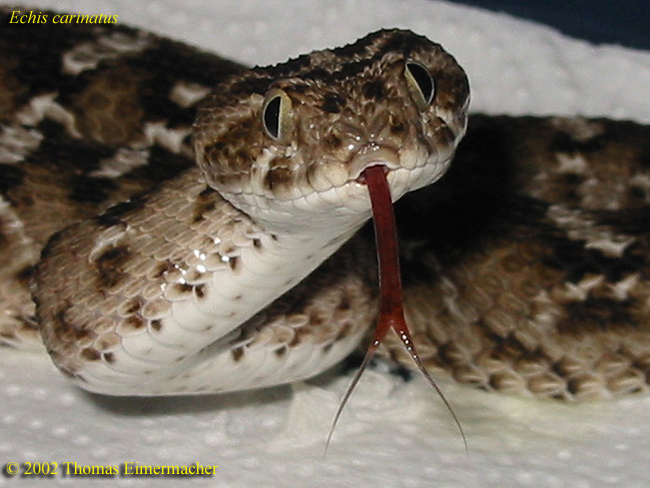
LOL thanks Thomas, as you can see I " borrowed " a pic from your post in the classifieds, thanks again for the additional information, see you in Daytona.
Barry
Nightflight99
Jul 23, 2003 11:50 PM
No worries, Barry.
See ya soon. 
~TE
WW
Jul 24, 2003 03:15 AM
>>The specimens of Echis carinatus that Barry mentioned were produced from parent animals that were imported from Pakistan in 2001. By current taxonomic standings, Echis carinatus has five subspecies, at least three of which have been given full species status by some authors. The five subspecies include E.c.carinatus (peninsular India), E.c.aliaborri (referred to as E.varia by Cherlin & Borkin, 1990), E.c.astolae (Astola Island), E.c.sinhaleyus (Sri Lanka), E.c.sochureki (India, Bangladesh, Afghanistan, Pakistan, Iran, Iraq, SE Arabian peninsula; treated as full species by Cherlin 1984 & 1990 and by Okuda et al 2001), and E.c.multisquamatus (NW Baluchistan in Pakistan northwest into Turkmenistan), which is also viewed as a full species by some authors.
Just a quick comment: aliaborri is from Kenya, and almost certainly nothing to do with E. carinatus - presumably, it's allied with pyramidum. E. carinatus (or, better, the E. carinatus complex) includes the various Asian Echis, including those from the NE part of the Arabian Peninsula (UAE, northern Oman).
Cheers,
Wolfgang
-----
WW
BGF
Jul 23, 2003 05:20 PM
Get antivenom and then buy snakes that are from the same region. 
Cheers
BGF
Venom & Toxin Database
cressm3
Jul 23, 2003 11:18 PM
These are the ones I am purchasing what species Carinatus?
WW, or BGF any ideas or too young?
Barry
Image
