Reptile & Amphibian Forums

Welcome to kingsnake.com's message board system. Here you may share and discuss information with others about your favorite reptile and amphibian related topics such as care and feeding, caging requirements, permits and licenses, and more. Launched in 1997, the kingsnake.com message board system is one of the oldest and largest systems on the internet.

Click for 65% off Shipping with Reptiles 2 You
https://www.crepnw.com/
Click here for Dragon Serpents

Question for FR, Phil or anyone else......

crimsonking Nov 23, 2005 07:52 PM

I was wondering if you or anyone here had done studies or kept records on the dispersal of neonates (any species or ssp. will fit here) and just how far they may range from their hatching site and how long that may have taken.
I think in some cases the dispersal of the neonates is rather quick and sometimes (relatively)over a large range.
Obviously you find some snakes in their "home range" many times but are you also finding ones that have "disappeared" for some time to return to the area they were hatched/born??
Just some things that I would like to hear from experienced herpers that might help me understand more of the natural history of snakes.
Thanks for any and all replies....and of course if there are citations, I'd love to read up!
:Mark
-----
Surrender Dorothy!

www.crimsonking.funtigo.com

Replies (47)

Phil Peak Nov 24, 2005 08:43 AM

Hello Mark. Great question! I have not studied neonate or hatchling dispersal per se, and I would imagine that considering the small size and at times secretive nature of young snakes this is a fairly difficult task. I read a study several years ago that was tracking this information with hatchling turtles but the recapture rate was so low the results were limited. This study had to do with natural growth rates over a period of time and habitats frequented by the various age classes. At hatching snakes would be too small for telemetry devices and even the insertion of pit tags would be risky. Scale clipping would be a possibility but this wouldn't solve the problem of subsequent recaptures. I have made some field observations regarding neonate snakes and I believe some inferrences can be made by what is seen in the field as far as their activity is concerned to some degree. I believe that depending on the species the dispersal rate can be great or fairly minimum. For example, those species that have different dietary requirements as to potential food items as juveniles from adult may need to seek places where they can secure substanance and this may well be somewhere other than where the adults find food. A couple of examples of contrasting needs. Diadophis feed heavily on earthworms and Plethodon salamanders at all age classes. There is no need for great dispersal and these snakes are often found in colonial situations while some species that feed preferentially on rodents as adults may feed on lizards and tree frogs as juveniles and may have a greater need to disperse to different feeding grounds. Another consideration of course would be nesting sites and rookeries may well be different than optimal feeding grounds for many species so there may be a need for original dispersal for the young snakes upon hatching/partuation. I think it is generally understood that this original dispersion coincides with a high rate of mortality in young snakes as they are finding their way. We frequently see baby snakes in unusual places in the late summer and early fall. Young rat snakes finding their way into inhabited buildings is an example of this. There is strong evidence that at least in some species such as Pituophis (Zappalorti) and C.horridus (William Brown) the young snakes follow scent trails from the adults to places in which they overwinter. We have reason to believe this happens with Agkistrodon.p.leucostoma in Ky. Here the adults leave the swamps and spend the winter months on adjacent rocky bluffs. After the adults start moving to higher ground we see good numbers of neonates leaving the swamps in that direction. I think there is much yet to be learned on this topic and I would be interested in hearing what others have to say. Phil
Snake hunting in Kentucky

ratsnakehaven Nov 24, 2005 09:06 AM

Here is a couple excerpts from, Snakes: Ecology and Evolutionary Biology, 1987, edited by Seigel, Collins, and Novak. “In this section we have attempted to summarize the current state of knowledge concerning movement patterns and home range in snakes. Information on these phenomena in snakes ranges from anecdotal observations to detailed studies aimed at addressing specific questions about habitat use; hence the quality of information varies widely among studies. For many taxa we know nothing at all about these subjects. Most of the literature deals with Temperate Zone snakes.” Also, “One might expect that, within species, the size of a snake would affect the extent of its average daily movements, because vagility should increase with size, as noted by Clark (1970, 1974). However, dispersal distances or distances between captures for juveniles have been shown to be as variable and as great as those for adults (Fitch, 1960; Clark, 1974; Macartney, 1985). Viitanen (1967) suggested that the range of movements from the hibernaculum increases with size and age in Vipera berus, but his data are not very convincing. For other species no correlation has been found between body length (or weight) and distance moved (Fraker, 1970) or home range size (Barbour et al., 1969; Coddard, 1980; Michot, 1981). Certainly, one area where we need more research is in the movements of young snakes.” These quotes are from the paper, “Movements and Home Ranges”, by Gregory, Macartney, and Larsen, pgs. 374-380. There is an extensive bibliography.

Another book which has a lot of great info is, “Rattlesnakes,” by Laurence M. Klauber, first printed in 1956. This is one of the most indepth studies of a group of snakes by any herpetologist, but there is very little info on snake dispersal. I think this is a topic that has not been covered very well and is open for research. I personally have not done any scientific studies and all my observations should be considered as anecdotal.

In Michigan, some of my favorite snakes for study have been the Eastern massasauga rattlesnake, Eastern milksnake, and three garter snake species. Although research is ongoing with the massasaugas and much current understanding needs to be confirmed with more data, it seems they do migrate seasonally to a certain extent to accomplish their various goals. At my current study site it seems they hibernate in a swamp and forage actively in summer in an adjacent dry field area. Adults are very loyal to their hibernating locations and it’s possible the young of the year follow them into the swamps. However, I have found young in the foraging areas after the adults seem to have left and before they have returned. It’s possible the young overwinter in the foraging areas. The winter death toll may be quite high for the young snakes. At any rate I don’t think any of the snakes move more than ¼ mile within their respective ranges. Nearby is a ridge that leads to a higher elevation plateau area. No rattlers have ever been seen on this ridge or in the plateau area. They are restricted to certain habitats.

About two miles from my rattler site is a site for Butler’s garter snakes. I’ve been studying them at this site for about ten yrs. The site is not more than ¼ mile square and I have never seen any of these garters outside of this site. I have always found the babies in a very small area within the site. Different snakes do different things and Butler’s garters are capable of maintaining themselves in a very small area. Growing up in the Detroit area I knew of several locations that were just a vacant lot that had good populations of Butler’s garters. I think the amt. of dispersal is dependent on many variables including the species itself.

Hope this is a good starter for you…..TC

FR Nov 24, 2005 10:38 AM

The whole post skated around the question, as in gave no real answers. No distances, no firm facts or opinions. In fact it would have been more meaningful to say, I don't know. This goes for Phils followup too.

Again, what you two said was, could be? some may?, others may not? different sizes, may or may not? different species, may or may not? etc.

The poster asked a specific question, to people, not to literature. I was named personally, but others included. This I believe means, give your experiences. Of cousre as a secondary consideration, citing related text is absolutely wonderful. But your experience is what is valuable here. Again, your experiences, not your paradigm(belief or confines), from what you think others wrote.

With that said, both you and Phil did not have real evidence for this question, only annodotal information, which is also suitable as long as you tell the reader that its annodotal. So while both of your followups were nice, they said little of help, is that true? or did I miss something?

For Phil, I absolutely agree with a couple things you said, snakes normally and habitually follow scent trails, their own and of members of their colony(as in your term, colonial). Neonates and adults do so. Its what they do and easily tested. And secondly, I agree with your term, colonial when you applied it to ringnecks. But I think it applies to most if not all species of snakes. There are differences like density and size. With larger species colonizing larger areas.(as suggested in literature you cited) I guess its depends on the distance you viewed it from. For instance, you can stand there and view a ringneck colony. Yet your standing in the middle of a kingsnake colony and under and in, a ratsnake colony. Its all about how you view your site. For our rattlesnake site, its easy to view it, we climb to a higher area(peak) and sit and discuss the colonies. From our view point, we can see the outer limits of our recaptures. Depending on which peak we climb to, we can view several colonies. I used to do this with Pyros as well. From these view points, you can start to see similarities and differences that may allow the colonies to be where they are. Please consider, I said, start to see. For you fellas, rent a helicopter, hahahahahaha, to many trees to see thru j/k. Consider, the distance you view from is important in judging or viewing a colony.

For Terry, I have to wonder about some earilier conversations. I suggested dens or hibernics were not about survival but more attuned to a reproductive behavior(hence not hibernation). Of course you flat fought that concept, tooth and claw. But now you expressed evidence of what I was talking about. With your massa's, you said, the adults(loyal to), moved to dens or hiber's or simply put, winter sites. Yet you found subadults still in the fields. Yes, you said this. I suggest you think about which individuals move to winter sites, dens/hiber's, I suggest, its the part of the colony that is planning on reproduction. So its not a hiber or dormant state, but a state and site to enhance reproduction. The other individuals stay in their foraging ranges and find different areas to winter. These individuals do indeed hibernate/brumate, by difinition. As they are staying dormant until suitable conditions arrive, for continued feeding and growing. Just something for you to think about. You mentioned you found a single individual under some buried logs in winter. You used that to verify your opinions on hibernation. I agree that individual was hibernating. But what about those that gathered in groups. Why did they go to a particular place and what are they doing there? Cheers FR

ratsnakehaven Nov 24, 2005 11:37 AM

Frank, I suggest you reread my post. I specifically said it was anecdotal information. The poster also stated he wouldn't mind some citations. Part of my point was that there isn't much data in the literature. Didn't you read that? Anyway, my post was not intended to take anything away from Phil or you or anyone else. Lots of times I think it is all the different views which helps discuss a topic in depth. Do you think the poster only wants scientific data and to not hear from anyone else?

You said, >> For Terry, I have to wonder about some earilier conversations. I suggested dens or hibernics were not about survival but more attuned to a reproductive behavior(hence not hibernation). Of course you flat fought that concept, tooth and claw. But now you expressed evidence of what I was talking about. With your massa's, you said, the adults(loyal to), moved to dens or hiber's or simply put, winter sites. Yet you found subadults still in the fields. Yes, you said this. I suggest you think about which individuals move to winter sites, dens/hiber's, I suggest, its the part of the colony that is planning on reproduction. So its not a hiber or dormant state, but a state and site to enhance reproduction. The other individuals stay in their foraging ranges and find different areas to winter. These individuals do indeed hibernate/brumate, by difinition. As they are staying dormant until suitable conditions arrive, for continued feeding and growing. Just something for you to think about. You mentioned you found a single individual under some buried logs in winter. You used that to verify your opinions on hibernation. I agree that individual was hibernating. But what about those that gathered in groups. Why did they go to a particular place and what are they doing there? Cheers FR

Whoops! I used the dreaded "hibernation" term. I'm very guilty of that when talking about herps in MI, but I meant to try to avoid that. It isn't that I don't remember our discussions, but the question had to do with movement of the juveniles of snakes, or others. I was just concentrating on the movement, not why they were moving or not moving. I'm not arguing with you about what the adult massasaugas are doing in the swamps in winter. I don't know what they are doing except they are underground and pretty cold. I'm not even sure where the juves and subadults are in winter. All I'm saying is that I've seen them in certain places and not others and it may suggest something or other. I plan on looking for massasaugas next spring in our swamps. Maybe I can learn something about their breeding behavior and/or movements. Right now let's think about the movements we're seeing with different snakes

TC

FR Nov 24, 2005 01:06 PM

I also mentioned that is was great to cite other sources, and to give annodotal information, if labeled. I did not say, you did not do that. What I said was, you did not give data as to what you have seen, which I believe was the focus of the question. You did not mention if you had seen neonates then seen them again and at what distances. Which I believe was the question. Then we could gage if those distances were large or limited.

For instance, I/you all have different interpitations of what we say. Again for instance, My response was with neonates under 6 months of age and HMK's used two weeks as neonates. The word neonate includes both, so does hatchlings, young ones, etc. But HMK's difinition was more defining and with our experience, more limited. As he said, we shy away from messing with immediate newborns and the very young. Althought I remember a recent conversation on a rock where HMK mentioned it has not harmed the ones we recaptured!!!!!!!!! hahahahahahahahaha (but what about the ones we didn't recapture?) The point is, some information is better then no information. And it does include some risk, in reality, a high degree of added risk.

I don't know if you think about our conversations, but if you did, you would see that I am not throwing the whole ball of wax at you at once. But instead, weaning you along as you absorb and think about various things we show(both of us) and say. For instance, at first it was, they do or do not hibernate. Now we have moved to a point of some do and some may not. Even in your area. Along the way, we then understand, this fits snakes from where you live to the equal area in south america.

The first problem with you was your use of the word "snakes" as when you say that, that means all snakes. Then "snakes" in your area, which means all species and age groups. Then "snakes" referring to one species. Then lastly, what "snakes" are doing what, in your or any area.

In the recent past, your use of literature and sightings was fit into a paradigm of thinking. A confined handy way of thinking. How about when I ask you to question of what you saw or read, go out of your paradigm and ask the same questions. Like, how do your experiences add up, if you came from a paradigm that parts of the population do not hibernate. Could you change the way you think about your supporting evidence and have it support this new idea? Of course you can. You can in the same way you use it to support your original thoughts. The problem is, for you it doubles the amount of unanswered questions. So yes, I understand its difficult for you.

Now consider, I looked at snakes the same way you and Phil now look at them. The difference is, that was forty years ago. In the last few decades, I/we, have come to view and support snakes in a much different way. There is a simple reason for this, your method of simple hibernation leaves far to many exceptions. Even in any one population.

Your first and continued arguement was, our snakes are different, is very weak. The reason is, if they were that different, they would not be "snakes" How snakes differ in the world seems to be about type of habitat used coupled with, type of prey consumed, not using requiring a total different temp range. As mentioned, ours and yours, maintain cognitive mental abilities and functioning physical abilities at just above freezing. They also fail at the same maximum temps. Or at least they are so close as to make be different. What may be slightly different is behavior and how deep, how available, and how common are the places that support that. Just some turkey induced thoughts, FR

ratsnakehaven Nov 24, 2005 06:23 PM

I hope you had a good one with your family. Our guests just left and I'm totally stuffed.

FR, sometimes it feels like you want me to argue with you..haha. I don't disagree that snakes, in general, have the same temp requirements, similar limitations, etc. There are some differences, I think, because of the different climates adapted to. For instance, some species are adapted to functioning under generally cooler temps than others. Some species can be kept at relatively low temps and digest with no problems. Others would regurge all the time at the same low temps.

Right now the problem I think we have is that I feel all our snakes (in MI) overwinter for many months at low temps of 55*F, or less, and I think you feel there are places where the temps are much better than that somewhere in the subterranean world here. As a matter of fact, I'm not even sure the 50-55*F. range is possible for snakes to find all winter. As the freezing temps go lower and lower, what happens to that nice 50-55*F. level? Does it go lower too? Can the snakes go low enough to keep up with it? I'm not saying snakes are not active at the 50-55* level, or not pursuing their reproductive strategies during winter. I'm just questioning whether they can find those temps all winter (any age of the pop.) anywhere in MI.

Right now I think my job is to find out what the temps are doing underground here in winter. I'm not going to be able to dig up any snakes to find out what they're doing. I'll try to get some temps, but even that will be challenging since the ground is usually frozen by early Dec.

Thanks for the brain food. Back to evidence of baby snakes dispersing from their place of birth.

Cheers....TC

FR Nov 24, 2005 07:46 PM

Actually Terry I never once said anything about 55F degrees, you do, not me. I keep bringing up temps that I and many others here have found snakes actively crawling around at. Like, in the fifties or forties, or even less. I mentioned we found a gravid female willards that was so cold, it could only crawl at a very slow pace or go into convulsions. I do not remember the body temp of that individual, but it was drinking out of a puddle that was partially frozen. So no, I do not mention temps in the fifies as what I think they are at.

I will say. I will bet you that the temps the adults congregate at is higher for longer then the ones that do not congregate. Hows that? Remember, recently I admitted to holding back information. Have any ?'s about that? FR

ratsnakehaven Nov 24, 2005 08:02 PM

I guess I didn't word that very well. It's my idea that the "sweet spot", the temp the snakes would find optimal in the winter months, here in n. MI, would be that 50-55*F. range, that they can also find in the summer. We talked about the idea they could be active at those temps. I think if those temps are maintained at a level in the ground the snakes could get to, then they would be somewhat active at those temps. What they would be doing, I'm not sure. Yes, I've got questions about what you're holding back on. When are you going to tell me. I just figured you'd say it when you wanted to.

As far as some spots being warmer than others, there's a possibility of that, but not because of rocks or hills, etc. I believe different habitats have different temps, like the cedar swamp that doesn't freeze. But the problem is 35*F. isn't much warmer than 30*F., or lower, on the surface. What are you thinking, Frank? Do you think some of the adults are congregating and breeding during the winter? I'm back to the idea that it's just too cold in MI.

Thanks...TC

FR Nov 25, 2005 09:42 AM

Happy stomach acke day Terry(day after Thanksgiving)

First, the problem, you keep falling back on what you think, you said, you think those are the temps they would be at. The problem is, you do not know or have any real idea what temps they are at. Which is reason you must actually compare apples to apples. You must find a congragation and monitor their temps over a winter, then you will know. Wait, no you won't, you will know what that groups temps were over a winter, and you will then assume what others in that area are.

You see Terry, you have invisioned a bunch of circles, these circles represent your beliefs. One large circle, "snakes hibernate", in this circle we went round and round. Now you have changed that circle because you were exposed to a bunch of people that did not agree with that circle. But that circle contains little circles. These little circles contain things that support your original beliefs. You now have to solve these little circles. For instance, temps during hibernation. We have gone round and round over these temps, The only why to solve it is, for you to investigate and see the actual temps. As we discuss this, you keep going back to the circle, they must be, this or that. As you have seen, You often place words in my mouth and think I said things I did not.

I did not say any temp other then I tried to give examples of different mass temps. I did so to point out, they may have choices. Its very obvious you are unaware of these choices, as shown by your posts, you keep trying to predict them, without knowing them. You do mention that some species seem to "be loyal" to certain places in winter. I would really investigate that. Not that they do that, but WHY? are they loyal? Sir, that is the important question. Also do not offer me the old, they are loyal because they survived doing that. I want to know and there has to be a physical reason why they are choosing one place over another? Once you see these things, you can start to eliminate the circles that are misleading you.

I have called these circles, paradigms. Which is basically a way of thinking, and insinuates a confined or institutional path. Paradigms do not have to be wrong or bad, in fact, as applied here, most started out being very good, then as time goes by, become very limiting. For instance, you said, if what you say is true Frank, would would all those old timers think. You know what? If I am right, I would think those old timers would appreiate the new information. That is, if they were good researchers. After all, their interests was discovery. Of course the bad ones would not.

How about approach. Why do you constantly remain in those circles. Is it painful to leave them? no, it may be scary, but it doesn't hurt. Heres the point, do not remember or hold important what you have read or experienced. Forget all that. If its in literature, just keep the book safe. You do not need to remember it. If its only in your brain, then write it down, then forget it. As a reseacher, you do not want or need a confining set of rules(paradigm). Your task is to gather information. To gather information without prejudice. Your circles are prejudice. Your circles are prejudice, your circles that are not accurate, are bad paradigms, Improper confines. You circles based on guesses and assumptions are also bad paradigms, improper confines. All and all, once your questions exceed your circles(paradigms) it means you need new circles.

The point and evidence that something is going on, is in your statements. These snakes are prejudiced. They express loyolity. They are moving here and there. Different members of the same species are moving to different loyolities. Your task is to find out why. Until you do, you have no answers and no reason to have the beliefs you have. The truth is, the snakes in MI and the snakes in AZ. express these same loyolites. Why? I showed you that. I showed snakes gathering in their loyal spot. Just like yours do. Hmmmmmmmm and to think, its so different here. Please sir, get out, get out now, your circles are killing you. FR

p.s. why do they gather in wells?

ratsnakehaven Nov 25, 2005 06:06 PM

I get it

Actually, this strand was a good exercise for me. Before this I wasn't thinking about why I was seeing so many females at my massasauga study site in summer. Now I'm thinking about what the different members of that population are doing. I'm going to try to get some temps from different sites this winter, and next spring I'm going to do some hunting in the swamps themselves to see what's moving there.

I think you know why they gather in wells. Lots of different species use wells because it's so easy to move up and down and get the right temps for what they need to do. Also, they don't have to worry about dehydration too much in wells. I mentioned the rattlers using wells because I've heard reports of them doing that. I haven't confirmed that, yet.

I have another spot where snakes gather in large numbers near Lake Huron. Cool spot. It's on a ridge, not too far from the big lake, less than a mile. The top of the ridge is covered in limestone rocks, rocks that have crevices that go deep underground. It is pretty much free of trees, open, and sunny a lot. Guess what? Northern ringneck snakes gather there in huge numbers. We have seen multiple ringnecks under the rocks, as many as seven adults under one rock. This is a snake that is rarely seen in MI, and I have only seen it in any numbers along the shores of the Great Lakes in n. MI. Funny, though, we haven't seen any rattlers in this spot.

Later...TC

FR Nov 26, 2005 10:50 AM

That you get it. but your now on the road to getting it.

I was going to post about this;

I was going to explain that My task with you is done. All further conversations is for fun. As a teacher, you should understand this. My task was not to teach you anything, but only to make you aware there was another world of possibilites out there. Its your task to actually learn them. My job was to make you question what you are seeing and view the world in a different way. hahahahahahahaha, now you will question all you see, and not in the same manner you did in the past.

A rather large point you and Phil have missed is about HMK and I, you should have retorted, You fellas have paradigms too, hey? of course we do, and in fact, had the very same ones you and Phil have. The reason is simple, we read the same books and have the same history. But for some reason, I am goofy/left handed and primitive and often forget what I learned, so I fall out of paradigm quickly and unintentionally. These, often considered bad abilities, has allowed me to see things in different ways. Which is meaningless, by the way, until I showed how these ways worked. For instance, your female gravid massa. We indeed had the same paradigm as you, only not as bad, we thought they would breed very young. Then we started finding gravid females that were just about a year of age(guessing) they had one less rattle that yours(from what I can see from the pic) The truth is, whether they were one year old, or two years old(we can debate forever how many times they shed in a year) the reality was, they were very tiny and very very young. The reality was also, this was very very common. The QUESTION is, how did we miss it. And now, How did you miss it? Thats an easy one, we and you did not look. Now I look, and if you look, you will see what we have seen. But if you do not look, of course you will not see it. Thats the nature of paradigm. A paradigm(a way of believing) restricts you from looking outside of it. Thats why I keep asking you to look at these things, not just believe them for any darn reason. You have judged what you read or saw, as right or wrong. That sir is the begining of mass paradigms. There is not need to judge. Just gather information and tie them together. Sir, that is the first thing they teach in science. To research is to gather information, not judge it.

Now consider, once you see all these very young massa's gravid, you will look back at what you thought, and what you read, and think, WHAT THE HECK WAS I THINKING, and wonder how the heck did they and I, miss such a common event. Thats again the nature of a false paradigm, you did not believe it could happen so you did not recognize it happening. How did we miss it, hmmmmmmmmmm that still bothers me. hahahahahahaha ask HKM.

Then with this new information, you can start to add the whole thing up in a different way. Pretty soon you will be telling me, to get out of my old paradigms and look at the subject, not the text. hahahahahahahahaha

Now remember, these rattlesnakes are doing the exact same major behaviors as kingsnakes, only do them where we can see them. They have adapted to use the surface more then kingsnakes. But kingsnakes and ringnecks and ratsnakes are all doing very close to the same major events.

Once you understand what these rattlesnakes are doing, you can "back engineer" and see how it fits other species, but at least now you will have a basic outline to follow.

For me, it was Thayeri, that got the ball rolling, up until that time I was a major gooner. That is, I ran around flipping boards and tin all over the world and not knowing a darn thing except I was very strong from all that lifting. Because thayeri, are at altitude, they are often very close to the surface. I was able to find colonies and breeding and gravid females and clutches of eggs etc. Then I back engineered it to all the rest. So far, it fits. They are generally the same in behavior, with minor differences, specially in distance between individuals. For instance, coachwhips gather in groups(boy do I have a story about his) then disperse at much greater distances, of course, they have the physical ability to do so. They can travel 20 times faster then a kingsnake, so it makes sense, their range is 20 times larger, but its still the same. Now you can see how adaption works, hey?

Now all you need to do is get rid of AC and find out what they do naturally. You know they are not designed for AC. They are designed for nature. Consider, nature has differences that AC does not have. FR


ratsnakehaven Nov 26, 2005 06:59 PM

Thanks, Frank. I don't use much a/c. That tin just happens to be at my site. I usually don't see 'saugas unless they're basking for some reason. We don't have the windows you do and I rarely see them in any rock piles. Most people never see them unless it's by accident. I think I have a pretty good idea of what they're doing now. I know of another site which serves as a nursery for massasaugas too. I do have a question though. If females are thermoregulating at the nurseries, how do they feed like the males do, and if they're not feeding, how do they manage to take in the calories that males do? I know males are foraging at this time

TC

Phil Peak Nov 24, 2005 12:40 PM

Hello Frank. Hope you are having a great Thanksgiving! Regarding my response to Mark, here is some commentary on what you have posted.

< Officially, that is, with snakes that were marked(tagged) they do not go anywhere. That is, they have not traveled over a few hundred feet. Maybe HKM can give exact distance, as he has the record books. >

On this topic your field partner HKM adds,

< In the project that FR speaks of, we have hardly marked any newborns (less than 2 weeks). I think we have tagged two? >

Unless I'm misunderstanding two snakes does not seem like much of a study group. Cheers, Phil

FR Nov 24, 2005 03:13 PM

I was using neonates or young individuals as 6 months or younger, which we have more of.

What HMK mentioned was newborns, as in when we find a clutch. Like you, we really dislike messing with such a situation. In reality, we have avoided this type of contact. Which is not very scientific, when it surely eases our minds. But as Hugh mentioned, we have discussed different approaches to this, that are more non-contact. When I say more non-contact that means we will most likely disturb some, but use cameras and close ups to identify most clutches. That is, if we are lucky enough to find several clutches.

I think I may have mentioned this before, but I find this observation to be outa hand. Once I took these fellas out and found an adult blacktail. I lifted it up, and to my surprise, it was coiled on top of a whole clutch of rock rattlesnakes, 6, to be exact. I searched around and found the mother a foot or so away. What the heck was that blacktail doing? to make it worse, a few months before, I looked in a rock crack and found a blacktailed coiled up, with an adult rock rattlesnake coiled right on top of it. In the same spot. Happy thanksgiving. FR

Phil Peak Nov 24, 2005 05:37 PM

Thanks for the clarification Frank. That makes much more sense to me now. Interesting account with the crotes. I wouldn't know what to think of that situation. Thanks again, Phil

HKM Nov 24, 2005 04:08 PM

"In the project that FR speaks of, we have hardly marked any newborns (less than 2 weeks). One it is tough to do, two, we avoid harassing any snakes in our study area during birthing time (we did enough of that in the 70's). I think we have tagged two?"

The TWO is all the NEWBORNS we have tagged. Not much of a sample indeed. I explained that that is by design. As for the rest of the project, we have made somewhere in the neighborhood of 700 contacts with about 200 marked individuals, with about a 34% recapture rate.

Phil Peak Nov 24, 2005 05:42 PM

Thanks for the additional info HKM. Keep us posted on your research. Sounds very interesting. Thanks, Phil

FR Nov 24, 2005 05:21 PM

When the first post came up, I correlated the mention of babies as ones you see crawling about, as you did. HMK correlated them as newborns or new hatched. Which do not leave the area they hatched or were born for a week or two. So normally the babies or neonates or hatchlings you find, are several weeks to a month or more old, by the time you see them. I hope this helps, FR

Phil Peak Nov 24, 2005 05:56 PM

Good point Frank. I would think very little dispersal would take place before the first shed at least. I have seen neonate coppers, cottons and timbers around their mother clustered up while awaiting their first shed. I would be interested in what those snakes that are in the one to two month age group are doing as far as movement. Thats the age that I see most often crossing roads or turning up in slightly unusual places when it comes to young snakes. Places like neighbors yards, parking lots, inhabited buildings, crossing roads in unexpected places and so forth. I wonder how far they have traveled and what stimulus motivates them. I wonder if a certain percentage of any population is more apt to be genetically predispositioned to be transient in nature and be potential colonizers while the majority moves shorter distances from their original starting point and establishes home ranges there. Interesting topic for sure. Thanks again, Phil

FR Nov 24, 2005 07:32 PM

It appears that young males are by far the most likely to be found roaming around. This appears to be true for species like greenrats, pyros, vinesnakes, etc. But not so apparent with our rattlesnakes. Of course this is over a calender year. There are times when females are very commonly found, short periods. FR

ratsnakehaven Nov 24, 2005 01:38 PM

This is an example of a massasauga from my site in Presque Isle Co, MI. I found this snake as a juvenile in June '03. It was barely bigger than a neonate and I'm sure it was from the 2002 output. I found it again as a two yr. old (seen in this picture and ID'd from photos) in early September, 2004...

It was in the exact same spot. I believe it overwintered in this spot, not moving very far. A few ft. away is an old water well and the remains of an old foundation. This is a potential overwintering spot, as these rattlers have been known to spend the winter in wells.

This picture shows part of the massasauga site...

TC

FR Nov 24, 2005 07:54 PM

Thats common with me/us, finding them in the same place or close to the same place. Its also common to find them in areas that accomdate all seasons.

If I found the one in that pic, I would have to palpate it, as she appears to contain ovum. As least from the photo. And if she is really a she. FR

ratsnakehaven Nov 25, 2005 09:41 AM

The normal habitat for massasaugas in MI (and n. OH and n. IN) is wetland or swampland. I believe they seek out open, higher ground in their wet habitat for activities, such as basking. I'm not sure if they spend the winter underground in these higher areas (or mounds), but it seems reasonable, especially if they can get down to the water level in times of deep cold. They also overwinter in crayfish burrows, other burrows, and tree root systems, etc. I believe the swamps are more open than drier forest because the water creates a % of open areas, and trees are often blown over in winter, and because of occasional flooding, etc. They are seen mostly in spring, when some are found basking on dirt roads passing through their habitat, or summer, when they are often killed by farmers cutting fields of hay near their habitat, or fall, when hunters sometimes see them basking in the swamps while bear or deer hunting. I'm trying to see how conditions are similar at the same time as being different from those in AZ.

The snake in the photo may have been a female, but I didn't palpate or check the sex. I did have the impression it was female. I don't think two yr. olds are ever gravid, however, although I haven't seen very many that age. Easterns are just heavy bodied, even as babies, and often look gravid. This snake was only 15-18 inches. Of course, I wouldn't know positively, eh? How do you palpate them anyway? I don't like to pick them up..haha, although I do use a hook occasionally to get pix.

TC

Image

ratsnakehaven Nov 25, 2005 08:41 AM

I found a photo of the exact spot where the previous 2 yr old massasauga was found. This is the location of an abandoned settlement (can’t see the old house). There is a well buried in amongst the debris and tin. The snake was found under the tin each time…

The next photo shows where the settlement site meets the swamp forest. Notice the grassy wetland inbetween the swamp and the higher ground of the cleared area of the settlement. My vehicle is way in the background…

This next photo shows the higher ground which was cleared and built up many years ago. Guess how the snakes are using this manmade habitat?

This is a hole that penetrates deep into the open raised area. The massasaugas live in these burrows during the summer and are rarely seen above ground. One has to be familiar with the conditions the snakes rise to the surface under. An adult female was seen next to this burrow and crawled back into it after she was startled by me taking pictures…

Now we will be looking at a juvenile massasauga. This snake was seen in early July, 2004. Notice the very short rattle (maybe one segment and a button). It was likely born in August, 2003, and was 11 months old. This is what first year ‘saugas look like in n. MI. Also notice that it’s opaque, a condition seen a lot in ‘saugas found on the surface…

This is what we see a lot at this site…a gravid female, often opaque. Frank, look at the rattle. To me it looks like the base of the tail + four segments + the button. This is a typical rattle for three yr. old females. Is that how you count segments?…

Here’s one more photo, an old one from 2002, of another gravid female, not opaque, just sunning after a rain. I don’t have many pix from before then because I didn’t have the gear to do that at the time. I believe she has four segments also…

One reason I posted this series today is because I think something is going on with seeing all these gravid females at this open site, surrounded by massasauga (normal) habitat of swamp and woods. I do occasionally see adult males at these sites, but not nearly as often as the females. I also see quite a few juvenile and neonate ‘saugas at sites like this one, and have never seen babies at any other site types. Almost all my sitings have been between June 1st and the first week of September. What does this mean?

I have found places where the females are dropping their babies too, including this current site. I have always seen this event in the second week of August, although I’m sure it varies somewhat. It seems to me that the babies don’t travel very far. When they are older, they move into the swamp and down by the river, about ½ mile away, because that is their main habitat. I think as babies, however, they stay quite close to where they were born. I do need to do a lot more investigating in the swamps earlier in the year. I could be missing opportunities to make observations there. Other folks have observed massasaugas up to the month of October, in the swamps, but only adults.

Hope this helps some more

TC

-----
Ratsnake Haven...researching ratsnakes since 1988

Ratsnake Haven Group...an information providing list site.

HKM Nov 25, 2005 10:21 AM

Hey Terry,

Nice photos.

As for the the rattle you asked about, from what I can see, I would say it is 4 segments, no button. I haven't messed with sausages for 25 years, but, with the exception of their rattle segments of being much skinnier/thinner/smaller, I don't recall their rattle buttons being much different that other species? That one in the picture appears to not be rounded on the end like first buttons, rather, it appears to have the typical interlocking distal end of secondary segments. Anyway, from the picture that's my best interpretation.

So, why would opaque individuals and females be sitting out in the open??? Seems elementary my dear Watson.

ratsnakehaven Nov 25, 2005 01:25 PM

Thank you, Mr. Holmes.

I assume the opaque individuals are attempting to gain more heat because it helps with sloughing. Non-opaque individuals don't risk exposure if they don't have a great need. I also think the gravid females are using the site because it is warmer, being high and dry, and more exposed to the sun, and they have developing embryos which benefit from the added warmth. There are adult males present, most likely, but they rarely expose themselves

TC

HKM Nov 25, 2005 03:50 PM

Sounds like a winner to me. Specific physical opportunity allowing them to accomplish specific physiological processes. All part of that "how to maintain a population formula" we discussed a few weeks back: hydration plus caloric intake plus safe thermoregulatory opportunity equals babies.

And I can't tell you where the males are because you haven't said, and I haven't seen them. But, socially speaking, if they are doing what most of the beasts I have studied do, I bet those males are very nearby indeed.... hanging with their honies, just staying a tad cooler safely out of sight. But that is just a guess HAHAHAHAHA.

Later Terry, I am off to the leftovers!!!!!!!!! Hugh

ratsnakehaven Nov 25, 2005 04:40 PM

Thanks.

I hope you don't mind if I start using your formula..I love math

I bet you're right about the males. I've seen a few of them, but they sure are shy. I'm right behind ya in line for the leftovers. Take care...

TC

crimsonking Nov 25, 2005 11:21 PM

Great stuff again. I'd love to photo even ONE of those beauties!
Than goodness the ground has those nice hiding places, huh?
'round here there's concrete covering more and more.....
:Mark
-----
Surrender Dorothy!

www.crimsonking.funtigo.com

ratsnakehaven Nov 26, 2005 08:26 PM

Mark, I've had to work at finding them and sites. They are only locally common because there's so little habitat left. But you're right, it is nice up here as far as lack of civilization. I'll be glad to retire to AZ though and be able to herp all year. Sort of what you guys in FL do, eh? Hahah. Good huntin' this winter

Terry

PS: We have lots of these guys on our property. Babies usually hang around where they're born until they go under around mid-September...


FR Nov 24, 2005 09:44 AM

Officially, that is, with snakes that were marked(tagged) they do not go anywhere. That is, they have not traveled over a few hundred feet. Maybe HKM can give exact distance, as he has the record books.

On my other sites(photo id or memory id) They have also not traveled any distance either. They stay close to where they are found. Remember, these are with neonates that are identified. Either exactly(tagged or photoed) or close(memory, of couse, this is not official). An example of memory, I found a neonate lyresnake, it had a kinked tail. I found that individual over an entire year, and watched it grow from a hatchling to a young adult. It never moved over five feet. But then it disappeared????????

I do understand, why you would question this, as we see lots of neonates moving here and there, around our houses(in the desert) or crossing streets or on the way to and back from our sites. These animals are seen once and done. It would appear they are dispersing, as they move in waves. But again, maybe they are only crossing the street and not moving very far.

On our sites most individuals are one and done. With a few found over and over. Yes we have tagged individuals and had them grow up on our sites. But in the first few years we did not tag all individual neonates. We both felt it was harmful. Consider, neonates only have a very small chance of surviving, then to tag them must surely decrease what chance they have left. In fact, tagging them seems to have a deleterious effect on adults. As most of the adults we tag disappear imediately. Again, HKM can give a more accurate percentage. But it seems about 65% of the individuals we tag disappear. The other 35% we recapture, time and time again. For instance, if we have tagged 200(close to accurate) we are only recapturing 70 and most of those are repeatedly recaptured. On an average day, if we are visting the site regularly, 50 to 70% are recaptures. After missing a year, we found 33% to be recaptured.

Now consider, we have five small hillsides and assoiated canyon bottoms. These hillsides are very close to eachother, within 100 yards apart, as close as 50 yds. We have never seen any individual move from one local to the other. Also, we have never seen them in the areas between the sites(I call these areas, dead zones). This is over 15yrs.

Our original site was three canyons, we added two more about 8 yrs ago, just to see if individuals were leaving.

So your answer is, we have not seen any age group travel any distance, not on our sites or otherwise. But then so far, we are lucky, none of our sites have had deleterious changes, like fire or floods or landslides, etc. FR

HKM Nov 24, 2005 10:21 AM

A great question and one that needs to be evaluated carefully.

As for kingsnakes, I have no study data.

In most crotalids, it appears babies seem to be the the ones moving among the small groups that appear to be all living together, or side by side, or however one wants to try to label them. For now, I will call them family groups. This has been seen in several studies using several mark recapture methods. Some stay in the immediate area they were born in, and some move off to other spots.

In the project that FR speaks of, we have hardly marked any newborns (less than 2 weeks). One it is tough to do, two, we avoid harassing any snakes in our study area during birthing time (we did enough of that in the 70's). I think we have tagged two? I am too lazy to go into the data right now and see what happened to them. It appears no one else is moving around between the groups within our study area.

We are planning to zero in on this very factor beginning, hopefully, in 2006.

So here you go folks, jump on this:

My guess, babies do a little bit of each. There will be no set thing they do. Some stay put, some move off, lots don't get past square one.

Happy Thanksgiving.

crimsonking Nov 24, 2005 11:42 AM

Thanks for the input. Obviously, there's a lot more learning (at least by me) to do.
I have a feeling the more we know about them from DAY ONE the better chance we have of protecting them.
All this will vary from snake to snake and on an individual scale as well, I guess.
Good stuff.
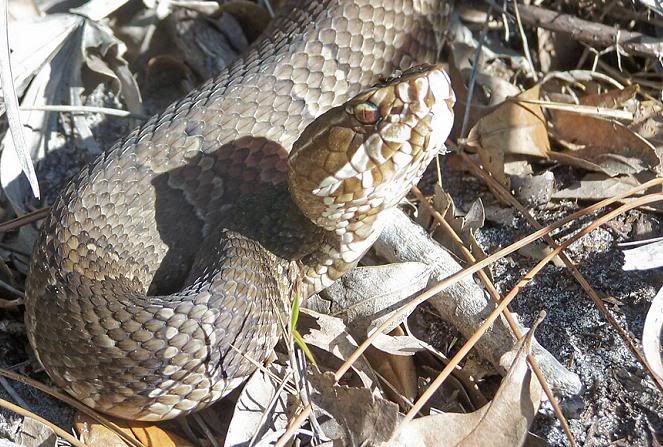
By the way, here's a shot of a local I saw about an hour ago on a nearby trail.

Happy Thanksgiving everyone!
:Mark
-----
Surrender Dorothy!

www.crimsonking.funtigo.com

candb Nov 24, 2005 11:53 AM

Awesome picture, do you live in southern florida crimson?
-----
1.0 Albino Corn "Lucky"
1.0 Snow Corn "Snow"
0.0.1 Southern Ringneck "Lazy"
1.0 Green Amevia "Gizard"

crimsonking Nov 24, 2005 12:07 PM

...I'm in Tampa. This guy was in St.Pete.
:Mark
-----
Surrender Dorothy!

www.crimsonking.funtigo.com

ratsnakehaven Nov 24, 2005 12:04 PM

Ahhhh, Florida, where there's always herping

You're right, Mark. All of us are always learning, hopefully, otherwise we're stuck. I also believe that the more we know the better the chances we can conserve what we have left.

Nice snake.

Happy Thanksgiving from all of us too! (It's 10*F, strong winds, and we're supposed to get 12" of snow today.)

Terry

crimsonking Nov 24, 2005 12:09 PM

What? No herping in the snow???
You guys get in some great field time though when the spring/summer comes, huh?
:Mark
-----
Surrender Dorothy!

www.crimsonking.funtigo.com

ratsnakehaven Nov 24, 2005 12:32 PM

Now, I know you've heard of snow snakes..haha!

Actually, I have seen garters crossing a snow bank before.

But...I took this pic on April Fool's Day in '05. It's the shores of Lake Huron, which has a cooling affect on the local flora/fauna...

Not much moving when it's that cold

We do have fantastic summers and can find herps all hours of the day.

TC

HKM Nov 24, 2005 03:10 PM

Happy Thanksgiving to you too Terry.

Mark seeing a cottonmouth today is cool, but you saying you once saw a garter crossing a snow bank makes my brain crank into high gear. hmmmmmmmmm.

leads to another interesting question???? In soft substrates, why do snakes sometimes leave a track, and other times they don't?

crimsonking Nov 24, 2005 03:43 PM

..out of the snow here in FL.
Indigo with frost on the ground??? That's different.
:Mark
-----
Surrender Dorothy!

www.crimsonking.funtigo.com

ratsnakehaven Nov 24, 2005 07:48 PM

Thanks, Hugh, hope you had a good one.

Remember, I have seen snow in almost every month of the year here in MI. It would not be unusual to see a garter crossing over snow in April through September, if there were snow on the ground. However, I did see one cross the snow in January once too. Also saw a milksnake a couple years ago in Jan, that a student brought into school

By soft substrates, do you mean like sand or mud, or something like that? I don't know why a snake would leave a track sometimes and not other times. Maybe under certain conditions the track disappears, like if the sand smoothed itself out, or the wind, or something like that. Just a guess? What's the answer?

TC

Afton Farm's "Little Pond" in spring...

Image

FR Nov 25, 2005 09:58 AM

In the last five years, its snowed here twice(different years) in april. Hmmmmm FR

HKM Nov 25, 2005 10:27 AM

I wish I had a photo we took on 1 April a few years back of the snow we had in Tucson. Long story but it was hilarious.....

On the substrate question, let's use sand (though I am curious how it would relate to snow?). At my sidewinder study area just down the street (where I find beautiful cal kings ), and also on Frank's famous driveway, we have seen snakes crawling, possibly the same individuals. Sometimes there is a track left, sometimes not.

ratsnakehaven Nov 25, 2005 12:38 PM

I think I remember that day. I wanted to go for a hike in Madera Canyon. When I parked at the 5,000 ft. lot I got out to find two ft. of snow on the ground. Then it melted, filled the creek, and the next couple days were good hunting in the low hills..haha. So, tell the story

What's the reason they sometimes don't leave tracks? What kind of snakes? How about a pic of one of those cool kings too?

Later...TC

HKM Nov 25, 2005 03:53 PM

The story is fire department related and surely will be deleted from this thread for lack of kingsnakicity.

I am not sure why they sometimes leave a trail and sometimes don't.... Before I spew more, what about those garters on the snow??? Did they?

ratsnakehaven Nov 25, 2005 04:50 PM

Well, sometimes they do and sometimes they don't..haha.

In January the ones I saw that got flushed out of the burrows because of sudden high temps crossed snow that was pretty hard..no tracks. But ones that cross soft, spring snow that is very temporary can and do leave tracks (sometimes a squall will come through and temps will drop as much as 20*F, then rise right back again after the squall).

Cheers....TC

Phil Peak Nov 24, 2005 12:43 PM

Happy Thanksgiving to you as well Mark! I think we all have much to learn on this topic. Congrats on the cotton! I envy you guys down in the sunshine state about this time each year
Phil

Site Tools