Reptile & Amphibian Forums

Welcome to kingsnake.com's message board system. Here you may share and discuss information with others about your favorite reptile and amphibian related topics such as care and feeding, caging requirements, permits and licenses, and more. Launched in 1997, the kingsnake.com message board system is one of the oldest and largest systems on the internet.

Click here for Dragon Serpents
Click for ZooMed
Click here for Dragon Serpents

so what are the wild floridana doing this time of year?

daveb Dec 10, 2005 12:52 PM

Soooo, is anyone field herping in the peninsula at this time of year? i'm interested in hearing what sort of observations are being made at this time of year, what are the kingsnakes doing? while we're at it, how are you florida breeders preparing your breeders for breeding? do you force a brumation or let things go as they would be just outside the door?
see, (hahaha) my kings have it GREAT. for years there has been NOTHING more I could do to improve the quality of captivity for my floridana group. they are all above average,great feeders, perfect breeders with 100% fecundity and hatch rate, sort of like lake wobegone...not. things are good but i would always like to improve. and i am kind of tired of the hobby concept of brumation if there is no added benefit relative to nonbrumating ( hence why i ask what the wild things are doing for comparison).

the phone lines are now open...

dave

Replies (37)

phiber_optikx Dec 10, 2005 02:00 PM

I am sure this is a stupid question, but what kind of snake is that?
-----
0.1 Snow Corn "Hope"
1.0 Ball Python "Wilson" (Castaway)
1. Orange Albino Black Ratsnake "Chunk" (Goonies)
.1 Orange Albino Black Ratsnake "Peaches"
0.0.1 Mexican Black Kingsnake "Onyx"

bluerosy Dec 10, 2005 02:04 PM

I only collect when I can drive up, open my car door and reach down to pick them up. This time of year involves getting out of your vehicle which is to much work for me.

Patton Dec 10, 2005 02:19 PM

If you know Bob Macken you'll find it funny, if you don't, oh well.
-Phil

Horridus Dec 10, 2005 02:54 PM

You forgot drive up REAL FAST and reach out!

Horridus

crimsonking Dec 10, 2005 11:07 PM

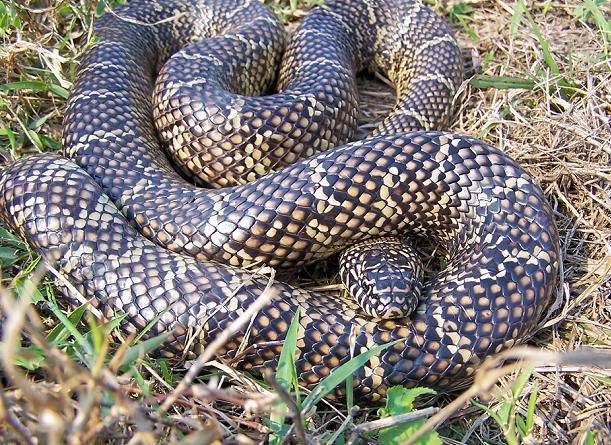
Because as it turns out, this brute was out and about today(12/10/05)in temps of mid to high 70's along with more I am sure. (more pics later)
One of the largest I have seen in some time and in great condition.
Have a look at him...
Rainer you'd most likely have to get out of the car for this one....


.
By the way, my captives here at home are getting ready for cooler weather too. A week or so behind my self made "schedule" but it'll do.
:Mark
-----
Surrender Dorothy!

www.crimsonking.funtigo.com

crimsonking Dec 11, 2005 10:33 AM


Obviously ia a shed cycle it looks as if he has had a retained eye cap as well.
:Mark
-----
Surrender Dorothy!

www.crimsonking.funtigo.com

ratsnakehaven Dec 11, 2005 03:13 PM

Do you find them all through Dec and Jan? Thanks...TC

crimsonking Dec 11, 2005 04:55 PM

You can certainly find them all year, but when it does stay cool for more than a few days I doubt they will be out and about. More likely back in the recesses of the rocks and even underground a bit I'm thinking. On a warm day at any time of the year you may see them.
Now in the dog days of summer,they may be back in the rocks and underground very much as you would expect them to be at the coldest times.
I wish they were as abundant throughout FL as they are in the fields but with FL losing many many acres a minute to development, there is little chance of that. The canefields may be undergoing some large changes soon as well, in part, to help restore the 'glades, so that may have a big impact on that population as well.
:Mark
-----
Surrender Dorothy!

www.crimsonking.funtigo.com

snakesunlimited1 Dec 11, 2005 05:57 PM

LOL Are you kidding Mark. Restore the everglades. HAHAHAHAHAHA Jeb just sold off a huge chunk of the glades a year or two ago. The sugar cane money will keep on buying it.

The only people to "restore" any wet lands in Florida are the developers eating up the coastal wet lands who develop protected lands. A little known fact about our environmental protection policy is this. If you want to develop protected salt marsh wetlands then you need to "restore" "wetlands" elsewhere. that means that the guys who own the land need to buy up the groves in the center of the state and make them wet again. Have you noticed the groves that have been getting cut down nd bulldozed lately in the middle of the state. usually near a wetland area to extend that area and make it easier on the un-developers.

Later Jason

ratsnakehaven Dec 11, 2005 06:09 PM

Man, that is uncool. Where are our lobbyists?????

TC

snakesunlimited1 Dec 11, 2005 06:13 PM

LOL making money hand over fist for coming up with this "compromise"
Later Jason

crimsonking Dec 11, 2005 06:28 PM

Not kidding but I maybe should have put emphasis on the word "restore" for sure.
On another note of reference, the owner of the tract of wilderness known as Babcock-Webb has "agreed to sell" the state of FL 75% (I think) as long as he can develop 25%. It's in the thousands of acres.
What can you do there? They'll develop the whole damn thing if the State doesn't grab it...
No more from me...I'm getting depressed...
Jason, you must realize that there is a give and take these days here..Mostly TAKE. The canefields are not a natural part of the ecology for sure. If you could lose some of that and help the Kissimmee drain more naturally into FL Bay, well I think in the long run it may be a good thing.
I like to be able to find a king now and then when I want on the canals (no matter HOW boring) but if it is better for the whole, then I say help the glades.
:Mark
-----
Surrender Dorothy!

www.crimsonking.funtigo.com

snakesunlimited1 Dec 11, 2005 06:40 PM

NONONO mark don't get me wrong i agree with you whole heartedly but the fact remains that this is happening. It is just silly how little the people are paying attention and how little is reported in the papers.

Have you driven route 60 in the last 2 years. On the Vero Beach end they have 20 miles of jersey barriers up on the side of the road while they widen it but it is in the middle of the St johns marsh and all the semi aquatic animals reptiles there are getting murdered. i know it happens but you gotta think there is a better way. i tossed 4 gators off the road in one night there and there where 3 others killed. One night man. that's a major trucker highway and they don't stop for gators. i also saw way to many gravid turtles DOR and it was just sick. Bottom line is that the welfare of the animals has very little to do with policy in Fl.

Thats enough for me man. Maybe we can hook up for a run at the cane fields in the week I am there.

Later Jason

crimsonking Dec 11, 2005 06:45 PM

...gimme a call. I'd like to head to Apalachicola too.
:Mark
-----
Surrender Dorothy!

www.crimsonking.funtigo.com

ratsnakehaven Dec 11, 2005 06:05 PM

That's what I expected. The only thing is, kingsnakes stay underground most of the time anyway. When you see them, isn't it under cover? I mean they don't usually come out and bask, do they?

It's a shame about what's happening to the land in FL. You have my sympathy, but I regret it too. I like herping in FL. The same is happening everywhere. It's all about the land/habitat. Here in northern MI we are quite far away from civilization, but even here it's affecting us. The best land prospects for development are usually the best places for herps too. Our coastal wetlands have taken a beating and are in dire need of protection. It's all about protecting the land. I can't wait to retire and fight the good fight

TC

-----
Ratsnake Haven...researching ratsnakes since 1988

Ratsnake Haven Group...an information providing list site.

snakesunlimited1 Dec 11, 2005 06:17 PM

Terry i don't know if you ever heard of walking the canals or not but that is how a lot of guys find the kings. Under cover in the early morning and out in the sun in mid morning to afternoon depending how warm it is. They are in tall grass but they are out. I found it pretty unexciting because they are so calm that when you pick them up they kinda wrap your wrist and look at you and say "Ok lets go to your place" LOL

later Jason

ratsnakehaven Dec 11, 2005 06:42 PM

Dang, I almost never see any kings in the open, except when coming out of their wintering spots, or crossing the road at night. I've hardly ever been to south FL, and I've seen very few kings in north FL. Are they like that all over the state, or is that peculiar to that part of FL? Thanks...TC

crimsonking Dec 11, 2005 06:50 PM

....it is my experience (limited for sure) that they are diurnal and actively out during the day. More times than not I suspect "out" still means just under the surface grasses,rocks etc. and out of plain sight. Of course they can hide in plain sight as well - from me!
:Mark
-----
Surrender Dorothy!

www.crimsonking.funtigo.com

crimsonking Dec 11, 2005 06:17 PM

While I do find thenm under stuff, full half I find are out in the open. Basking or just being kingsnakes.
:Mark
-----
Surrender Dorothy!

www.crimsonking.funtigo.com

ratsnakehaven Dec 11, 2005 06:47 PM

Thanks, I may have to check that out someday when I go to the everglades. I've never thought of kingsnakes as being baskers, except maybe in the very early spring. They only do that in the early part of the year, correct?? TC

crimsonking Dec 11, 2005 06:52 PM

....that higher numbers would bask in the early spring, yes.
:Mark
-----
Surrender Dorothy!

www.crimsonking.funtigo.com

ratsnakehaven Dec 11, 2005 06:23 AM

things are good but i would always like to improve. and i am kind of tired of the hobby concept of brumation if there is no added benefit relative to nonbrumating ( hence why i ask what the wild things are doing for comparison).

In other words, if there's no added benefit, you don't want to brumate (kingsnakes). Why don't you test it out and not brumate and see if they breed anyway? Noone said you had to brumate your snakes. If you let them do what they're doing in the wild I'm sure you'd get breedings, don't you think? I'm sure in the wild they're doing whatever they want...heheh. What do you think they're doing? You could give them a choice...dang, where's FR when you need him TC

Phil Peak Dec 11, 2005 08:33 AM

I have successfully bred floridana with no cool down period at all other than the winter temps in my house being milder at that time than the rest of the year. In the wild (as Marks post shows) there are kingsnakes active and on the surface in south Florida in the winter months. Females found in March will be heavily gravid. Something else I have noticed is some of the field collected floridana I have kept would tend to go off food for a while in the mid summer. Makes me wonder if perhaps this occurs in the wild too when the exposed cane field habitat is hotter than blazes and the snakes are no where to be seen. It makes me wonder if many of these snakes actually estivate during these times.

By contrast I have never been able to successfully reproduce more northern ssp's such as nigra without a bona fide cool down period of 10 to 12 weeks with temps in the 50F to 60F range. I tried breeding these snakes a couple of times years ago without the cool down period and they simply did not respond. These snakes go off food in Oct and become lethargic regardless of the choices provided. Keeping the snakes warm through the winter only spends their metabolic reserves and weakens their physical state.

All these snakes fullfill their life functions throughout the calandar year though clearly the time tables they use for doing so are different. Phil

ratsnakehaven Dec 11, 2005 09:30 AM

>>All these snakes fullfill their life functions throughout the calandar year though clearly the time tables they use for doing so are different. Phil

I don't doubt that floridana spends some time (a metabolic rest) in summer underground where it's cool and moist. I'd venture to say there's numerous times during the year for all kingsnakes to rest. They're not metabolizing constantly year 'round. I would expect them to slow down in winter, but probably eat occasionally, in south FL. However, we need to remember that they meet their life functions in basically the same ways. They just have some different times for use of surface conditions. Floridana probably lays much earlier than nigra.

As for nigra...Story: One time I found a gravid, female, black king in spring. She laid her eggs and they hatched on time, near September. I remember not being able to get a single hatchling to eat and I tried hard. Ended up letting them all go. I assumed they were ready for a cool down although I had little experience with them in captivity at that time. This isn't proof, but it sounds like nigra stops feeding sometime during the fall season.

It's so interesting how these snakes meet their needs with some variation, in spite of being the same species. Can we say, same species, different snake?

Cheers....TC

Phil Peak Dec 11, 2005 10:26 AM

I think thats a good accessment Terry. Same biological needs, different environmental conditions to accomplish these in. There are clear reasons linked with survival that dictates when certain activities take place in nature.

Oviposition occurs in early June in Ky in nigra with hatchlings emerging in late August and Sept. I have had around 50% success rate on getting hatchlings to feed on pink mice on the first couple of attempts. Phil

ratsnakehaven Dec 11, 2005 11:35 AM

Hi, again, Phil. Thanks.

I'm just having a little difficulty with this sentence..."Same biological needs, different environmental conditions to accomplish these in." I think I know what you mean by that. The ssps are in different habitats with different climates, but my problem is I see them accomplishing their tasks under very similar conditions.

In FL the kings are probably mating in Feb/Mar; in KY they're probably mating in April; and in MI the Eastern milks, and others, don't mate until May. Yet, they tend to do this under very similar conditions, or in other words, springtime. It's just that spring happens at different times in the various regions.

The Eastern milk is active all summer and accomplishes the task of obtaining adequate nutrition for the year. The FL king probably does that best in spring and fall and is not as active during the other seasons, not that I've researched that. It just stands to reason that they have similar requirements and would accomplish them in similar fashion.

Thanks for the info on the baby black kings. I figured part of my problem was that I was inexperienced at the time. However, I do think the black kings are active pretty much all summer in s. OH, and disappear fairly early in the fall, probably before the KY kings do.

Anyway, just brainstorming again..heheh...TC

Image

Phil Peak Dec 11, 2005 12:24 PM

< "Same biological needs, different environmental conditions to accomplish these in." I think I know what you mean by that. The ssps are in different habitats with different climates, but my problem is I see them accomplishing their tasks under very similar conditions. >

Well, sort of. The floridana are mating much earlier than March. In March females can be found that are ready to lay. Kingsnakes are early breeders in Ky. I have field collected females that turned out to be gravid in March and pairs are most often found together at this time and in early April. I think that spring time is an arbitrary term since its clear that reproduction in floridana is actually taking place in winter. However this is the part in which I am referring to when I am talking about biological needs. All these activities are taking place and are part of the annual reproductive cycle yet they occur at different times due to the constraints and opportunities in the various places involved. The bottom line is survival of the species and it is imperative that these events are synchronized with the time of year in which reproduction and egg laying allow the best opportunity for successful hatching and the subsequent survival of the young. I agree it is all in a spring time pattern in which these events take place but the slight difference in time matters much. This goes back to local environmental conditions and how they determine when life events take place to a large degree. In other words there are very good reasons why floridana lay in March and early April and why nigra lay in June. They are achieving the same results but under a slightly different schedule. One that fits their biological needs. Phil

snakesunlimited1 Dec 11, 2005 02:44 PM

I am following you on all of this but I have a question for you. How do the rat snakes compare in KY to kings as far as their breeding season?? I ask because I know from experience that the rats in S. Florida are gravid in June which is the same time as your Nigra. So are your rats gravid a month or two later there? If not why not?? Also you have Obsoleta which in my experience tends to lay later than ... lets just call them corns (to much BS with the latin) and the yellow rats I found gravid in Florida where in late June and July.

My point is more why are the kings able to breed earlier than the rats in Florida. Also I have never found a gravid king down there so I was curious how many you found in March gravid and if you kept them when did they lay?? I think you have said you don't keep much in the way of snakes that you find so if somebody else kept them do you know when they got eggs?? I am not doubting the idea that the Floridana where gravid in March but I have found some very fat females at all times of the year down there and like I said none laid eggs for me.

Later Jason

crimsonking Dec 11, 2005 05:05 PM

As an observation, would the "ability for kings to breed earlier than the rats" have anything to do with the fact that maybe through an evolution of sorts, the kings are using the rats(snakes) as a food source? Wouold it be better/worse for one to come first so to speak?
Personally, I have had wc everglades rats breed very late in the year but rarely have my kings...
I have felt that in the event that two snakes (m&f) meet up , that the male would probably try to jump her no matter what time of year it is..
Have you witnessed any "mating" activity or attempts at any other times of the year than you would call "normal" or "expected"??
I very very rarely witness 2 snakes together (other than mangrove waters here)at any time, so I have no clue.
:Mark
-----
Surrender Dorothy!

www.crimsonking.funtigo.com

ratsnakehaven Dec 11, 2005 05:54 PM

I believe it could be the evolution of behavior. Consider..where the ancestral stock came from for both kingsnakes and ratsnakes and how their behaviors could have evolved

TC

Phil Peak Dec 11, 2005 09:43 PM

Jason, our rat snakes breed later here too, I have seen combating males and courting pairs in May. They usually lay in July and hatch in Sept. This would lead me to believe either their social structure is different or most likely their is a biological reason why it is more beneficial for the survivorship of the young to hatch at certain times. The time difference between hatching in Ky rats and kings is fairly small. For example late August through Sept. There is an abundance of prey items for them to feed on here at this time in the way of metamorphed tree frogs, young of the year lizards and hatchling snakes of other species. The question would be what do hatchling rat snakes feed on in Florida? Does their hatching coincide with an abundance of prey items they would preferentially feed on? Here Hylid tree frogs breed late in the spring with the tadpoles emerging later in the summer. Do hylids breed at the same time in Florida? This could be an explanation. Is there an abundance of small lizards there in late summer that is not available earlier in the year? I guess the question is what do the young rat snakes feed on there and is there a connectedness with large amounts of prey and the time of hatching? The same goes for kingsnakes in Florida. Though I have seen comparitively few Nerodia in the cane fields I have heard that their hatching coincides with large litters of Nerodia being born. Yes, I have brought back gravid Florida kings from the cane fields that laid a couple of weeks later and I know of others that have done the same. Phil

ratsnakehaven Dec 11, 2005 03:09 PM

All these activities are taking place and are part of the annual reproductive cycle yet they occur at different times due to the constraints and opportunities in the various places involved. The bottom line is survival of the species and it is imperative that these events are synchronized with the time of year in which reproduction and egg laying allow the best opportunity for successful hatching and the subsequent survival of the young.

Agreed. Thanks for the clarification, Phil.

I wonder if this helps the original poster. I suppose breeders want their snakes to breed at a certain time, so they can have their babies at a certain time. That might be one big reason for "brumation". If there is no brumation, then the breeder would have to watch close to see when the female is ovulating, or keep the male with her all the time.

Just an afterthought....TC

FR Dec 11, 2005 02:39 PM

Hi Phil, a couple considerations, you mentioned your captives going off feed mid summer, then assoiated that with wild kings. Consider, the wild kings have choices and are actively making them(the surface or near the surface is too hot) so they stay down and your captives did not have those choices, so they go off feed. The analogy should be, you are not giving the captives the proper choices.

Also, what gives you the idea those wild kings that are not feeding? just because they are not on the surface where you can see them? Where is there food? on the surface or is it down there with them? Just something to think about.

Also consider, How often do you see kingsnakes feeding on the surface and how does that relate to how many times they feed? In my opinion, most of their feeding activity is under the surface. In addition to that, they only come near the surface when conditions restrict them from higher temps in the ground. Conditions that cool the earth like rain, or cold fronts, winter, etc. Cheers FR

Phil Peak Dec 11, 2005 10:02 PM

Hello Frank, I can understand the points you are making and can see the logic there. As in what we are seeing above the surface is only a part of what is going on and there is much that we can't see that happens beneath the surface.

The warmer conditions that exist in my snake room in summer have no effect what so ever on my black kingsnakes which feed ravenously at this time. Why would this condition only effect the Florida kings which are kept in the same conditions? Also, regardless of how I manipulate temperature my black kings go off food in the autumn. I have tried keeping them up by providing a variety of choices yet regardless they crawl into their hide and refuse food. All this makes me think that some things are less about choice and are more instinctual. This is carried to an even greater extreme with some of the other snakes I keep such as bull snakes from the northern sand prairies. No external manipulation can illicit a feeding response once these snakes are done for the year. Thanks, Phil

daveb Dec 12, 2005 10:37 AM

Phil,
have you tried introducing your bulls at this time of year to see if there may be any breeding activity during this low/inactive period?
Dave

Phil Peak Dec 12, 2005 12:31 PM

Dave, no I have not tried that. I have been using a formula that works well for me and the snakes seemingly thrive under as well. I bring the adults up around the 1st of March and begin offering food a week to 10 days later. The females accept food at this time but the males always refuse. After feeding the females several times I introduce the pairs together for several days. Sometimes breeding commences other times I reintroduce a week later and try again. Once the male breeds he begins accepting food as well. At this point I feed all of my adults a rat rat every 5 to 7 days. The male snakes will feed until sometime in July then stop. After the females lay they continue feeding until sometime in August then they stop too. I continue offering food after this time just in case but they never accept. In late November I put them down for the winter. Although the snakes only feed for a fraction of the year they feed very heavy at this time and put on good weight and grow. These are northern snakes and I believe they have instinctual inclinations to do certain things at certain times. Many years ago I tried to keep bull snakes from this area up year round and the result was snakes that only fed a few times a year and never maintained proper weight and looked generally miserable. I'm very much of the mind these days to give my animals what they want when they want it. Do you keep bulls as well? Have you attempted fall breeding? Its an interesting idea and honestly I never seriously considered it since I have good success following the above pattern. Here's a pic of one of my adult females. Phil
Image

daveb Dec 13, 2005 09:31 AM

Hi Phil,
nice looking bull, very very impressive. I have no bulls but several groups of pines (northern, black and Louisiana). I am going to be pairing the Louisiana pines on and off during the traditional brumation period and observe the behavior. I have had some success the past several years pairing them up in the spring, but I would like to try something different, maybe observe something new, maybe achieve better results (or not). I wil still have the opportunity to pair them up in the spring if nothing occurs.
Dave

Site Tools