Reptile & Amphibian Forums

Welcome to kingsnake.com's message board system. Here you may share and discuss information with others about your favorite reptile and amphibian related topics such as care and feeding, caging requirements, permits and licenses, and more. Launched in 1997, the kingsnake.com message board system is one of the oldest and largest systems on the internet.

Click here to visit Classifieds
https://www.crepnw.com/

plant identities

redmoon Dec 29, 2005 12:25 AM

Anyone here know their plants? I've bought a few plants at Wal-Mart, and I'm not quite sure what they are. I'd like to use these in vivariums, but I want to make sure nothing here's going to be toxic.

I know the first two are bromeliads, but i'm not sure what species.


I'm almost positive that's a vrieseas of some kind.

Here's another bromeliad, possibly a vrieseas.

I don't know what either of these are. They were $.50 each, so I bought them.

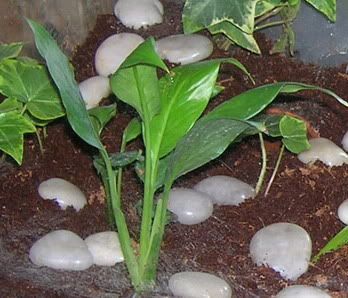
And this last one is another $.50 plant that I don't know. I think it's a peacy lilly, but then someone told me it's not.

Thanks,
Ronnie Nocera
Image

Replies (5)

odatriad Dec 29, 2005 10:49 AM

The first photo is of a Vriesea, most likely a cultivar of V. splendens. The second photo is of a Guzmania, not a Vriesea, and probably a hybrid between Guzmania species. Bromeliad species may be difficult to distinguish nowadays, due to hybridization and integration of different species and subspecies, not to mention many different cultivars of each particular species. Determining which genus a bromeliad belongs to is rather simple, as each taxa has rather distinct flower morphology, which differentiates eachother between genera.

The next two plants, going from left to right is Spathiphyllum("Peace Lily", and Dracaena, respectively. The exact species of each I do not know, as it is virtually impossible to tell which particular species it is, without being able to see the flower. Most species within each of these groups(Spathiphyllum and Dracaena) are very similar in overall appearance, and differ only in flower stucture. So without a flower to view, it would be near impossible to specify which species you are looking at.

As far as toxicity goes, there is nothing to worry about these plants, as they do not possess harmful alkaloids or other toxins, nor irritating/toxic sap as many other common household plants possess.

I hope this helps a bit, take care and have a wonderful day!

Bob
-----
Treemonitors.com

redmoon Dec 29, 2005 12:03 PM

Thank you! I really appreciate it.

Matt Campbell Dec 29, 2005 05:53 PM

>>As far as toxicity goes, there is nothing to worry about these plants, as they do not possess harmful alkaloids or other toxins, nor irritating/toxic sap as many other common household plants possess.

I have to disagree with Bob on this one. The Dracena plant is harmless, but not the Spathiphylum. Spathiphylum is in a huge group of plants called 'Aroids' which are characterized by their flower called a 'spath' which is the lily that the 'Peace Lily' [Spathiphlyum] gets it's name from. They're all toxic to a degree, some far more than others. Some like Diffenbachia can cause intense burning in the mouth and loss of the ability to speak if ingested, hence one of it's common names 'Dumb Cane.'
-----
Matt Campbell
25 years herp keeping experience
Full-time zookeeper
Personal collection - 21 snakes (9 genera), 20 lizards (4 genera), 6 chelonians (2 genera)

redmoon Dec 29, 2005 11:04 PM

Hm. So, would that be bad in a dart frog vivarium? Should I pull those ones out?

Matt Campbell Dec 30, 2005 01:21 AM

>>Hm. So, would that be bad in a dart frog vivarium? Should I pull those ones out?

No. The toxicity of plants is only an issue where you have herps that would consume them. Those plants are completely safe for a dart frog vivarium. Depending on your lighting though you may end up having to remove that Dracena as it might outgrow the vivarium. The same goes for the Spathiphylum - but at any rate it would be a while before they would get too large. You can always pick up plants like those at Home Depot for about $2.00 each - they're usually in 4 inch pots.
-----
Matt Campbell

Big animals, little animals, plants - right down to the sea itself. We need them, not just for their own sake, but because all this has to be here for everybody forever. Only one thing is certain: if we are to preserve our environment and save this priceless wildlife we need much, much more knowledge.
Harry Butler from 'In the Wild With Harry Butler' 1977

Site Tools