Hi there!
When I crossed two black back should I have red axantic? I read this on http://www.jbpythons.de/farbvarianten-englisch.htm this is true?
Cypress mulch is a good substrate to rack system?
Best regards
Welcome to kingsnake.com's message board system. Here you may share and discuss information with others about your favorite reptile and amphibian related topics such as care and feeding, caging requirements, permits and licenses, and more. Launched in 1997, the kingsnake.com message board system is one of the oldest and largest systems on the internet.



Hi there!
When I crossed two black back should I have red axantic? I read this on http://www.jbpythons.de/farbvarianten-englisch.htm this is true?
Cypress mulch is a good substrate to rack system?
Best regards
They have to be specific black backs that are heterozygous for the red axanthic, such as numbers 1,2and3 in the picture. Number 4 is a normal from the same clutch.
Cypress mulch is a good substrate, especially for species that require a higher humidity. Good luck. Rin

And if You cross numer one with number two You will have this?:

Yes, approximately 25% of the offspring would look something like that, 50% on average would look like numbers 1,2 and 3 and 25% on average would look like #4 (normal)
>>And if You cross numer one with number two You will have this?:
>>
>>
n/p
I may be wrong, but I beleive that Red Axanthic is the Dominant form of the morph (there wouldn't be a super). Corey posted a picture a couple of weeks ago of his breeding a normal:

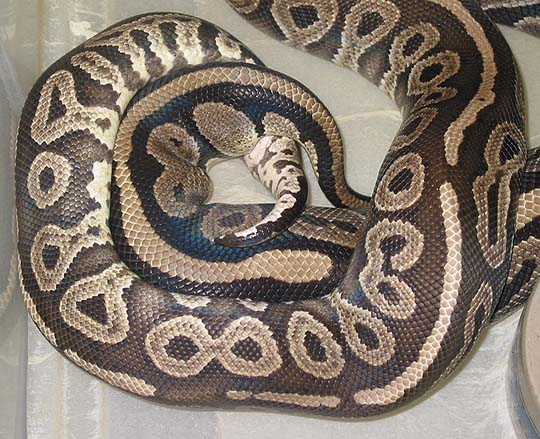
If you do search you can probably find more picts.
-----
Tosha 
"Nihil facimus sed id bene facimus"

10.35.0 Ball Python (Harry and Fluffy and gang)
1.0.0 Angolan Python (Anakin Skywalker)
0.0.1 Green Tree Python (Verdi - yeah I know but my kids love the book)
0.2.0 Feline (Pippen and Pandora)
0.0.1 Desert Tortoise (Pope John Paul aka JP )
2.2.1 Fish (1,2,3,4)
0.0.1 Lizard rescued from feline
0.0.0 frogs rescued from pool skimmer
Yes REDX are probably dominant
It's actually the difference between the two forms and normal that defines the mutation type as co-dominant. The mutation is co-dominant with the heterozygous version being a morph called "het red axanthic" and the homozygous version being a different morph version just called "red axanthic". It's a little different than a lot of the other co-dominant mutations in that it was first named for the homozygous version rather than the heterozygous version. It's sort of like calling lessers het leucistics rather than having their own name.
“Dominant” would refer to a mutation type and it would not be correct to call the red axanthic the “dominant form” of this mutation because the mutation type is still co-dominant regardless of if you are looking at a het red axanthic or a homozygous red axanthic. It's actually the difference between the two forms and normal that defines the mutation type as co-dominant. The homozygous red axanthics just have two copies of the red axanthic mutant gene and the hets only one.
The term “super” is often used for the homozygous version of a co-dominant mutation but it will get a little confusing if a completely dominant mutation is eventually proven because the homozygous version will look the same and not more “super” than the heterozygous version. By using genotypes like heterozygous and homozygous to describe animals you can use the same descriptions across all three mutation types (recessive, co-dominant, and completely dominant) and follow the same rules to predict their offspring.
Actually it would be correct to call both the red axanthic and the het red axanthic dominant type mutations (co-dominant or incomplete dominant) It would be incorrect to call the homozygous form 'The Dominant form'. Yes, I read Kevins book too and I disagree with him on that point. It would be more correct to say that the Het Red Axanthics are the heterozygous form of the mutation, and the Red Axanthics the homozygous form of the mutation.
Mark
>>I may be wrong, but I beleive that Red Axanthic is the Dominant form of the morph (there wouldn't be a super). Corey posted a picture a couple of weeks ago of his breeding a normal:
>>
>>
>>
>>
>>
>>If you do search you can probably find more picts.
>>-----
>>Tosha
>>
>>"Nihil facimus sed id bene facimus"
>>
>>
>>
>>10.35.0 Ball Python (Harry and Fluffy and gang)
>>1.0.0 Angolan Python (Anakin Skywalker)
>>0.0.1 Green Tree Python (Verdi - yeah I know but my kids love the book)
>>0.2.0 Feline (Pippen and Pandora)
>>0.0.1 Desert Tortoise (Pope John Paul aka JP )
>>2.2.1 Fish (1,2,3,4)
>>0.0.1 Lizard rescued from feline
>>0.0.0 frogs rescued from pool skimmer
Just wanted to post in addition to Randy's post regarding what Tosha said.
Firstly, regarding animals that are "Dominant" and "Co-Dominant/Incomplete Dominant" it is easier to remember it this way for me. A dominant animal will look the same in the heterozygous form (having only one of the mutant genes)as in the homozygous(having two of the mutant gene). A Co-Dominant animal will look visibly different from both the normal(doesn't have the mutant gene) and the homozygous (has two of the mutant gene, also called the "Super" .
.
Regarding "Supers", you can call any homozygous animal a "Super" meaning that it is at the opposite end of the spectrum from the normal, with an intermediate form.
Another good tool in understanding is knowing the principles of Genotype and Phenotype. Genotype means like it says, a description of what the specimens genes are. Phenotype, is a lil less descriptive, but it just means how the specimen appears.
Examples of phenotype, and genotype:
A het albino's genotype would be "het albino", while its' phenotype would be "normal"
A homozygous clown's genotype would be "Homozygous Clown", while its' phenotype would just be "Clown"
Hope this helps some, anymore questions feel free to ask.
-Dan
And also it is incorrect to refer to animals as dominant, co-dominant, recessive...
The genes are dominant, codominant or recessive, not the animals.
Animals have a phenotype and a genotype and may display (phenotype) a gene (genotype) that is dom, codom, recessive.
-----
when life hands you lemons, make super lemons, bumblebees, etc...
Help, tips & resources quick links
Manage your user and advertising accounts
Advertising and services purchase quick links
