Reptile & Amphibian Forums

Welcome to kingsnake.com's message board system. Here you may share and discuss information with others about your favorite reptile and amphibian related topics such as care and feeding, caging requirements, permits and licenses, and more. Launched in 1997, the kingsnake.com message board system is one of the oldest and largest systems on the internet.

Click for 65% off Shipping with Reptiles 2 You
https://www.crepnw.com/
Click here for Dragon Serpents

Could ratsnakes have come from venomous?

ratsnakehaven Jan 15, 2006 11:54 AM

I was reading from, The Snakes of Pakistan, this morning, by M.S.Khan, and saw in the venomous section that he considered several rear-fanged snakes as venomous, including...Coluber ravergieri, C. rhodorachis, C.ventromaculatus, and Spalerosophis diadema. I've also heard that Coelognathus radiata and Gonyosoma oxycephala have Duvernoy's glands. I not only think it's possible that racers and ratsnakes came from the same early ancestor on the colubrid family tree, but that the ancestor may also have been rear-fanged/venomous. Anyone want to comment as to those possibilities, or have any info on rear-fanged/venomous racers or ratsnakes? Thanks...TC
-----
Ratsnake Haven...researching ratsnakes since 1988

Ratsnake Haven Group...an information providing list site.

Replies (13)

Sighthunter Jan 15, 2006 10:24 PM

My hunch is that all snakes had venom.


-----
"Life without risk is to merely exist."

ratsnakehaven Jan 16, 2006 06:42 AM

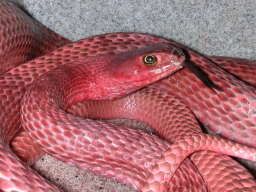
Wow! That's a great pic and beautiful snake. It shows the peculiar little subocular scale that I talked about before really well too. Thanks

I think most, if not all, snakes that were not boidae were venomous at one time. In other words, modern colubrids evolved from venomous snakes. Most of them still have Duvernoy's glands according to Dr. Fry (venomous forum), and technically are still venomous. I believe the only major group of non-venomous colubrids is the North American lampropeltinae...ratsnakes, kingsnakes, racers, etc. For some reason they have evolved away from using venom and lost the apparatus.

TC

phiber_optikx Jan 15, 2006 10:28 PM

I am by no means educated in this field but.... If you look back at evolution most everything starts simple and then gets more intricate. This leads me to believe that the venom came at a later point in the evolution. Just my 2 cents.
-----
0.1 Snow Corn "Hope"
1.0 Ball Python "Wilson" (Castaway)
1. Orange Albino Black Ratsnake "Chunk" (Goonies)
.1 Orange Albino Black Ratsnake "Peaches"
0.0.1 Mexican Black Kingsnake "Onyx"

ratsnakehaven Jan 16, 2006 07:26 AM

>>I am by no means educated in this field but.... If you look back at evolution most everything starts simple and then gets more intricate. This leads me to believe that the venom came at a later point in the evolution. Just my 2 cents.
>>-----

Maybe it did.

If you look at Australia, where nearly all the snakes, not boids, are highly venomous, you could say that these snakes are highly evolved. Now, if Australia were to become a very cool continent and much moister, the snakes would have to adapt to that, and maybe they would fall back on constriction more to secure their prey and not have to use the venom. Eventually, they might even lose their venom apparatus altogether. Just a point to show how something intricate could evolve and then be lost again.

This is what I think happened in Asia. As the continent cooled in the north and the snakes adapted to a cooler environment maybe they began to rely less on the venom apparatus and more on constriction. This theory could explain how the Lampropeltinae have lost the ability to envenomate and rely solely on other means to subdue their prey.

Anyway, I think it's likely that the racers and ratsnakes evolved from the same ancestral tree, and from a snake that was racer-like, had the ability to constrict, and probably was rear-fanged with Duvernoy's glands also. The remnants of that group of snakes can be found in southern Asia today.

Thanks for responding...TC

alex Jan 16, 2006 07:19 AM

It's definately looking like they did come from a venomous background (or are still venomous but lack delivery systems)
I forget the people who are all involved, but looking for Dr. Fry or Dr. Wuster on something like PubMed should get you enough hits, and the bibliographies on their websites
Basically all colubrids seem to have gone through a period of being venomous, from which elapids (who they still seem closest to) and vipers split off, and then colubrids have gone their merry way - very few, like the nor. am. lampropeltini, are truly non-venomous constrictors. If you look at exactly how they constrict, they are anatomically a little different than boids and it's probably a different evolutionary origin as a trait.

ratsnakehaven Jan 16, 2006 08:46 AM

Thanks for the response, Alex. I'll put a link to Dr. Fry's site below.

Since the boids are much more ancient than colubrids, crotalids, and elapids, I think it's likely that the colubrids evolved from the boids, or maybe an intermediate snake. Thus, I feel that constriction was only natural for early colubrids also. One thing I wonder about is, if they lose the ability to constrict, can it evolve again later on when the conditions have changed?

Interesting stuff and not easy to come up with answers. Hopefully, we'll learn more from the research of others who can come up with more data to work with.

Later....TC

Dr. Fry's site

alex Jan 17, 2006 12:41 PM

Why not? While evolution is limited by the morphology of the existing animal (it is highly unlikely elephants will ever begin to fly due to how much has been modified) the snake body plan is very well adapted for a trait like constriction. You can see those who don't constrict, snakes like garters which coil to restrain without pressure, what I think of as hemi-constrictors like the Pituophis who kind of smush their food until it stops moving, and then full constrictors (having been constricted by my male black rat, they are quite good at it... it took 2 hours for me to regain muscular control of my right hand)not to mention all the maybe-venomous and quite venomous colubrids out there.
Kardong's vertebrate text used to have quite a good introduction on how anatomy can shape evolution, at least in the edition I have. I haven't looked at subsequent ones.

ratsnakehaven Jan 17, 2006 07:40 PM

The whole concept of the constriction behavior is pretty interesting. Several snakes have been called "weak constrictors", including ringnecks and a couple garter snakes, making me wonder if they didn't evolve from a constricting snake. Also, there are a number of venomous snakes that also constrict. The mursurana and at least one cobra comes to mind. Sometimes snakes are pretty closely related and there are differences in constriction behavior. The Russian ratsnake seems like a pretty strong constrictor compared to some of the other Eurasian Elaphe. Even within one species, Elaphe dione, there seems to be some differences, whereas, the South Korean Dione's ratsnake seems to be a better constrictor than other members of the dione group. It's actually kind of unusual to be a strong constrictor in the colubrids and a lot of these are in N.A. It remains to be seen to me if any snakes are evolving towards being better constrictors, but a lot remains to be learned along these lines, imho.

TC

alex Jan 18, 2006 08:13 AM

There's also a difference between whether or not they can constrict and whether it's behaviourally relevant to their lifestyle - venomous snake eating venomous snakes I can see needing to constrict - can you imagine trying to hold down another powerful long-bodied animal with only your mouth? Apparently the relative length of epaxial to hypaxial muscles in snakes is a good indication of constricting ability, but a lot of my cb, never-eaten-live-animals simply don't. It'd be interesting to look at whether or not the capacity is there, but if the behavioural cues no longer need to be linked to the action - that kind of intense muscular work might be too costly in animals who eat relatively energy-poor diets, or ones like my E. climacophora who will eat mice, birds, etc, but really prefer energy-low but quiescent eggs. If they evolved more and more into the niche of an egg specialist, could they lose constriction as well?

ratsnakehaven Jan 21, 2006 06:34 AM

Hi, again, Alex. I've never delved into this topic too heavily, but it's quite interesting. I hope some researchers in the area publish one of these days. I've mostly been interested in comparing racers and ratsnakes and wondering if they were evolving towards or away from the constriction behavior. It seems to me to work under the idea of "use it or lose it." I think the N.A. ratsnakes radiated out from an ancestor that had good reason to use it under favorable circumstances. In Eurasia, the ratsnakes may not have had the same favorable circumstances causing pressure to rely on constriction. They seem to still have the racer characteristics to varying degrees. In N.A. the ratsnakes lost the racer characteristics, the racers and ratsnakes occupied separate niches.

Thanks for the input. Later...TC

ratsnakehaven Jan 29, 2006 02:32 PM

>>It's definately looking like they did come from a venomous background (or are still venomous but lack delivery systems)
>>I forget the people who are all involved, but looking for Dr. Fry or Dr. Wuster on something like PubMed should get you enough hits, and the bibliographies on their websites
>>Basically all colubrids seem to have gone through a period of being venomous, from which elapids (who they still seem closest to) and vipers split off, and then colubrids have gone their merry way - very few, like the nor. am. lampropeltini, are truly non-venomous constrictors. If you look at exactly how they constrict, they are anatomically a little different than boids and it's probably a different evolutionary origin as a trait.

McDowell, 1987, used this definition of the family, Colubridae, Oppel (ex Colubrini). Solid maxillary teeth anterior to fangs (if fangs are present), the fangs with open groove (not closed canal), below or behind pterygoideus attachment to ectopterygoid; if a thick-walled and muscularized venom gland is present (Mehelya and Gonionotophis), the attached muscle is the pterygoideus, not the levator anguli or oris or the adductor externus superficialis; venom secretion (lost in some) normally by Duvernoy's gland (in the supralabial gland, external to the quadratomaxillary ligament) supplying teeth (grooved or not) on rear of maxilla (opposite or behind posterior medial process of maxilla, adjacent to anterior attachment of pterygoideus superficialis). Distribution nearly equals that of terrestial snakes.

It seems to me that McDowell, and others, believed the base of the Colubroidea was comprised of snakes with venom and venom apparatus for delivery. I think he believed the Elapidae and Atractaspididae diverged early from the Colubroid stem and the Colubridae later gave rise to the Viperidae. It is thought that the Duvernoy's gland and fangs are lost in some genera/species, secondarily.

I'm not saying I believe this scenario of which family came first and evolved from which, and there's much more data today than back then, but the general idea of the ancestral Colubrids being venomous seems like a very strong possibility.

That's all for now....TC

-----
Ratsnake Haven...researching ratsnakes since 1988

Ratsnake Haven Group...an information providing list site.

snakesunlimited1 Jan 16, 2006 10:02 PM

Terry I just hate to think that our NA snakes de-evolved to non-venomous. Instead they skipped that route in my mind. Also the colder climates all over the world have seem to have fewer hots than nots. Is there some relation to temps and venom production/potency??

From the fossil records NA seemed to have been much colder in the recent history than it is now. The more northern areas of the US have less hots and less potent hots currently. Just look at the Canebreak/Timber Rattler. Some of the northern regions have snakes that can almost be considered non lethal but in Georgia there are Canebreaks that test out more lethal than the Mojave Greens. That is just one angle on the whole story and there are far to many for my little mind to wrap around fully but there seems to be something there to me.

I think in the US constriction is very highly developed. I think also that some of our rats snakes and kings can kill more efficiently than some of our hots. For instance I worked with a guy with a large hot collection and he fed live pre-stunned rats to his larger animals. One time we fed a cotton mouth and a large king at the same time without pre stunning. The snakes were the same size and the rats were as well. The king killed and started eating his rat before the cotton mouths rat had even stopped twitching. If not for the cage the cotton mouths rat would have hopped a long way off before it died finally. Would the loss of venom and the subsequent energy used tracking the prey cost more in the end in a colder climate??

Like I said it is to big for me to wrap my head around but the many different angles are interesting for sure. I know also before you guys get started that there is about 30 different angles to what is more a efficient means of killing. My point is only that I feel that because of our colder climate constriction was more useful in the past and our snake never had venom. If they do now they are evolving to use it and not de-evolving to not use it. Just my opinion based on nothing other than feelings

later jason

ratsnakehaven Jan 17, 2006 05:08 AM

Jason, the radiation of the North American Lampropeltinae is one of the more difficult to understand with data being hard to find and accumulate through the years. It goes way back before the Pleistocene and those cold Ice Ages. I didn't mean to get into all that, but just wanted to draw a comparison bt. the racers and ratsnakes. In North American racers and ratsnakes don't seem much alike because neither group evolved on this continent, according to theory. Ratsnakes have come a long way before getting to where they are today, and yes they are better constrictors. Probably because they have maintained that behavior instead of evolving away from it and becoming racer-like. I do believe that climate has something to do with it and venom is much more prevalent in hotter climates, especially tropical. My theory is that as land masses became drier snakes started changing towards more racer-like behavior. They needed to be quick and efficient in dispatching their prey. The venom helped break down tissues so the snake could digest faster which racers tend to do. You must also remember much of the venom and venom apparatus evolution occured a long time ago, not today's world.

Thanks for your thoughts....Terry