

Reptile & Amphibian Forums

Welcome to kingsnake.com's message board system. Here you may share and discuss information with others about your favorite reptile and amphibian related topics such as care and feeding, caging requirements, permits and licenses, and more. Launched in 1997, the kingsnake.com message board system is one of the oldest and largest systems on the internet.

Click for 65% off Shipping with Reptiles 2 You
Click for ZooMed
princess_venom Aug 14, 2006 06:39 PM

For anyone who's good on day geckos..

Today I bought a new day gecko to replace my poor male, George. I picked it up from the store earlier today, and brought it home. It was sold to me as a giant day gecko, male. Anyway, it looks female. I couldn't see into the tank, as it was high up and I'm short.. but I trust this store as I've been going there for years. When I compared it with my female at home, I noticed that it's slightler paler than her... well... obviously paler. Here's the photo:
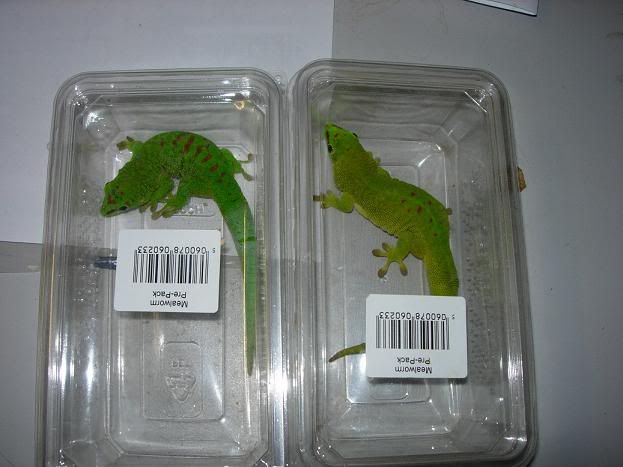
The one on the left is my old female, and the right is the new gecko. To me, it doesn't look quite like a phelsuma m. grandis... perhaps a phelsuma m. kochi? Is anyone else 'up' enough on day geckos to confirm this with me? If it is a kochi, I think he/she will need to go back to the shop if they'll take it back, as I don't really have the space or money to have a kochi instead of sorting out my breeding pair of grandis's :/

Replies (2)

reptayls Aug 17, 2006 07:57 PM

It sure looks like our pair of day geckos: Phelsuma madagascariensis madagascariensis.

We call them "mad mads". Slightly different than the grandis. The spots on the back are commonly round.

Check around on the web - I am sure you will find pictures. Good luck with your breeding project.

oliverk Aug 24, 2006 12:05 PM

Honestly, she looks like a grandis to me, but if anyone else would like to comment, please do. She's very nice and fat, if you keep her I'd put her on a slight diet, since if she is going to be used as a breeder, overweight geckos have a higher chance of producing infertile eggs, and they have a higher chance of becoming eggbound. No big deal, just lower her fat intake, ie just feed her crickets, no waxworms or other fatty insects. Hope this helps...
-----
1.4.8 leopard gecko
2.3.0 nephrurus levis levis
1.1.0 nephrurus wheeleri cinctus
1.0.0 nephrurus amyae
1.1.0 pastel ball python
1.0.0 axantic kenyan sand boa
1.0.0 gargoyle gecko

Site Tools
