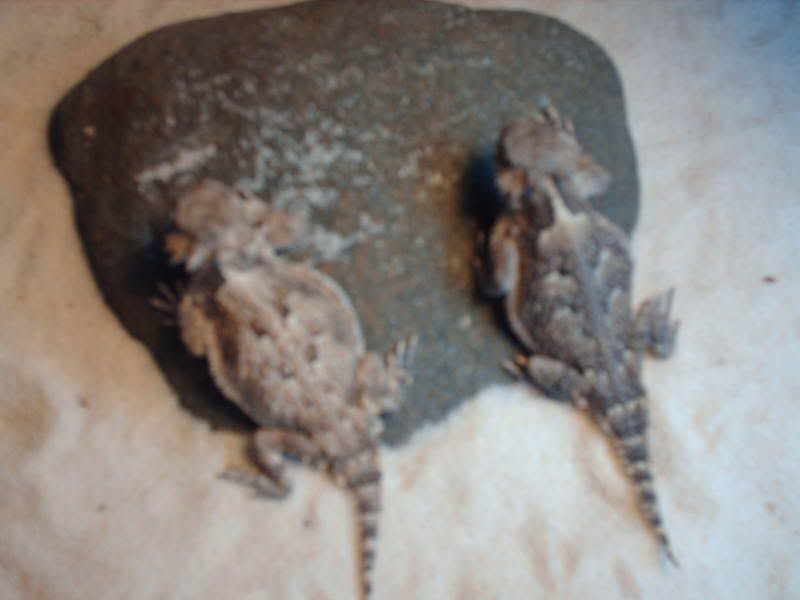
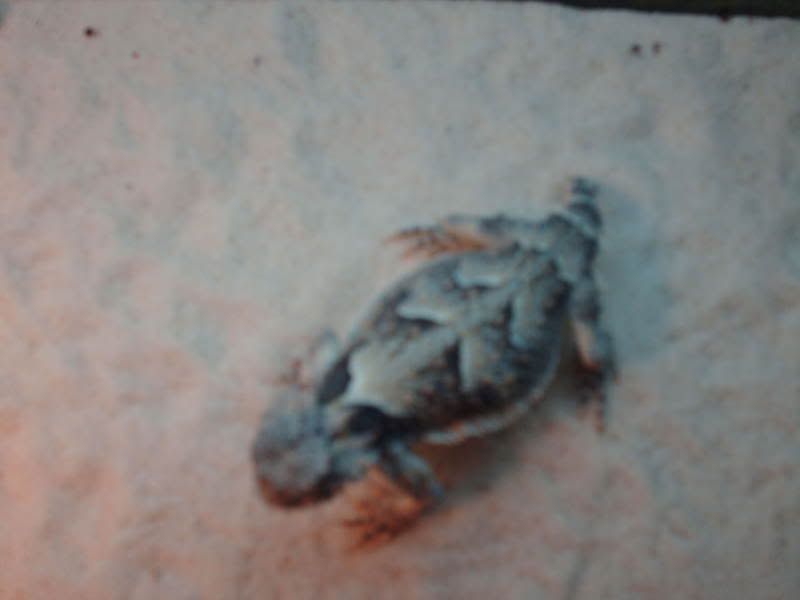
Can anyone tell by looking at dhl's if they are a male of female? I can't tell by looking under their tail. Picture 1 is suppose to be a male and female. Picture 2 is suppose to be male. Sorry the pictures are a little blurry.
Reptile & Amphibian Forums
Welcome to kingsnake.com's message board system. Here you may share and discuss information with others about your favorite reptile and amphibian related topics such as care and feeding, caging requirements, permits and licenses, and more. Launched in 1997, the kingsnake.com message board system is one of the oldest and largest systems on the internet.



Male/ Female
treerich4
Sep 09, 2006 04:12 PM
Replies (8)
Cable_Hogue
Sep 09, 2006 04:56 PM
The one on the left in the first pic might be a female. Hard to say.
They look a little thin in the hips. This makes it harder to tell, especially with these pics. Do you have an more?
-----
 Phrynosoma.Com
treerich4
Sep 09, 2006 06:08 PM
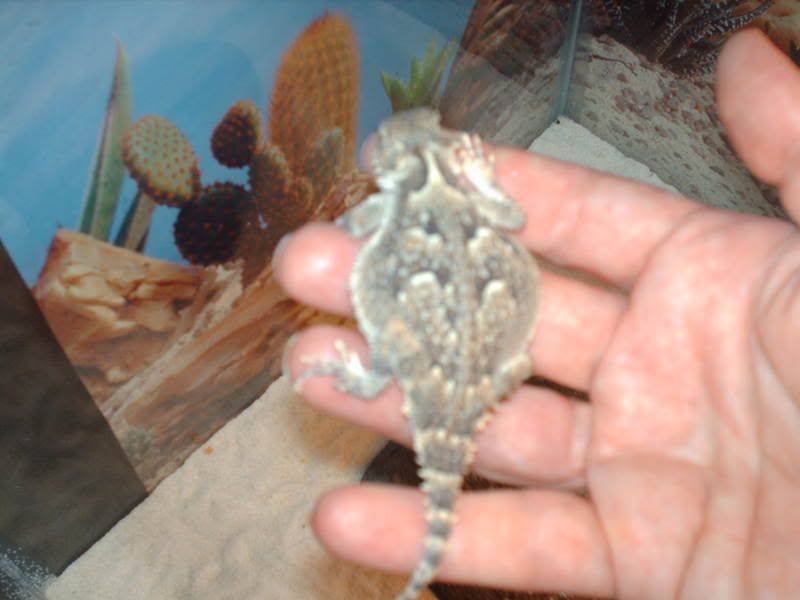
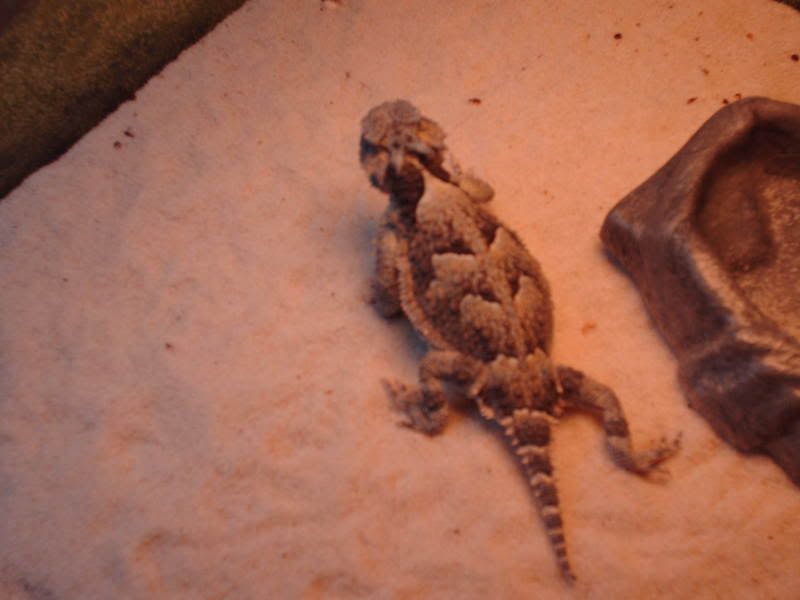
The first picture is one of the ones in the first picture. The other dhl was buried. The second picture is the one in the first second picture.
Ryan-reptilian
Sep 10, 2006 01:10 AM
Looks to me like in the first pic female on the left male on the right. The second picture looks all female to me.
-Ryan
Les4toads
Sep 10, 2006 03:45 PM
These two horned lizards look to be in real poor shape. Their weight and fat storage need major work. The one on the left is female and the one on the right is male. I would work at an even pace to build up the fat storage and increase their weights. Do not feed the horned lizards anything that is high fat content or use any vitamin supplements initially. Ants are the primary diet and that is the primary food item to work with initially. After there are signs of weight gain, very minimal supplements can be supplied, but I recommend against that, as the natural diet will be the best cure. Provide fresh water at all times for hydration.
Lester G. Milroy III
Conservation Biologist
treerich4
Sep 10, 2006 06:22 PM
Thanks les4toads. Now I know it is not my imagination. I have been very worried about those two. I have had them since July 28 2006. I feed them all the ants that they will eat. I give them fresh water in a dish and I mist them three times a week. I fed them crickets and mini mealworms when I ran out of ants. The temp is 105 and cool end 80. They have a 8.0 uvb about 6" from them. Is there anything else I can do to fatten them up. I do not want to loose them. Should I seperate them?
fireside3
Sep 10, 2006 11:40 PM
You haven't had them for that long and I'm sure you got wild caught. They're usually not well taken care of when you get them. That's another reason I'm against wild sales. It may take a while, but I think Lester is steering you right. They should have been seperated in the beginning for quarantine ideally, but right now I'd say they only reason to do so is if one is sick, or you're having trouble making sure they are equally feed.
-----
"A man that should call everything by it's right name, would hardly pass the streets without being knocked down as a common enemy." The Complete Works of George Savile, First Marquess of Halifax 1912,246
treerich4
Sep 11, 2006 05:56 AM
When they were shipped to me, they were in the same container. I figured if one had something then the other one did too. And yes, they were wild caught. They are seperated from my other female however.
fireside3
Sep 13, 2006 07:36 PM
This is a question for a biologist:
I often skip supplementation in sick herps where supplementation has no bearing on the likely illness, and I often skip heavy protein/fat...just to put less of a strain on the organs in general. Especially with regard to digestion and bowel movement.
But in this case ( emaciated ), is the logic primarily the same? i.e. taxation on organs, such as the liver, and reduction in metabolism from excessive fat and unnecessary supplements?
-----
"A man that should call everything by it's right name, would hardly pass the streets without being knocked down as a common enemy." The Complete Works of George Savile, First Marquess of Halifax 1912,246
