Reptile & Amphibian Forums

Welcome to kingsnake.com's message board system. Here you may share and discuss information with others about your favorite reptile and amphibian related topics such as care and feeding, caging requirements, permits and licenses, and more. Launched in 1997, the kingsnake.com message board system is one of the oldest and largest systems on the internet.

Click for 65% off Shipping with Reptiles 2 You
Click for ZooMed
Click here for Dragon Serpents
Shane_OK Dec 14, 2006 09:59 PM

Does anyone know of a good online photo of this species? I have googled endlessly and can't seem to find one.
Also, this link, which seems to have some questionable accounts, lists Elaphe davidi as occuring in the Mt. Jirisan area of the ROK??
http://en.wikipedia.org/wiki/Snakes_of_Korea#_ref-3
Does anyone breed the species? Are they imported from time to time? I don't have the Elaphe Monograph, so any general info on them would be appreciated.

Thanks,
Shane
-----
Lifelist

Replies (26)

Shane_OK Dec 14, 2006 10:35 PM

www.wwf.com.cn/csis/search/english/detail.shtm?cspcode=030470053

I started checking some of the Chinese links...duh.
-----
Lifelist

jfirneno Dec 15, 2006 08:53 AM

Shane:

There's not a lot out there.

With respect to occurrence in South Korea, Schulz states “The Korean distribution was only recently discovered (Szyndlar 1985). All present records come from the southwestern part of the country (meaning North Korea), thus it can be assumed that the range extends into South Korea as well”. The distribution map has two records right on the northwest side of the DMZ. As far as I know no one is breeding (or even keeping) davidi. Schulz has a picture of one in his monograph. This specimen was picked up in a chinese food market. Schulz quotes Helfenberger (who is an associate of his) that it “is a very agile snake that can bite strongly if threatened”. There isn’t very much natural history info available. Among the food items found in stomach contents were small mammals, birds, eggs, lizards, frogs and at least one snake (elaphe dione). Habitat info indicates a “vertical distribution between 100 and 1000 meters above sea level”. There are some records indicating proximity with water (streams and dry canal beds) in summer months could be important. Older sources like Pope say preferences are for “open river valleys at moderate altitude”. “Boulenger notes a rocky canyon as a locale”. “Sowerby stated that E. davidi inhabits the same biotopes as E. dione”.

That’s about all the info I’ve ever seen.

Best regards
John

Shane_OK Dec 15, 2006 09:32 PM

John, many thanks for the info and the link. The odd thing about that wikipedia article is that it says they occur around Jirisan, which is in the southern part of the ROK. I wish I knew where that info came from......possibly just misinformation, but then again, there are other equally strange isolated distributions in that part of the world. One more to-do on my research list. Unfortunately, all of the time I spent in Korea was when the ground was frozen solid!

Shane
-----
Lifelist

jfirneno Dec 15, 2006 10:50 PM

Shane:
You're welcome. About the southern locale, Schulz assumed the range was much greater than was known. Climatically southern South Korea is comparable to the Chinese range for davidi. So who knows.

I envy you your globe-trotting travels. Boy I wish I could head out to Asia and see mandarins or porphys where they live. The most exciting field specimens I find are eastern milks. But please take some pictures for the rest of us to enjoy. Who knows. Maybe you'll be the first guy to raise davidi in captivity.

Best regards
John

jfirneno Dec 15, 2006 12:40 PM

I finally found a photo link (see below). When you open the link there's a photo of an anomala showing. Just use the right arrow below the photo to advance (in alphabetical order to davidi).

Regards
John
Elaphe photos

ratsnakehaven Dec 15, 2006 06:20 PM

>>Does anyone breed the species? Are they imported from time to time? I don't have the Elaphe Monograph, so any general info on them would be appreciated.
>>
>>Thanks,
>>Shane

Shane, I've never heard of any being imported or any herper that has one. Photos are very rare also. They have been discussed slightly before alluding to their rarity mostly. IMHO, davidi probably belongs in a group with Elaphe carinata and E. quadrivirgata. It is a montane snake with heavily keeled scales, medium sized, 21-23 DSR, divided anal, and the supraoculars are large and slightly protruding over eyes, as with carinata and quadrivirgata. Also, they sometimes eat other snakes. They also have hypapophyses which are curved forward, probably for breaking egg shells of birds. Along with the info John gave that's probably about it.

TC

Shane_OK Dec 22, 2006 02:51 AM

TC, I've been meaning to reply to your post for some time. Personally, after viewing the pics of davidi alone, I think it deserves unique generic status. Its scales are keeled on an order with carinatus, maybe more so, but it has round pupils. The pupils alone seem to considerably distance it from carinatus and quadrivirgata. Probably closer to schrencki, which would make sense given geographic distribution.
On a side note, my quad loves eggs!

Shane
-----
Lifelist

ratsnakehaven Dec 23, 2006 07:42 AM

>>TC, I've been meaning to reply to your post for some time. Personally, after viewing the pics of davidi alone, I think it deserves unique generic status. Its scales are keeled on an order with carinatus, maybe more so, but it has round pupils. The pupils alone seem to considerably distance it from carinatus and quadrivirgata. Probably closer to schrencki, which would make sense given geographic distribution.
>>On a side note, my quad loves eggs!
>>
>>Shane
>>-----
>>Lifelist

Carinata, quadrivirgata, davidi, and schrencki are all very different from each other and I would think have been separated for a very long time. I link davidi with carinata, tentatively, because of the differences they have and separation, but if carinata were different enough from other Elaphe to give rise to new species then the direction, to the northeast, would be a good direction to go in. The differences they have could be explainable from moderation of carinata's characteristics, adaptations to new ecosystems to the cooler north. The change in the eye shape could be from an adaptation to a more diurnal way of life, in which the eliptical eye wouldn't be necessary. However, I don't claim to be the expert on this. It's just a suggestion, and there could be several other possibilities for the evolution of davidi in the location it's at.

Thanks for the discussion and keep at it. We need all the workers we can get on this part of the world.

You still are keeping quadrivirgata? For some reason I thought you moved on from those guys. That's great! What kind of eggs are you feeding them, and how often? Do they break the eggs, or swallow them whole? Great to be able to make those observations. I think the snakes of the main Japanese islands have been separated from the mainland forms for a very long time, possibly since the Miocene. The distances in relationships are pretty large. Japan is another great place to study the evolution of these snakes.

Happy Holidays again...Terry

nydon Dec 16, 2006 10:26 AM

The location described (as best I can understand it) would put my house inside its range as I live a stones throw from the DMZ. I have never discovered E. davidi either where I live OR in any of my travels. I did a tv program on Korean snakes with Dr. Sim. This species was never discussed and to my knowledge is not covered in his book (I am not for sure as I do not have a copy readily handy right now).

I looked at the link John provided and the pictured snake resembled more of a Gloydius species to me (especially the head and keeled scales). I kind of chuckled because the first thing I thought when I saw the pic was G. saxitilis / E. dione hybrid (of course that is just based on the pictures appearance and I am not insinuating or implying anything here).

I will try to research it a bit more here locally and see if I can locate one through my contacts with local mania.

Don

jfirneno Dec 16, 2006 11:25 AM

Don:

That's very interesting. The reference given for distribution of davidi near the western end of the DMZ in North Korea was the following article:

Szyndlar, Z. (1985): Occurrence of Elaphe davidi (Sauvage, 1884) (Serpentes: Colubridae) in the Democratic People's Republic of Korea. - The Snake, Nittagun, 17 (2): 163-167

Now since Comrade Szyndlar probably had to hand over his collected specimens to the North Korean government and since food is usually in short supply there I imagine they've already been eaten. But if there are any on the South Korea side of the border then possibly Schulz is justified in hoping that they are to be found. But then again maybe he's wrong. I hope he's right.

As for the picture at that link I provided, it resembles the photo of davidi found on Plate 7 of Old World Species in Schulz' "A Monograph of the Colubrid Snakes of the Genus Elaphe Fitzinger". The shape of the head seems a little different and this animal is pretty well fed compared to the animal in Schulz but the overall look is quite similar. That snake was from Shaanxi Province, China. Where the photo on the link comes from is open to question. I notice that some of those photos are borrowed from Schulz' website but without acknowledgement. So maybe the davidi was borrowed in an equally casual fashion from another legitimate source. But that doesn't make it improbable that it is davidi (just makes it harder to confirm it).

Best regards and Merry Christmas
John

nydon Dec 17, 2006 08:21 AM

John, thanks for the info. I am going to make a point this coming year to try to locate E. davidi here in the ROK. I was planning on doing a bit more work with Dr. Sim regarding E. s. schrenki / anomala so I will also discuss and hopefully try to confirm E. davidi presence with him. However the snow is now falling so it will have to wait some.

It is very difficult to get much info on Korean snakes. Most of what I see is drawn from those species with large distribution areas and the sources I believe are more China than actually Korean. I know that most of the Korean species represented in U.S. collections are actually out of China or Russia with the possible exception of E. dione and perhaps a very few E. s. schrenki that would have been exported many years ago by the late Lloyd Lemke. To my knowledge there has not been anything legally taken out of Korea since then.

Thanks again for the info,
Don

jfirneno Dec 17, 2006 08:59 AM

Don:
I'm really glad Shane started this thread. This is one of the most interesting threads I've read in a very long time. We get people on here from the US and even a few from Europe. Recently I've seen a few folks from Taiwan and Southeast Asia on here. We had a post a little while ago from a fellow visiting the Philipines who had a nice photo of a Coelognathus species he'd field photo'd.

And now someone in Korea can comment on one of the few ratsnakes that nobody ever hears about. Recently I posted a photo of a hatchling schrencki and Shane posted a photo of a Gloydius to note the similarity in pattern. Then Shane posts a question about davidi and you post photos of Gloydius to comment on it. Definitely good to hear some new info around here.

I'm interested in mandarina and other asian ratsnakes. Most of my information comes from Schulz's book because that really is about the extent of info out there. I never see anyone posting anything from China (well we used to get some messages from a few animal dealers in Hong Kong). The Chinese would be the ones to answer alot of the questions about mandarina, moellendorfi and several other interesting species. It's good to see that there are a few people interested in herps who are actually located in Asia (either permanently or periodically) and can communicate with us here on this forum.

Best regards
John

nydon Dec 17, 2006 05:07 PM

John, thanks. I got the email and will respond in more detail direct.

I have not done a lot of work with korean species because i cannot legally sell them here. I import from indo and the US for the herp trade. I also have several breeding projects including several morphs of boas, balls, retics, kings, corns, leopard geckos, etc. I also have projects with chondro, scrubs, carpets, d'alberts, some varaus species etc.

I had hoped to do more work last summer with some korean species (field work) but the herp program I do for sbs tv scheduled me for a trip to australia so i spent a month there this spring instead. I was scheduled to go to Biak / PNG for 40 days beginning in august but landed up in the hospital for a spell a week before we were to depart. Unfortunately all this left me no time except for what I observed and photographed around my farm and a short field trip in june to an island west of Inchon. I will do much more work this summer as I believe there is too little reliable info out there on korean snakes. Most references are to Baek & Sim (1999) and their info is vague and based on my speakings with Dr Sim, may be a bit lacking.

I only got a few hours of sleep but will post a thread on E. schrenk/anomala and reply to the email later today. I am glad to see interest in asian species and if i can help anyone to obtain information at this end, will certainly try to do so.

Thanks, Don

jfirneno Dec 17, 2006 05:51 PM

Sounds like you have a pretty cool job. Trips to Australia for herp stuff. Very nice.

Regards
John

>>John, thanks. I got the email and will respond in more detail direct.
>>
>>I have not done a lot of work with korean species because i cannot legally sell them here. I import from indo and the US for the herp trade. I also have several breeding projects including several morphs of boas, balls, retics, kings, corns, leopard geckos, etc. I also have projects with chondro, scrubs, carpets, d'alberts, some varaus species etc.
>>
>>I had hoped to do more work last summer with some korean species (field work) but the herp program I do for sbs tv scheduled me for a trip to australia so i spent a month there this spring instead. I was scheduled to go to Biak / PNG for 40 days beginning in august but landed up in the hospital for a spell a week before we were to depart. Unfortunately all this left me no time except for what I observed and photographed around my farm and a short field trip in june to an island west of Inchon. I will do much more work this summer as I believe there is too little reliable info out there on korean snakes. Most references are to Baek & Sim (1999) and their info is vague and based on my speakings with Dr Sim, may be a bit lacking.
>>
>>I only got a few hours of sleep but will post a thread on E. schrenk/anomala and reply to the email later today. I am glad to see interest in asian species and if i can help anyone to obtain information at this end, will certainly try to do so.
>>
>>Thanks, Don

ratsnakehaven Dec 17, 2006 06:32 PM

>>I know that most of the Korean species represented in U.S. collections are actually out of China or Russia with the possible exception of E. dione and perhaps a very few E. s. schrenki that would have been exported many years ago by the late Lloyd Lemke. To my knowledge there has not been anything legally taken out of Korea since then.
>>
>>Thanks again for the info,
>>Don

Hi, Don. Good to see you on the forum again.

I got my E. dione from Lloyd Lemke back in 1996, I believe. He was one of two herpers that helped get me started in Eurasian ratsnakes. He also got me started with E. bimaculata. In our talks we never mentioned any other Korean snakes that I remember. I'm pretty sure he would have told me if he had E. davidi.

I don't have the original dione pair from Seoul, anymore, but here's my F1 female...

I do think there's a lot of variability in the dione in South Korea. I've hatched out several clutches with light and dark ones and some differences in pattern. They still look quite a bit different from the Chinese dione, however.

The dione, like E. davidi, are kind of montane. I believe they're in the lower and medium elevations. A friend of mine who works in Seoul found a couple dione last summer. They looked similar to the ones I have. I understand dione can be found on Quelpart Island too. That is pretty far south. I'd love to see one from there.

Rufodorsata is another type of ratsnake-like snake that occurs in Korea. Along with schrencki, that would be at least four ratsnakes there.

Thanks for the post and good luck finding davidi.

Terry

nydon Dec 18, 2006 03:34 AM

nice looking dione. I will post some pics of a few I have found around my farm. I will post them on a new thread and perhaps others who keep them can post on the same thread so we can go right down the line and look at the various patterns/colors. I attatched a few field pics of a E. Rufodorsata that you made reference to. This one was found near Shihueng.

I often wondered what Lloyd was calling Seoul dione. I am wondering if he was simply refering to the NW portion of the ROK. I am sure there are some dione in Seoul but for those who know Seoul, it is not exactly what one could consider "prime habitat. I more suspect he was refering to what is known as the "green belt" which is a farm/no build area surrounding the city.

Anyway, thanks for the input and hopefully this summer I will be able to get a davidi so at least we can have some more detailing pics of the species than what I see out there now.

thanks,
Don

dinodon Dec 18, 2006 04:30 AM

Nice pics and info Thanks.
Looking at the pics of the E dione I'm starting to think the albino E bimaculata I have, might be an E dione, Their patterns, size and shape are very similar and with the pigment gone it makes it very difficult for me to ID it.
Are there any difinitive featur differences between the two species, I can look for to help ID this snake ?
I'll post pics as soon as I get a chance.

nydon Dec 18, 2006 04:57 AM

as i am just getting started with these species, i suspect there are much more qualified people on this forum that can answer your questions.

I will post shortly some pics of some of the dione I have found around my farm including some closeups of the heads. I am not sure if there is a difference in head scales.

My intent this summer is to locate and take photo id's of as many snakes as possible and keep very detailed info including scale counts, weight, length, eye/tongue/belly color, etc.

Hopefully I can do something constructive to help with some of the lack of info concerning at least the species found here in Korea.

I would love to see the pic of your amel.

PS. based on your forum name, thought you might enjoy the attatched pic. I have better pics but could not locate them right now.

thanks,
Don

ratsnakehaven Dec 18, 2006 05:07 AM

>>Nice pics and info Thanks.
>>Looking at the pics of the E dione I'm starting to think the albino E bimaculata I have, might be an E dione, Their patterns, size and shape are very similar and with the pigment gone it makes it very difficult for me to ID it.
>>Are there any difinitive featur differences between the two species, I can look for to help ID this snake ?
>>I'll post pics as soon as I get a chance.

I don't keep Chinese dione anymore, but have in the past. The differences are somewhat subtle, but there are some. If you can, post a photo of the head, both above and from the side. You can often tell from the head shape. Also you could count dorsal scale rows. Dione sometimes has more rows than bimaculata. There are differences in behavior too. In person, I could tell them apart easily by picking them up. Dione are calmer and constrict more readily, whereas bimaculata are much more nervous. We should be able to tell from the pics, however.

Look forward to it, but have to run off to work now. Talk more later on...

TC

ratsnakehaven Dec 18, 2006 04:57 AM

Thanks, Don, and thanks for the rufo pics.

I think a dione thread would be great, but I don't think many hobbyists in the U. S. have dione from ROK. Some have Russian or North Korean which are not too distant, however, but I've seen very few on this forum. My friend in Seoul might have one or two still. The photos he sent me aren't too great, however. I'd love to see your pics. Here's an old scan of the original male and female I got from Lloyd...

I don't think Lloyd ever said they were from inside Seoul, but rather from near Seoul. I'm sure they were in the farmland and hills, also. This pair has produced a bit of variation too. I would be able to post photos of a number of different individuals from this stock.

I'd love to see photos of your farm and any herps you find there. There is precious little information coming out of the ROK, as well as other Far Eastern countries. Even info on the habitat and climate, etc, is very interesting most times. I know the peninsula has cold winters, as I monitor the temps in Seoul. I understand the summers are moderate and humid, but more details would be nice, like "How long?", etc. Are any of the snakes nocturnal? One of the things that strikes me is how much hill or mountainous terrain there is. Doesn't seem like there's much in the way of level country or low elevations.

Thanks for keeping up the strand and look forward to a new strand. I hope you find davidi next summer, but they are supposed to be pretty rare. Have a nice holiday...

Terry

Shane_OK Dec 16, 2006 04:44 PM

That's a nice lookin' tigrinus! Is that typical color and pattern for Korea? Here are some Rhabdophis tigrinus from Japan:

What species of herps do you find regularly throughout Korea? From what I understand, it is a relatively poorly surveyed area?
I'd love to see some ratsnake and habitat pics from the field!

In regard to the link that John provided, the snake certainly looks like the same species as the link I pasted. Definitely not Gloydius sp..

Shane
-----
Lifelist

nydon Dec 17, 2006 05:31 AM

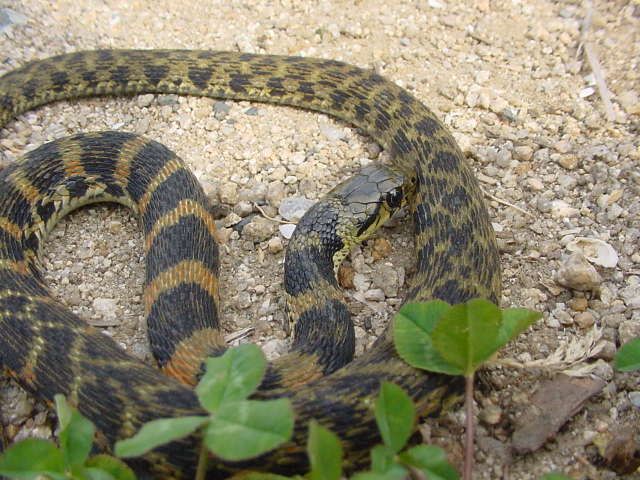
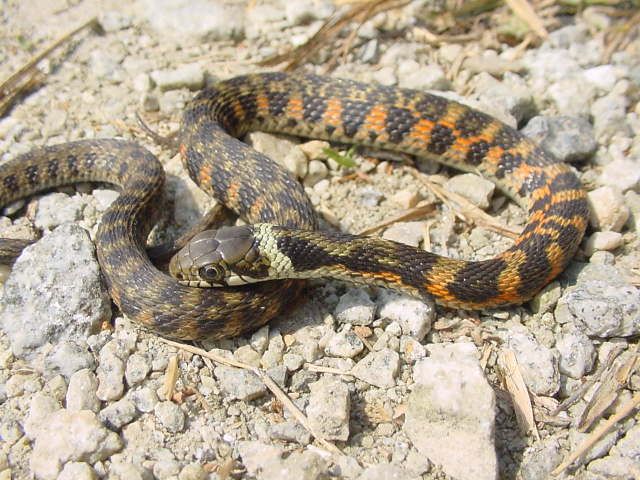
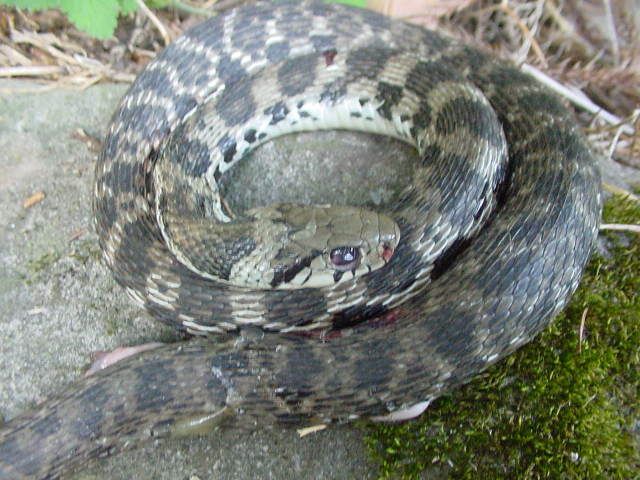
yes, i have located keelbacks down south near masan (2nd and 3rd pics) and see them around my farm (which is way up north) (1st pic)on a regular basis and the colors are all fairly typical of the ones in the pics. Not nearly as variable as E. dione.

The most common snakes I locate are Gloydius, E dione and Rhabdophis. I do not really field hunt them because they are not supposed to be kept but did some field work while filming a tv series here in korea. I commonly see them though while working around the house or horse riding in the hills behind my place.

I normally am too busy with the reptiles i import and breed at my facility but here recently i have had an interest in doing some work with E. dione (pertaning to locating and photographing various localities to see if there is pattern colors that are locality specific or if it is simply a highly variable species). I also was hoping to go back to an island that we visited west of inchon. While filming I located a melanistic (of sorts) E. schrenki and I wanted to do a follow-up to see if i could locate any others with the same hyper melanism. My line of thinking is that due to the cooler climate of the island, perhaps the population has evolved the darker coloring to help with heat absorption. I will post some pics of it (i had posted a few before some time back on another forum). Anyway, now with this original post, I am building a bit of an interest to see if I can locate any E. davidi.

well....

The wife is needing the PC now so I will post some pics/replies later.

Thanks, Don

Shane_OK Dec 16, 2006 04:49 PM

What is the local mania?
-----
Lifelist

nydon Dec 17, 2006 04:55 AM

sorry, a bit of konglish or slang. Mania just means interest in the subject. Everything is mania over here, like golf mania, movie mania or in this case herp mania.

thanks,
don

beau Dec 20, 2006 10:23 PM

ive had them offered to me but they were being caught in china. I dont have any more info than that, but i can try to contact the exporter in china to find out information. I havent seen them on price lists for over 10 years

beau

Shane_OK Dec 21, 2006 09:27 PM

Thanks Beau, any info on them would be appreciated (probably more so by academic ratsnake types). They're probably not uncommon where they occur, but much info is obviously needed on them.

Shane
-----
Lifelist

Site Tools