I took a photo of one of my "sleeping" mandies

Regards
John
Welcome to kingsnake.com's message board system. Here you may share and discuss information with others about your favorite reptile and amphibian related topics such as care and feeding, caging requirements, permits and licenses, and more. Launched in 1997, the kingsnake.com message board system is one of the oldest and largest systems on the internet.



I took a photo of one of my "sleeping" mandies
Regards
John
John, that looks like a nice looking Sichuan. What temps is he brumating at? I've got mine at 60*F, and I'm wondering if I should take them lower. Thanks,
Terry
Terry:
He's my oldest male from Rex. I'm thinking of using him for breeding this spring. Up until a few weeks ago it was about 60 F in the basement. But the very cold snap we've had has finally dropped the temps below 50 F. I hope it will last long enough for the foxes to click for breeding. I guess it's enough for the mandarins. But of course I shouldn't count my chickens before they're hatched (in a manner of speaking). Over in western NY they got over 8 ft of snow in the last few days and more is on the way. We've had about 1.68" in Grafton, MA in the last 2 months. It's a wacky winter.
Best regards
John
I think our Sichuans are related, haha. Mine are still a little young. I may wait another year.
Yeah, the weather has been weird this winter. We didn't have any snow cover til mid-Jan, then it started to get cold afterwards. The past couple weeks have been bitter and the cold tolerant snakes have had their exposure to 45-50*F. I didn't brumate most of mine until near January, however. It will probably be a few more weeks of real cold, I'd think. Looks like we'll be breeding near the end of March this year.
We have close to a foot of snow cover, but nothing like western NY. Lot of lake affect around L. Ontario. I've had a chance to work in the woods and have all my new wood cut for next year. Also have all the ponds ready, brush trimmed, etc, and waiting for spring. The frogs and toads should be happy.
Nice to see ya over at the new ratsnake site. Take care...
TC
Related for sure. The more I work with mandarins, the more I appreciate the stock from Rex. He must have a good eye for snakes. And his animals have been consistently good feeders which is a plus for mandarins.
Hey, we may get a foot of snow this Wednesday. I'm almost looking forward to it.
Good seeing you too Terry.
Best regards
John
I'm sure this topic has been discussed numerous times on the various forums, but it's a topic that I rarely follow. Recently, on another forum, it was mentioned that a good rule is to use the mean annual temperature from a species native range as a basis for brumation temps. The logic sounds solid.....though I've never tested it.
Of course, many claim that keeping the animals in the dark is more important. I suspect that line of thought comes from those who are keeping subtropical animals, where the mean annual temp is only in the mid 60s, or higher (thus inconclusive results). Certainly that logic would fail when trying to (successfully) cycle vulpina?
I wonder, with some of the northern species, if you can get away with higher than ideal brumation temps, as long as you provide a short cycle or two of lower temps?? Since you guys deal with some of the higher latitude species, I'm curious to know what kind of results you've experienced. I need to start getting a feel for these sorts of things, as I'm sure it will be critical to keeping wild conspics successfully.
I guess now would be as good a time to ask as any........what's the story with wild, adult conspics? The only literature I've read is from the KDS monograph. I don't have it on me right now, but as I recall, the biggest problem was the animals going off feed for extended periods. That, by itself, doesn't bother me, but if their expected mortality rate is anything like wc mandarinus or moelendorffi(sp?), then I will have to seriously reconsider taking any adults that I may find.
Shane
-----
Lifelist
Shane:
I hope that anyone who has done actual experimental work with brumation will chime in. For myself I can only speak to the species I've had success with.
Vulpina has been notorious for difficulty in breeding. I attribute this to the majority of commercial breeders being down in Florida. With the warmer climate and lack of basements they'd be hard put to consistently keep the temperature below 60 degrees without air conditioning. I've managed to get offspring when the basement temps only got as low as 50 degrees. Above that I believe it would be hit or miss. I think they would easily tolerate low forties. As far as cycling temps I'm not sure of how long you'd need to be down low to accomplish cycling but one thing that I would be worried about would be too rapid temperature change. Bringing it up and down should be done gradually over the course of days. I think rapid temperature changes are stressful.
I hadn't heard about the average temp theory. I'll have to look into that.
I'm sure that darkness is important but I wonder if by itself it can cycle these animals. I don't know the answer but I am skeptical.
As far as keeping wild caughts, I have noticed that they are more likely to stop feeding when the tempratures get too high in the summer and when the days get too short in the winter. But I believe that even if the brumation temperatures were higher than optimal the snake's survival would not be at risk. But the reproductive cycling might not occur.
I don't know the details of w/c conspic mortality. We could ask K-D Schulz (or possibly Rex) if there are major issues. I'm assuming (and this is an assumption) that if the wild caughts are fresh from the wild they will be much more likely to survive captivity than the Chinese food market snakes that we import. Most people believe that the mortality of those animals involves gross neglect before they even reach the exporter (lack of water, over-crowding, rough handling and wide temperature swings). Mandarins don't die in captivity because they aren't feeding. Acclimating these snakes is more important than feeding. Cool temps, moisture, shelter and darkness is what they usually lack when they end up in a pet dealer in the US. Some knowledgable people have told me that de-parasitizing the snakes should wait until after they've had a chance to stabilize. That part I'm not sure about. I'll see what I can find out about conspic w/c mortality.
Best regards
John
I'll just try to add to what John said, a little bit.
I only raised a pair of cb conspics from Rex, but I am in a neat location for brumating cool adapted colubrids. This year, for instance, we had a very warm Fall overall, and I didn't put down any subtropical snakes until January when it got colder. They did fine until then and there's plenty of winter left to cycle them. The problem for me comes in when the really cool adapted ones go off feed on their own in early Fall. I have to try to cool them and hope the Brumation Room gets cold enough soon after. Once the ground freezes outdoors I can maintain around 50*F. in my Brumation Room.
I don't think conspics need a terribly cold brumation temp. I think I cooled the babies for near three months at around 55-60*F. They started feeding for me in early spring, around the end of March, I think. They fed all year, including summer, and I think the key was the fact that my Herp Room doesn't get overly warm. It generally stays bt. 70 and 80*F. during the summer, and even cooler in fall. The conspics went until late fall when I cooled them again, maybe four months the second winter. I don't remember exact periods.
I believe w/c conspics are different in that they feed mainly in the spring and likely go off feed during summer for at least two months. Then they resume feeding again for a couple months in fall. They don't seem to tolerate hot temps, but tolerate cool temps very well.
As far as getting them out of the wild, you'd have to first deal with the parasite issues, which may be few with this species. Acclimating them might be difficult, especially if you couldn't keep the temps down in the range they like. Certainly extra heat wouldn't be necessary. If you could get a gravid female, and then some eggs, you could hatch out babies which probably would fair much better. Also, young snakes would probably acclimate much better than adults, just like in other northern species.
Let's look at the fox snakes again, briefly. If you collect an adult, the acclimation process is going to be difficult because they've had several years of coming up from brumation in May and going back down in early fall, like September or early Oct. They're going to want to stop feeding long before you have cool enough temps for them, in most cases. If you collect a juvenile, they usually won't care in they brumate, or they can be fooled with a very short brumation. The same might be true for young conspics, not brumating, or fooled with a short one, maybe a month, or so.
Anyway, that's the way I'd approach it. Good luck finding one Shane.
Terry
John, TC,
Thanks for the input. I've always suspected that the high mortality with some species was due largely to gross neglect (and missing parts), but I wasn't sure. You'd think that the exporters could get herps directly, instead of through the food markets.
Of course, I hope to find a gravid conspic, but I'll be happy with anything. The area where I will be herping is south of my current latitude, so at least the snakes from that particular area aren't especially accustomed to a severe climate. Two of the three that I found were at relatively low elevation......I want to think it was right around 1000'. Maintaining cooler temps in the summer won't be a problem, so I guess I'll just have to be very diligent in acclimating them. I think the idea of deparisitizing them afterward is sound; I also imagine that the parasite load would be lowish, but who knows??
I'm looking forward to this summer! I'll be in Japan from May 8th thru 30th, and then doing some herping with TC shortly afterward......should be a blast!
Oh yeah, I finally got my new toy, and some good reading material:
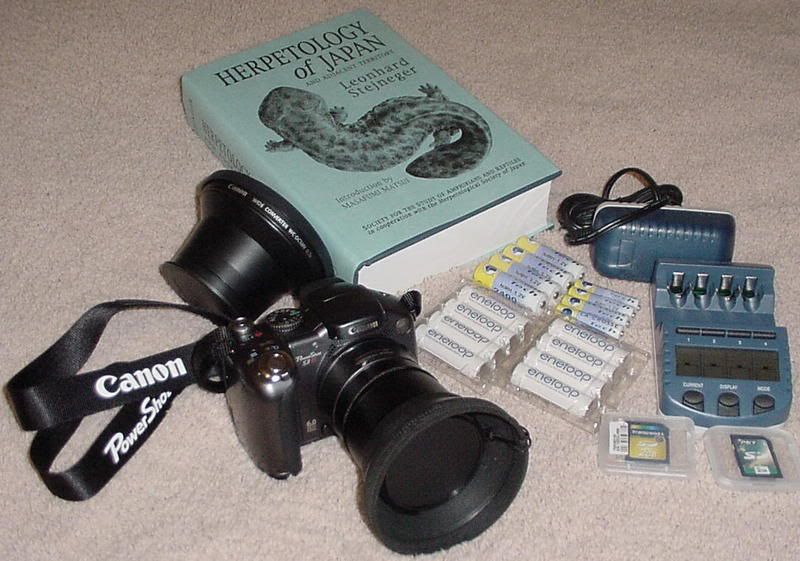
Dreaming of May..........
Shane
-----
Lifelist
Well, I definitely envy you!!! But at least you'll have all that great firepower to get alot of excellent habitat shots of all the herps you find. Best of luck and enjoy.
Regards
John
>>John, TC,
>>
>>Thanks for the input. I've always suspected that the high mortality with some species was due largely to gross neglect (and missing parts), but I wasn't sure. You'd think that the exporters could get herps directly, instead of through the food markets.
>>
>>Of course, I hope to find a gravid conspic, but I'll be happy with anything. The area where I will be herping is south of my current latitude, so at least the snakes from that particular area aren't especially accustomed to a severe climate. Two of the three that I found were at relatively low elevation......I want to think it was right around 1000'. Maintaining cooler temps in the summer won't be a problem, so I guess I'll just have to be very diligent in acclimating them. I think the idea of deparisitizing them afterward is sound; I also imagine that the parasite load would be lowish, but who knows??
>>
>>I'm looking forward to this summer! I'll be in Japan from May 8th thru 30th, and then doing some herping with TC shortly afterward......should be a blast!
>>
>>Oh yeah, I finally got my new toy, and some good reading material:
>>
>>
>>Dreaming of May..........
>>
>>Shane
>>-----
>>Lifelist
Hi, Shane. Looks like you got some great new reading material and toys. Looks familiar.
I'm jealous of your Japan trip. Wish I could join ya. I'll be looking forward to hearing anything about the trip.
I just found out my calendar for the rest of the year and my last day of work is June 6th. I should be making my way down towards, OK, soon afterwards. I really look forward to that.
Last night we got freezing temps in Green Valley, AZ, but today it got up to 70*F, already. I'm trying to get some decent shots of our new property here. Looks like great habitat for diamondbacks and gophers, heheh!
Later....TC
Help, tips & resources quick links
Manage your user and advertising accounts
Advertising and services purchase quick links
