Just brought all my Rubber boas out of burmation, just to see if I can get a jump on the season.
Bonner co. Idaho pair.

Welcome to kingsnake.com's message board system. Here you may share and discuss information with others about your favorite reptile and amphibian related topics such as care and feeding, caging requirements, permits and licenses, and more. Launched in 1997, the kingsnake.com message board system is one of the oldest and largest systems on the internet.


Just brought all my Rubber boas out of burmation, just to see if I can get a jump on the season.
Bonner co. Idaho pair.
Same male from above.

Three year old female.

Sister to the one above.

Thompson falls co. MT, male

Head shot from the above male.

One more head shot of a female

Rubber boa w/ a wild pattern. O.K. this is a Redtail I caught in Brazil, but he might make good breeder for the Idaho female.
Just kidding, and not funny. 
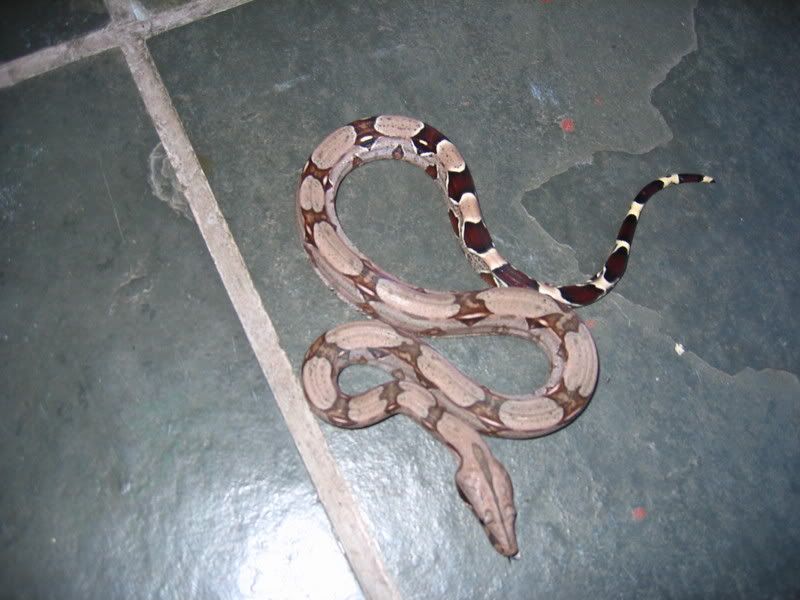
Nice little neonate female. Thanks for looking.

Awesome pictures...thanks for sharing.
Ooh, can I get in line for some of the babies?
E-mail me for more information.
-Dell
Great looking snakes. Really clean good looking scales. Pretty abundant where you live?
reako45
TD,
You can get a jump by shortening brumation, etc. I believe there is a gentleman in Washington that produces litters in the spring and litters every year by females by manipulating his artificial conditions of brumation, etc. Of course, he is into the commercial aspect. My approach has been different because my focus ahs been on research. Below I detail what I have done for many years and you can then judge what you might wish to do by altering conditions.
Locally this year, I began finding adult male boas on Feb. 9th with the last two (of 9 so far) on the 2/17 before the weather again turned winter like. With the adult males now making their appearance on the surface in the wild, to break the brumation period in my captive setup, this afternoon I turned on a 40 (or 60) watt bulb over a metal pan hide in the large cage in which I house my adult male Rubber Boas.
A timer is set to turn on the light at 7 AM and turn off at 6 PM which is close to when it gets light and dark here in northwestern Oregon at this time of year. If history repeats itself, a few of the males will find and curl up under the heat source whereas other males will remain under one the two hides at the cool / cold end of the cage. Eventually within a week or two, all males will be found curled up under the hide with the heat source overhead.
I won't do the same thing for the cage containing my female boas until late, possibly mid March depending on local weather conditions. That is when I begin finding reproductive females in the wild which usually occurs from late March or early April, sometime mid March, rarely early March.
As with the males, not all females will immediately position themselves under the heat source but some will remain under one of the hides at the cool or cold end of the cage.
This set-up has worked for over 35 years --that is, mimicking the natural sequence of events and environmental conditions that takes place in the wild. There are other regimes that work for others so my system is not necessarily ideal for everyone. But it has worked like a charm over the years. I have produced hundreds of captive bred litters, one female producing 10 litters every other year over a 20 year span.
I might mention that at first, my heat source is suspended well above the metal hide and that the temperature beneath the hide may only get up into the 50's at first, depending on the outside temperature which in turn affects the temperature inside my unheated snake shed. The cooler end of the cage will remain in the low to mid 40's, again depending on natural temperature conditions. In a couple of weeks, I will lower the light bulb closer to the metal hide to increase the temperature beneath the hide to again coincide with conditions that are occurring in the wild where boas can be found thermoregulating under surface cover objects or curled up in dead grass, leaves, loose soil.
In mid to late March, I will offer prey to the males but again if history repeats itself, most will not accept prey but will wait until after the mating season. For the males not needed for crosses, I will remove them to an enclosure that does not have an external heat source so as to conserve their body reserves. I will continue to offer prey ever so often but it usually isn't until late May or early June when males will begin to take offered prey on a more or less regular basis. For the males that will be used in crosses, I will again lower the heat source closer to the metal hide and allowed temperatures to range into the mid to upper 70's / low 80's.
As soon as all females begin to locate under the heated hide, I will offer them prey as well in order to increase body mass and fat reserves. As occurs locally in the wild, for females I wish to mate, I will introduce males in early to mid April and leave then together until at least late May and sometimes into early June. I will continue to offer prey to both sexes but usually only the females will accept prey during that period.
And by the way, I have been in the practice of weighing my boas at the time they enter brumation and when they are coming out of brumation conditions. This allows a backlog of data on which to judge relative health / condition of each specimen. Under the conditions I have used during the brumation period, the Rubber Boa looses a very small amount of body reserves during winter dormancy. Some have even gained weight, undoubtedly via the intake of water.
The same situation occurs in the wild as I have taken the weights of wild specimens in late Oct. near the onset of brumation and then weights when the same specimens are recaptured the following Feb. and March. As with the captive specimens, weight loss is very small during the brumation period in wild specimens. This fact lends confidence that the process I have been using is quite suitable for this species.
Richard F. Hoyer
Wow Richard,
That is a ton of information, and I have printed it off to use as a reference.
I have done your natural set up in the past, and have done well w/ it. But I have of late(last two years) been putting boas on heat tape once they have been out of burmation for a few days. The heat tape seems to get them eating quicker for me. My boas came out Feb. 2 and all have taken pinks or hoppers. The males ate again today.
After a few more feedings I'll move all boa to a natural set up, and let nature take it course.
This worked well for me last year, and hope it will again.
I also keep notes on weight into burmation and out of burmation, and have seen very little weight loss from burmation. Glad you said you have had boas gain weight in burmation, because I had one female that came out of burmation that had gained a gram where all other boas lost or stayed static in weight. I wondered if I read the scale wrong when I put her into burmation. Now I know it read true.
Richard do you have any information on weight loss on females after birth?
-Dell

Dell,
Have gobs of such data. Actually gave a talk on C. bottae reproduction at a symposium in the Seattle area in June, 1991. The symposium proceeding were published a year later.
Just off the top of my head, the weight loss experienced by females during the reproductive process (onset of gestation to just after parturition) ranged from around 33% to about 56%. Mean weight loss is probably around 45% in relation to the female weight at the beginning of the gestation period for female that fast throughout gestation.
The females of our local NW. Oregon boas fast during gestation whereas females from other boa populations will consume prey during the gestation period.
In determining the total investment a female Rubber Boa undergoes during a reproductive event, I devised a method whereby I could determine the contribution of each component of weight loss during the reproductive process. These components are 1) total loss of body reserves between onset of gestation to parturition, 2) biomass of neonates / undeveloped ova passed during parturition, 3) weight of all embryonic membranes passed and, 4) weight of lost fluid during parturition.
Richard F. Hoyer
Richard,
Interesting information. Mean weight loss 45%, this is why I asked the question, I have noticed a big drop in weight from gravid females after birth. Seems like more weight loss from C. bottae, then other snakes I keep and breed.
Your a wealth of knowledge, thanks.
-Dell
I'll boar you with one more shot of a female.

Richard,
I live in Northwest Oregon also, and have been trying to keep a female (recent mommy!) Rubber Boa.
She is full grown and just had 5 babies.
She has now escaped for the second time. First time I found her within the hour hiding nearby.
This time I put her in her feeding box and next morning- no snake!
In your experience would she go far, in a crack or crevice nearby or keep traveling?
Help!
Help, tips & resources quick links
Manage your user and advertising accounts
Advertising and services purchase quick links
