What is it that determines a Cal king as being hypo???
I have to ask this because I see so many dark kings that are considered hypo and I also see many light kings that are not considered to be hypo.
What am I missing here...?
byron.d
Welcome to kingsnake.com's message board system. Here you may share and discuss information with others about your favorite reptile and amphibian related topics such as care and feeding, caging requirements, permits and licenses, and more. Launched in 1997, the kingsnake.com message board system is one of the oldest and largest systems on the internet.



What is it that determines a Cal king as being hypo???
I have to ask this because I see so many dark kings that are considered hypo and I also see many light kings that are not considered to be hypo.
What am I missing here...?
byron.d
Sorry, I just had this uncontrollable urge to say something stupid. Ooops!
-Phil
From my point of view - it is only hypo if the colour is lighter due to a defective genetic condition that results in less melanin production than the snake ordinarily would have.
Variations in the base colour of cal kings exist throughout the range.
I think one of the determining factors when the term is used properly is the coloration when they hatch. I do not know if this is universal or not, but in every place I have herped with brown adult cal kings, they hatch black and the color changes to brown as they grow up (though often the head remains very dark).
If a Cal King is truly hypo, and this is me speculating, it will not be black base colour when it comes out of the egg.
-----
3.6 L. getula californiae - 18 eggs (Cal. King)
1.1 L. getula nigrita (MBK)
1.0 Pantherophis guttatus guttatus (Corn)
0.1 Pituophis catenifer catenifer (Pacific gopher)
3.3 Elgaria multicarinata multicarinata (Cal. Alligator Lizard)
I'm cool with what actually causes a snake to be hypo - genetically I mean, I just get confused when I see these dark brown snakes listed as hypos...
I very much agree with you on the 'proof' being that if they're truly hypo they'd be born considerably lighter.
Of course that being said the only way to prove a W/C Cal is hypo would be to prove it out, correct??
I guess I was sort of hoping for a trick that shows a snake is a visual hypo...
Thanks for the info man.
byron.d
> I'm cool with what actually causes a snake to be hypo -
> genetically I mean, I just get confused when I see these dark
> brown snakes listed as hypos...
I think there are degrees of hypo - and a snake that is genetically light brown might be lighter than a hypo of a snake that is suppose to be virtually black.
I define (my definition, not biological) hypo as a lighter color caused be a mechanism not working the way it is suppose to be, a genetic defect. I suppose technically every mutation that ever happens is technically a defect and some are beneficial and thus chosen by natural selection, but if it is the norm for a population than it is "no longer" a defect.
> I very much agree with you on the 'proof' being that if they're
> truly hypo they'd be born considerably lighter.
> Of course that being said the only way to prove a W/C Cal is
> hypo would be to prove it out, correct??
Yeah. I have a possible hypo female. The person I bought it from is in Alaska, and he got it from someone else. She looks hypo to me, and does sometimes have a lavender tinge to her. I can't call her hypo though in my mind until I can demonstrate it is genetic trait. I suppose hypo doesn't necessarily need to be simple recessive - but if it is, it would take at least two generations - first generation with a normal to produce all normal young, and second generation line breed should produce mostly normal some lighter.
She also has really weird banding, and a virtually completely cream belly - unusual for a banded.
> I guess I was sort of hoping for a trick that shows a snake is a
> visual hypo...
> Thanks for the info man.
In my case opinion, not really info. Keep in mind I sometimes come off sounding like I know more than I really do, and I don't have a lot of experience in this area.
I'm guessing that we need to sequence the Cal King genome before we really know what is going on in some cases.
-----
3.6 L. getula californiae - 18 eggs (Cal. King)
1.1 L. getula nigrita (MBK)
1.0 Pantherophis guttatus guttatus (Corn)
0.1 Pituophis catenifer catenifer (Pacific gopher)
3.3 Elgaria multicarinata multicarinata (Cal. Alligator Lizard)
Melanin is a pigment molecule that is the most common form of Black pigment in most animals and people. Cells called melanocytes make this pigment in a somewhat long multistep reaction with several precurser molecules that have different levels of dark coloring. If there is a defect in any of the enzymes responsible for any of the steps in this reaction, the animal will not be able to make melanin and will not be black, or as black.
The most famous of these enzymes is Tyrosinase. You have probobly heard of T+ versus T- animals. This is an enzyme responsible for converting melanin precuser molecule into a purple pigment. If the genetic defect in the enzymatic chain is after that step, then the animal will have a dark purple color instead of black or dark brown.
So if a snake can't make any melanin or any colored precursers, it is called amelanistic or albino. If it makes some of these colored precursers it is called hypomelanistic. If it makes too much it is called melanistic or hypermelanistic.
Now for how all of this applys to kingsnakes...
I don't know. 
I know what you mean about some dark snakes being called hypo and other "Normal" coastals look very light, especially as they age. Technically I guess you could argue that all coastal phase cal kings are hypomelanistic, as they are lighter and obviously have less melanin, or maybe even a different brown pigment entirely. I guess the desert phase would be considered "normal", and the davis/mendota/baja kings would be hypermelanisitc.
Because coastal phase kings are nearly black when they are born I suspect that they can fully produce melanin. If I had to guess I would say that they have fewer concentrations of melanocytes in their skin, and so appear brown.
The bottom line is that hypos will be different from birth. And just about all kings of any morph or type will lighten as they age.
The large coastal male in the pic appears to be lighter then the yearling hypo. However he is 15 yrs old. If you compare the yearling hypo to a yearling coastal (whose father is the male below) you can see the huge difference. Also, light regular cal kings will always be some shade of brown or tan. Most hypos have a purplish hue.


Zach. Thanks for the detailed post. I shake my head every time you post that huge Coastal. If that snake where black and white I'd swear it was an Eastern!!
I'm glad you posted the photos of your El Dorado Co. hypos... I have a group of Elfin Forest locale (San Diego Coastal) Cal's and these snakes are so light even for being Coastals that they almost look like dark lavenders. I'll have to get some photos tomorrow...
Even my '06's are super light brown and yellow.
Thanks again and awesome kings!!
byron.d
Elfin Forrest - are you sure it is So. Cal and not Middle Earth?

-----
3.6 L. getula californiae - 18 eggs (Cal. King)
1.1 L. getula nigrita (MBK)
1.0 Pantherophis guttatus guttatus (Corn)
0.1 Pituophis catenifer catenifer (Pacific gopher)
3.3 Elgaria multicarinata multicarinata (Cal. Alligator Lizard)
I think you guys somehow got this all wrong. A hypo is not a lite colored individual calking.
The above explination is great, and explains a lot. But its a bit out of context.
Calkings come naturally and normally is many colors, or shades of color. Coastals come from very lite brown on a yellowish snake, to dark brown on a yellowish snake(you could reverse that if you want) The yellow also verys in color and shade.
Desert calkings, are normally whitish or lite yellowish, with much darker brown to black markings. Again this is normal.
A hypo is not the shade of black or brown. Its the density of the melanocytes. Hypos have few melanocytes and appear translucent to some degree. With fewer melanocytes the darker markings appear less dark, liter brown or black,if you will and less dense. The liter colors are also less dense, and appear liter. So you cannot have a true hypo with normal lite colors.
Somehow this has been lost in the confusion of folks wanting to name something. Just something to consider. As you can and do call them any old thing you want(and rightfully so) But that does not make that lite brown coastal a hypo, or any lite brown snake a hypo(there are hundreds of lite brown species and they are not hypos) The reason is, the terms hypo and hyper, are applied to what is considered normal for a species. Calkings average a set amount of melanocytes. The very extremes from that normal are then coined hypo and hyper. Hypos and hypers are not part of normal variation.
Lite brown coastal kings are normal and part of the normal variation. Now if you caught that lite brown cal king in the high desert, it would be odd, a hypo maybe? Cheers
Yo Frank!!!!
Remeber those light brown stripes we found in San Diego County and that huge light brown from Temecula???? I sure miss flippin' tin and wood in California!!!! But Texas is cool too!!!!!
Pat
I remember a lot about our time herpin, we did have fun. I remember most that big mitchell I almost threw in your lag. hahahahahahaha(my bad) I never knew a human could move so fast. Again, I apologise.
Didn't we find a giant striper(five foot) that was just hit because we decided to move a ruber off the road to save it?? Cheers
Hey Frank
Good to hear from you back on the cool forum. Gettin tired of yellin at em to "keep em hot and feed em a lot" over on the monitor forum? Just kidding, I am actually saving up for my first pair of ackies.
You are right. For something to be hypomelanistic, or have less black, there has to be a normal standard to compare less to. I wasn't seriously saying that coastals should be called hypos, just comenting that they are lighter and do produce less melanin than desert phase.
You said
>>> A hypo is not the shade of black or brown. Its the density of the melanocytes. Hypos have few melanocytes and appear translucent to some degree. With fewer melanocytes the darker markings appear less dark, liter brown or black,if you will and less dense. The liter colors are also less dense, and appear liter. So you cannot have a true hypo with normal lite colors.
Is this a hypo?...Found in Carlsbad...
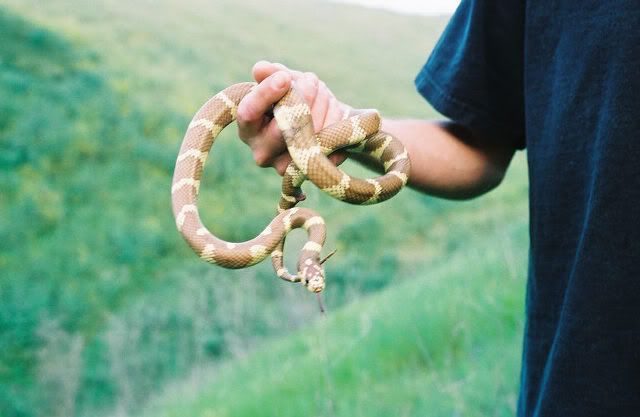
Ryan S.
it's pretty damn awesome!
great looking Cal Ryan!! That giant '06 you hooked me up with getting better and better.
Take care bro!
byron.d
Shatty, that king looks like it should be hypo.
This king was found in the desert where kings are very dark brown almost black even as adults. This one is berly 30"


A normal.

A very light Cal king from S.D.


I don't know about the S.D. king but I'm pretty sure the desert Cal king is hypo. Wont be sure until it's proven out.
Help, tips & resources quick links
Manage your user and advertising accounts
Advertising and services purchase quick links
