-----
I will be back!
Reptile & Amphibian Forums
Welcome to kingsnake.com's message board system. Here you may share and discuss information with others about your favorite reptile and amphibian related topics such as care and feeding, caging requirements, permits and licenses, and more. Launched in 1997, the kingsnake.com message board system is one of the oldest and largest systems on the internet.


New Pictures For This Week
Liquid_Metal
Jul 14, 2007 07:31 PM
Replies (12)
Liquid_Metal
Jul 14, 2007 07:42 PM
This is what the eggs look like this week.


-----
I will be back!
FunkyRes
Jul 15, 2007 01:39 AM
Your eggs are looking good!
Here's my eggs from a little while ago (7/3) at 30 days.
I'll take another picture on day 45 - they have swollen quite a bit.
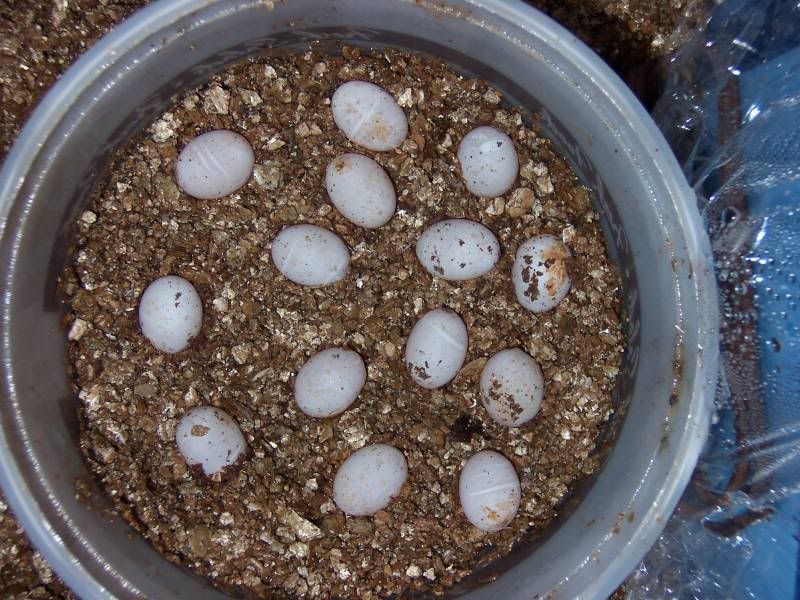
Last year Day 45 was the day the first one came out.
I don't expect them to hatch that fast this year because I'm not using any additional heat.
-----
6.8 L. getula californiae - 11 eggs (Cal. King)
1.2 L. getula nigrita (MBK)
1.0 L. getula floridana (Brooksi)
1.0 Pantherophis guttatus guttatus (Corn)
0.1 Pituophis catenifer catenifer (Pacific gopher)
3.3 Elgaria multicarinata multicarinata - 14 eggs (Cal. Alligator Lizard)
Liquid_Metal
Jul 15, 2007 02:01 AM
You got nice eggs too!  hehehehe
I have a question for you in regards to your commment about the heat. The room that I am leaving the eggs and lizard in gets about 80-90 degrees. You think that is ok? I leave a small window in the kitchen open for them.
Also, I accidentally bump the table when I took these pictures today. A slight bump will be ok right? I didn't knock it over or anything but just moved a bit. I don't want to disturb the eggs that is why.
Thanks
-----
I will be back!
FunkyRes
Jul 15, 2007 09:29 AM
Slight bump is fine.
I do not know what temp range alligator lizard eggs can withstand and be normal.
I do know that with snakes, heat spikes can cause increased occurrence of kinked spines. What constitutes a heat spike too hot depends upon species though.
On the hot days - I've been cooling my eggs - if the ambient temp of the room they are in hits 85 - I put them in a closet in a room on north side of house, where it is cooler.
I don't remember the paper, but there was a study done on tropical snakes - snake eggs that had a constant temperature hatched out long and skinny while snake eggs that a range hatched out short and fat.
-----
6.8 L. getula californiae - 11 eggs (Cal. King)
1.2 L. getula nigrita (MBK)
1.0 L. getula floridana (Brooksi)
1.0 Pantherophis guttatus guttatus (Corn)
0.1 Pituophis catenifer catenifer (Pacific gopher)
3.3 Elgaria multicarinata multicarinata - 14 eggs (Cal. Alligator Lizard)
Liquid_Metal
Jul 16, 2007 03:05 PM
When you incubated yours last year, what was the average temperature?
Also, I heard the higher the temperature, like in 80's, they will have a higher ratio of females.
-----
I will be back!
FunkyRes
Jul 17, 2007 10:44 AM
Last year - high 70s at night, low to mid 80s day.
-=-
AFAIK, alligator lizards are GSD (Genetic Sex Determination) - sex is determined by chromosomes (I think they are WZ chromosome - female sex cell determines sex of baby, opposed to XY where the male sex cell does - but I'm not positive which)
Many lizards, turtles, ect. are TSD (Temperature Sex Determination) but I don't think alligator lizards are among them.
-----
6.8 L. getula californiae - 11 eggs (Cal. King)
1.2 L. getula nigrita (MBK)
1.0 L. getula floridana (Brooksi)
1.0 Pantherophis guttatus guttatus (Corn)
0.1 Pituophis catenifer catenifer (Pacific gopher)
3.3 Elgaria multicarinata multicarinata - 14 eggs (Cal. Alligator Lizard)
Liquid_Metal
Jul 17, 2007 04:32 PM
Great to know Funky!
-----
I will be back!
Liquid_Metal
Jul 15, 2007 02:02 AM
Are yours Southern?
You and I should trade the hatchlings so that when they are grown, they won't breed with siblings and caused side-effects.
-----
I will be back!
FunkyRes
Jul 15, 2007 09:33 AM
Mine are southern but they are California subspecies - with *possible* (though not visual to me) influence of Oregon subpecies (I'm fairly close to integrade range).
Yours are San Diego subspecies.
So it would not be a good idea to swap for breeding as the results would be integrades.
-----
6.8 L. getula californiae - 11 eggs (Cal. King)
1.2 L. getula nigrita (MBK)
1.0 L. getula floridana (Brooksi)
1.0 Pantherophis guttatus guttatus (Corn)
0.1 Pituophis catenifer catenifer (Pacific gopher)
3.3 Elgaria multicarinata multicarinata - 14 eggs (Cal. Alligator Lizard)
FunkyRes
Jul 15, 2007 09:44 AM
My plan for genetic diversity -
When the two adults I have die, I will collect another pair from this locality (Redding, CA) to produce a clutch unrelated to the captive bred I have that can be used to bring fresh blood into what I'm working with.
I want to keep my line locality specific because of the possible influence of Oregon subspecies. Eventually some grad student will do a study of the genetics and hopefully at that time I'll know more about wether or not this locale is "pure" California subspecies or an integrade. IMHO integrade locales should be kept out of "pure" subspecies lines - at least until the species is widely bred with many keepers who do breed "pure" lines.
-----
6.8 L. getula californiae - 11 eggs (Cal. King)
1.2 L. getula nigrita (MBK)
1.0 L. getula floridana (Brooksi)
1.0 Pantherophis guttatus guttatus (Corn)
0.1 Pituophis catenifer catenifer (Pacific gopher)
3.3 Elgaria multicarinata multicarinata - 14 eggs (Cal. Alligator Lizard)
Liquid_Metal
Jul 16, 2007 03:08 PM
Yes, I think inbreeding is bad. I asked you about this before, and I think you said the same thing right?
Also, are you breeding for a school research and learning about the science? Or is this a hobby?
-----
I will be back!
FunkyRes
Jul 17, 2007 10:53 AM
It's a hobby for me.
Generally a few generations of inbreeding isn't too bad with most species of reptiles. Each generation of inbreeding reduces the genetic variety, but one or two generations usually is fine producing healthy offspring.
-----
6.8 L. getula californiae - 11 eggs (Cal. King)
1.2 L. getula nigrita (MBK)
1.0 L. getula floridana (Brooksi)
1.0 Pantherophis guttatus guttatus (Corn)
0.1 Pituophis catenifer catenifer (Pacific gopher)
3.3 Elgaria multicarinata multicarinata - 14 eggs (Cal. Alligator Lizard)
