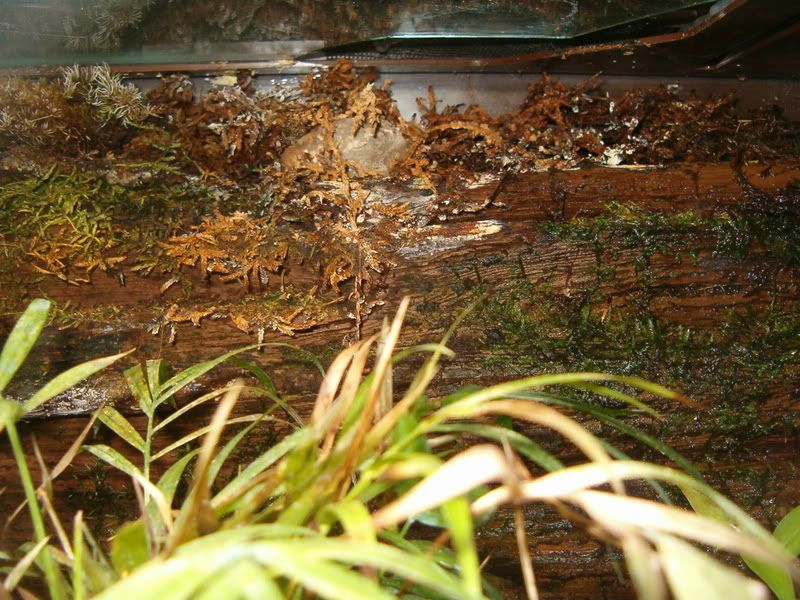
I'm afraid this stuff is snow mold. It started after I turned off the water feature on one side of the tank. The more it dried out the more this stuff showed up. Look familiar to anyone? Thanks
Reptile & Amphibian Forums
Welcome to kingsnake.com's message board system. Here you may share and discuss information with others about your favorite reptile and amphibian related topics such as care and feeding, caging requirements, permits and licenses, and more. Launched in 1997, the kingsnake.com message board system is one of the oldest and largest systems on the internet.


white stuff growing in terrarium??
skronkykong
Jul 31, 2007 11:51 AM
Replies (2)
Slaytonp
Aug 01, 2007 01:05 PM
Molds like this are unavoidable, and almost always totally harmless. They are just a more visible part of the biological cycling going on in any living terrarium. You can probably see a more spotty variety on the Malaysia drift wood the azureus froglet is sitting on in this picture. Most fungi will come and then disappear over time.
Actually, when I was looking over all of my tanks to find some fungi to photograph, this one was the only one I could find at the present time, although they have all had them at one time or another. The older a tank gets, it seems the fewer conspicuous fungi occur. New tanks will tend to get slime molds on the glass, as well as a webby white fungus, and drift wood and dead leaves will invariably grow some kind of fungi. It's next to impossible to specifically identify most of them, and in a living tank, there's no way to control them.

-----
Patty
Pahsimeroi, Idaho
D. auratus blue, auratus Ancon Hill, galactonotus orange, galactonotus yellow, fantasticus, reticulatus, imitator, castaneoticus, azureus, pumilio Bastimentos. P. lugubris, vittatus, terribilis mint green, terribilis orange.
Slaytonp
Aug 05, 2007 10:56 AM
I noticed that someone on another forum suggested that this might be water deposits. This should be easy to find out by putting a drop of straight vinegar on a section of it, (or removing a bit of it first for this purpose.) Although a stronger acid is usually used for this test, such as 10% HCL, it will work with vinegar, too. You just have to look closely.
-----
Patty
Pahsimeroi, Idaho
D. auratus blue, auratus Ancon Hill, galactonotus orange, galactonotus yellow, fantasticus, reticulatus, imitator, castaneoticus, azureus, pumilio Bastimentos. P. lugubris, vittatus, terribilis mint green, terribilis orange.
