Reptile & Amphibian Forums

Welcome to kingsnake.com's message board system. Here you may share and discuss information with others about your favorite reptile and amphibian related topics such as care and feeding, caging requirements, permits and licenses, and more. Launched in 1997, the kingsnake.com message board system is one of the oldest and largest systems on the internet.

Click here to visit Classifieds
Click for 65% off Shipping with Reptiles 2 You

False Water Cobra

Jerry Oct 26, 2007 09:18 PM

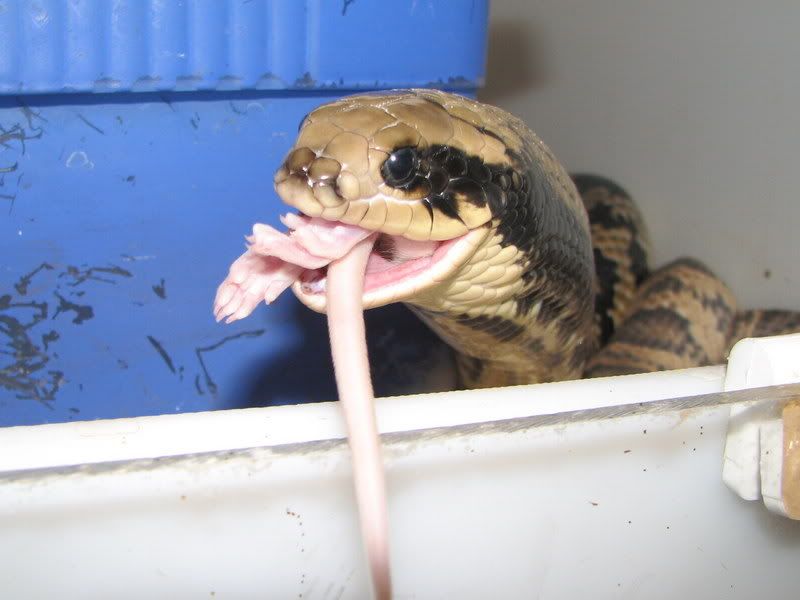
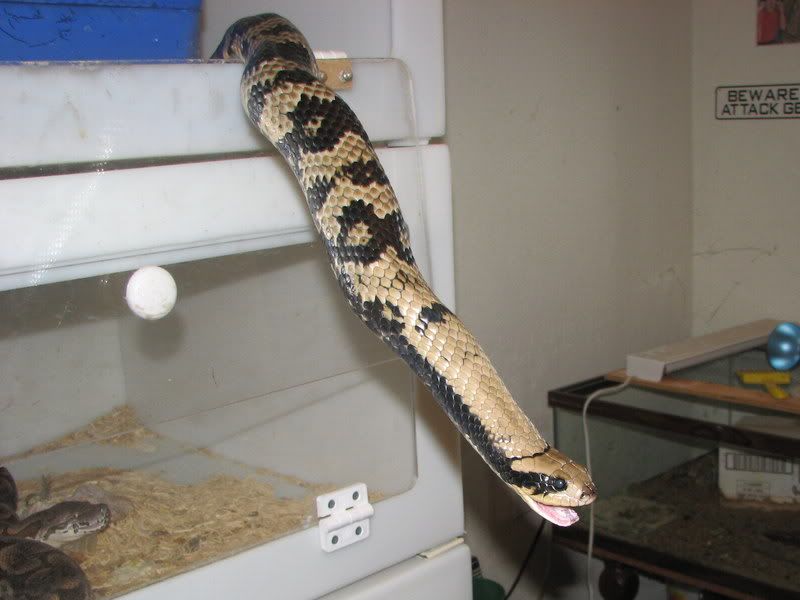
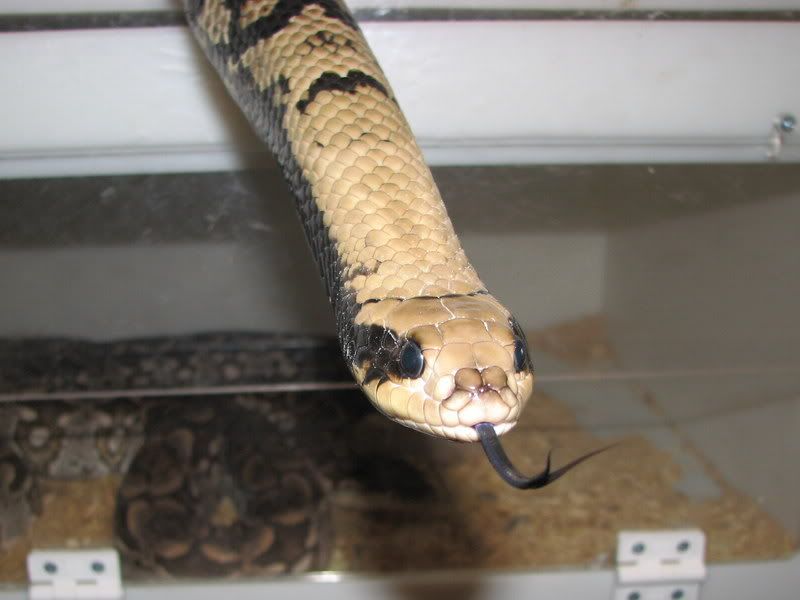
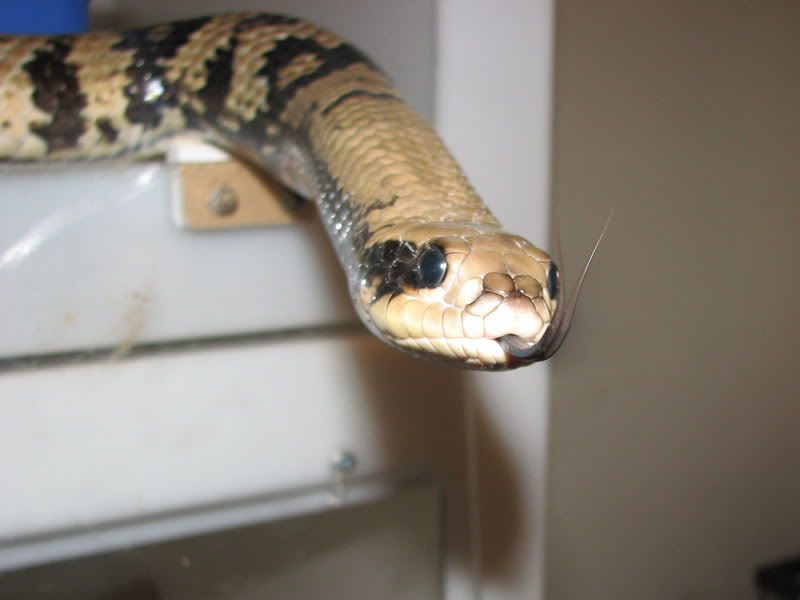
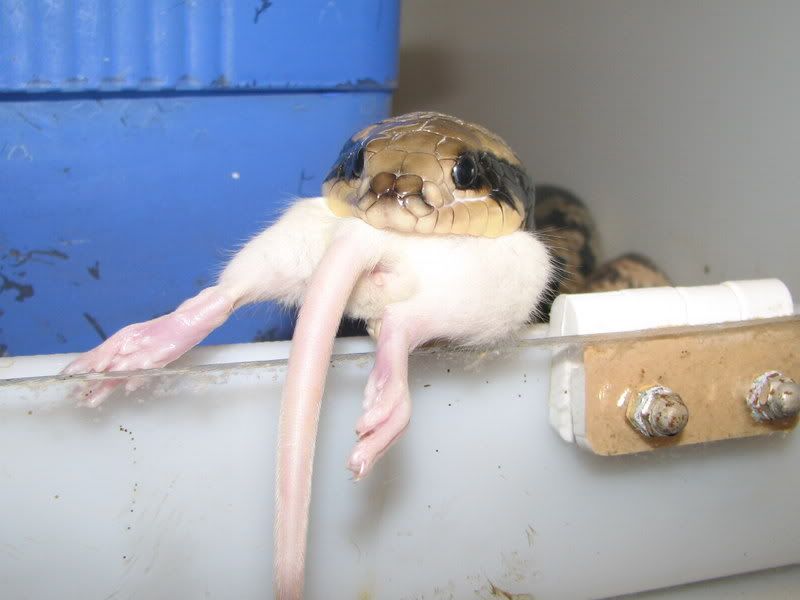
Just over 2 years old now. I purchased from Bill Gillingham of GVS @ the '05 Sacramento Show. According to Bill, these are Hydrodynastes bicinctus (http://www.snakemuseum.com/cobra.htm). My female is darker & twice the size of the male. My male was in shed today, I will post pics of him later.
thanks for looking ; D

Replies (13)

billstevenson Oct 27, 2007 06:30 PM

She is a beauty, Jerry. Looks like she's still hungry though...

Jerry Oct 27, 2007 08:06 PM

She probly is still hungry, However, I do not like to give them too much in one day. She gets offered food every 3 to 4 days.

WW Oct 28, 2007 03:50 PM

>>Just over 2 years old now. I purchased from Bill Gillingham of GVS @ the '05 Sacramento Show. According to Bill, these are Hydrodynastes bicinctus (http://www.snakemuseum.com/cobra.htm). My female is darker & twice the size of the male. My male was in shed today, I will post pics of him later.
>>thanks for looking ; D
>>
>>
>>
>>
>>
>>
>>
>>
>>
>>
-----
WW Home

Jerry Oct 28, 2007 08:27 PM

going by Bill's page, that is who I got them by. check it out or call him;
http://www.snakemuseum.com/cobra.htm

I am sure with the way things are going with DNA studies today, they will all be classified under the same eventually...LOL!

WW Oct 30, 2007 07:00 AM

Yours are definitely H. gigas. The juveniles of the two species are fairly similar, but whereas bicinctus retain their juvenile pattern (and basically look like tricolor kings), adult gigas look quite different - exactly like yours, in fact

The obvious distinguishing character in adults is that in H. bicinctus, the dorsal crossbands extend forward all the way to the neck, whereas in adult H. gigas, the top of the neck is largely plain, as shown very clearly in your specimen.

Cheers,

WW

>>going by Bill's page, that is who I got them by. check it out or call him;
>>http://www.snakemuseum.com/cobra.htm
>>
>>
>>I am sure with the way things are going with DNA studies today, they will all be classified under the same eventually...LOL!
-----
WW Home

TimCole Oct 30, 2007 05:06 PM

I've been saying that for several years.

HYDRODYNASTES GIGAS

All of the talk and questions about Hydrodynastes has prompted me to write and correspond with you all who keep them. Some of the info passed around on the list about these animals is incorrect or not complete. This also holds true for older literature printed.
I was introduced to these magnificent snakes in 1984 at the Nickerson Park Zoo. Max Nickerson gave me a behind the scenes tour at his facility. At this time he was also Head-Vertebrate Division at the Milwaukee Public Museum. Needless to say I trusted what he said. I saw the False Waters and asked a lot of questions about them. When I asked about their temperament he proceeded to open the cage and pull out the snake! I was hesitant at first but he insisted that it would not bite so I held the snake. This snake was between 8-9 ft. long! I fell in love with this animal. So much for them only reaching 6ft!
In 1989 I purchased a pair of these snakes from Louie Poras at Zoo Herp in Utah. The female was 3ft. and had less yellow than the 4ft. male. In 1991 the male was 7ft. and the female was 5ft. I treated them as tropical snakes when I put them together for breeding purposes. I only cooled them to low 70's and put them together with no interest. This was mid-winter. Since they did not breed I decided to sell them. I wanted to take pics of them but, as you know they do not sit still for long! So I cooled them to 60 degrees with hopes that this would slow them down long enough for me to take my photos. I got my pics and put them back together. They immediately began breeding! I discovered by accident that they needed to be cooled cooler than I thought. When the eggs were laid I put them in the incubator at 90 degrees figuring
once again that they should be treated as tropical animals. Wrong again! The neonates died full term in the eggs. I had them too hot. Shortly thereafter I moved and did not have the space available so I parted with them.
I recently purchased a another pair of hatchling gigas. They are het for hypo. The father was hypo and the mother was normal. I'm glad to have these again. They are certainly more popular now.

Now for the facts?

False Water Cobras or Brazilian Smooth Snakes.

Most literature recognizes 2 subspecies (H. bicintus and H. gigas). Mertens in his book "Living Snakes of the World" mentions a 3rd (H.shultzi). He also mentions that studies are in the works that may show all three to be one or the other genus. This was written in 1987 and I have
not found any more mention of it. Some of the photos of H. bicintus look like H.gigas! John Coburn's "The Atlas Of Snakes Of The World", and Dr. Marcos Freiberg’s "Snakes of South America" is the same lame photo. There is a photo of a H. bicintus in Frieberg’s labeled H.gigas. I think the photo captions were reversed and Coburn used the same mis-labeled photo. Campbell & Lamar’s "The Venomous Reptiles of Latin America" has a photo of H.bicintus. It has a lot of red on it. This is a much redder snake than H.gigas. Louis Poras also confirmed this to me by phone conversation. H.bicintus is well known for being a very
difficult snake to maintain in captivity because they do not feed well. This is also mentioned in a paper entitled "Analysis of the Duvernoy's Gland and Oral Secretions of Hydrodynastes gigas (Dumeril, Bibron, and Dumeril) (Reptilia: Serpentes). This is an excellent paper addressing the venom of the False Waters. It is mentioned that most bites occur from the H.gigas related to a feeding response. They could not find info about H.bicintus bites because of poor feeding habits! Most of the bites from H. gigas produced little symptoms but some have produced considerable pain and swelling. A larger H. gigas can possibly do a lot of damage! The toxicity of these snakes is well within the range of many rattlesnakes!
This book also mentions that H. gigas is capable of reaching lengths of 3 meters!
From some of the websites that I have seen concerning False Waters I have seen and read mis-information. I guess it's true that you cannot believe everything you see or read on the net! Just because someone has a website does not mean that they have done the research.
REMEMBER, Schmidt and Mertens died from a rearfang snakebite!

If I offended anyone by this I apologize. This is only meant to assist those interested in the False Water Cobras. I used the following references from my library, which you may wish to check out yourself. Some are obviously questionable.

"The Atlas Of Snakes Of The World" John Coburn 1991

"Contributions in Herpetology" Edited by Peter D. Strimple and Jane L.
Strimple 1992

"Amphibians And Reptiles Of The Paraguayan Chaco Volume 1" David R. Norman
1994

"The Venomous Reptiles of Latin America" Jonathan A. Campbell and William W.
Lamar 1989

"Snakes Of The World" Scott Weidensaul 1991

"Living Snakes of the World" John M. Mertens 1987

"The Encyclopedia of Snakes" Chris Mattison 1995

"Snakes" Johan Marias 1997

"Vivarium Magazine" 4.3 Monique Halloy

“Reptile & Amphibian Hobbyist” February, 2000 Mary Edith Moore

If anyone has more info available I would like to know of it.

Thanks,
Tim Cole
-----
Tim Cole
www.Designeratrox.com/
www.AustinReptileService.net
www.AustinReptileExpo.com/
~~~~~~~~~~~~~~<
Conservation through Education


coluber Oct 31, 2007 06:35 PM

Nice to read some informative discussion about Hydrodynastes,I agree there is very limited information about these snakes.
I have recently taken charge of a couple of hatchlings and am happy to glean as much information as possible from more experienced keepers of this species.

regards Paul (u.k.)

coluber Oct 31, 2007 06:41 PM

Forgot to ask...is it advisable to keep a pair together all the time ..even when very young??
Thanks in advance ...Paul

TimCole Oct 31, 2007 10:48 PM

I tend to keep snakes individually from a husbandry aspect. They can have quite a feeding response which can have bad results if they are kept together.
-----
Tim Cole
www.Designeratrox.com/
www.AustinReptileService.net
www.AustinReptileExpo.com/
~~~~~~~~~~~~~~<
Conservation through Education
WW Nov 01, 2007 05:08 AM

>Some of the photos of H. bicintus look like H.gigas! John Coburn's "The Atlas Of Snakes Of The World", and Dr. Marcos Freiberg’s "Snakes of South America" is the same lame photo. There is a photo of a H. bicintus in Frieberg’s labeled H.gigas.

Actually, all the Hydrodynastes photos in Freiberg's book are of H. gigas - again, the largely patternless upper side of the neck is the give-away. H. bincinctus is a rare snake in the wild, and even rarer in captivity. I have seen maybe half a dozen photos of that species (both versions of Campbell & Lamar, Starace's book on French Guyana snakes, Lancini & Kornacker's Venezuela book, one or two others, and that's it).

Regarding mating stimuli and temps for H. gigas, it will probably depend on where your animals came from. Hydrodynastes gigas has a huge range, from the Amazon (Guayanas etc.), where temperatures are hot year-round, down to southern Brazil, Paraguay and northern Argentina, where winters can get pretty chilly, at least intermittently. Specimens from the southern end of the range are quite likely to benefit from a period of chilling in the winter.

To Paul: I would advise keeping them separately, especially if there is any size difference - I once lost one H. gigas to its cagemate.

Cheers,

WW
-----
WW Home

coluber Nov 03, 2007 06:08 AM

Thanks guys!...seperate lodgings it is then!!

Wolfgang..could I ask if you know where the general breeding stock here in the U.K. is from?(i.e. geographical range)...both of my youngsters are captive bred,so its impossible to know their origin.I realise this may not be possible to answer but thanks in advance anyway.

kind regards Paul

WW Nov 14, 2007 08:04 AM

>>Thanks guys!...seperate lodgings it is then!!
>>
>>Wolfgang..could I ask if you know where the general breeding stock here in the U.K. is from?(i.e. geographical range)...both of my youngsters are captive bred,so its impossible to know their origin.I realise this may not be possible to answer but thanks in advance anyway.
>>
>> kind regards Paul

Sorry, no idea. I iknow they are gigas, but have no idea where the breedign stock came from (and it may of course have come from a number of sources...)

Cheers,

WW
-----
WW Home

Jerry Nov 01, 2007 12:03 PM

Bill Gillingham of Great Valley Serpentarium. If he is giving out wrong information on what he breeds & sells, he should know.
I personally would not go by some of the TFH books out there for reliable reference. I have found several mistakes in alot of their publications, including snakes with wrong pics(atlas book of snakes).
The "living snakes of the world" is pretty good, different publisher. This book is a general overview.

Site Tools