Reptile & Amphibian Forums

Welcome to kingsnake.com's message board system. Here you may share and discuss information with others about your favorite reptile and amphibian related topics such as care and feeding, caging requirements, permits and licenses, and more. Launched in 1997, the kingsnake.com message board system is one of the oldest and largest systems on the internet.

Click here to visit Classifieds
Southwestern Center for Herpetological Research
Click for 65% off Shipping with Reptiles 2 You

Head-spreading behavior in Diadophis

batrachos Dec 06, 2007 08:32 PM

I caught this little guy a couple of years ago and released him after taking these photos. He flattened out his head while I was photographing him, then reared up with head still flattened and held horizontally. He maintained this pose for quite a while; when I tried to move around to the front or side to get photos from a different angle, he would turn to keep the back of his head facing me. Now I've caught lots of Diadophis, but this is the only one I've seen do this. Have any of you seen or heard of this?

By the way, he's from Middle Tennessee, within the intergrade area of D. p. edwardsi and D. p. stictogenys, but he looked like a good edwardsi. He was about 6-7" long, which is typical adult size in this area.

Replies (11)

billysbrown Dec 07, 2007 10:28 AM

Cool post. I have never seen that, but then most of the ones I catch are D. p. edwardsii in PA or intergrades with D. p. punctatus. in NJ.

Thanks for the post,
Billy

-

Phillyherping
Phillyherping

Luis Feb 24, 2008 11:08 AM

Oh thats outstanding ringneck. I have let go of every ringneck I have caught within the minute but that one would have been tempted to house in a 10 gallon.

I have never found any hiding have found them all crossing the street ,driveway or inside garage.

tspuckler Dec 07, 2007 06:43 PM

It looks like he's doing a thing I call "lip curling."
I've seen it fairly frequently in red-bellied snakes.

Tim
Third Eye
Third Eye

batrachos Dec 08, 2007 11:37 AM

Thanks for your responses, billysbrown and tspuckler.

Tspuckler- I'm assuming by 'red-bellied snakes' you mean red-bellied races of Diadophis, like the lovely snake in your photo, and not Storeria occipitomaculata, correct? Head flattening is pretty common among natricines, though I can't recall seeing it in S. occipitomaculata.

tspuckler Dec 14, 2007 06:54 AM

Nope, I don't mean the ringneck, but rather the DeKay's Snake relative. In Bartlett's "Snakes of North America," he states "...an occasional individual may draw back its upper labial scales, exposing its teeth in a sort of snarl." when discussing the behavior of Storeria occiptomaculata.

Tim

MikeFedzen Dec 08, 2007 01:39 PM

Tim's "on the money" with the lip curling.

Usually ringneck snakes will do that... And then let some of their saliva drip down, which will sometimes carry a horrible smell. This is used to scared off predators... I don't know how often something like that would work though, ha.

And your snake that looks "most edwardsii" is an intergrade.
Based off the looks of the neck ring, it's not the typical neck ring for pure edwardsii and the adult size is too small for it to be pure.
-----
Mike
KingPin Reptiles Inc.
www.kingpinreptiles.com
^ Updated 11/29

batrachos Dec 08, 2007 01:53 PM

Thanks, Mike.

I've seen Diadophis flare the lip a little, and I've seen the saliva droplet they produce, but never with the jaw strongly flattened out like this, and never with the rearing behavior.

If you don't mind telling me, what about the neck ring is different from pure edwardsi? Is it the dark edging, the width, or something else? I was just going by the ventral pattern as far as subspecies designation (and I understand that all the specimens in an intergrade area are themselves intergrades, whatever they look like; I should have been more clear and stated that the animal had an edwardsi-like ventral pattern).

As far as adult size- I've caught ringnecks in East TN, which is supposed to be entirely within the range of edwardsi, and the size seems to vary a lot with elevation- big snakes (to 20" or more and stocky) in the mountains and smaller ones (13" or less, and usually quite slim)at lower elevations; I always assumed this was due to the greater concentration of salamanders in the mountains. The Middle TN intergrade area snakes also reach 13", but such snakes are not very common; 6-9" is typical.

MikeFedzen Dec 08, 2007 02:36 PM

6"-9" would make sense for an intergrade... Edwardsii typical get at least 12" if they're pure...

Off the neck ring, what makes the snake not look pure would be the width of the neck ring. Looks way too skinny.

What did the ventral area look like?
Spots, no spots?
-----
Mike
KingPin Reptiles Inc.
www.kingpinreptiles.com
^ Updated 11/29

batrachos Dec 08, 2007 02:49 PM

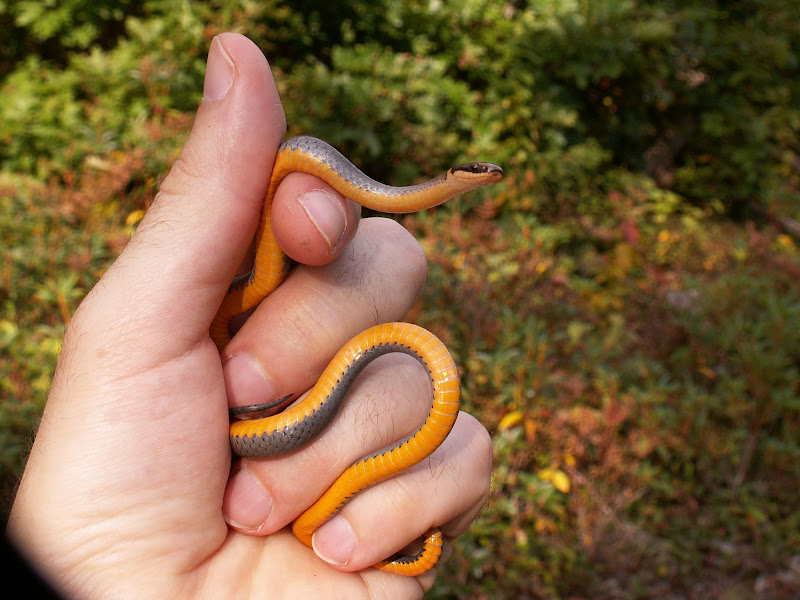
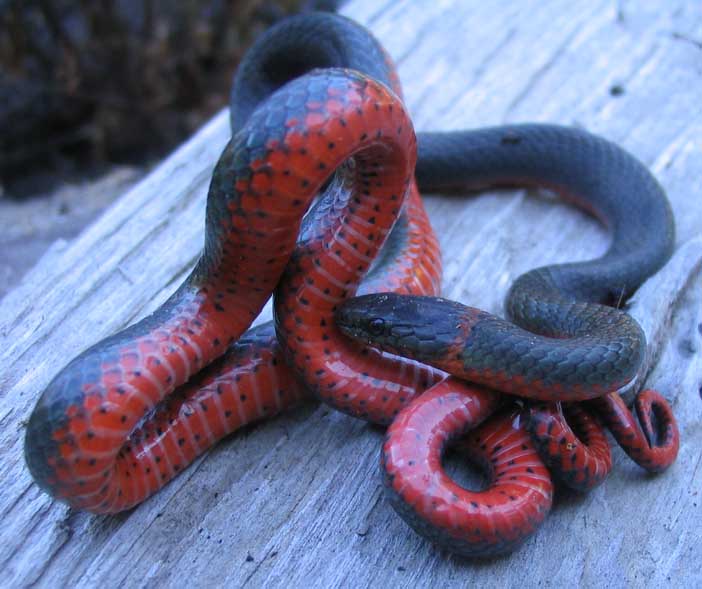
The first picture below shows the venter of the head-spreading snake; there are spots but they are small and scattered; usually snakes from this area with so few spots have them in a single line, but you can see this animal has some scales with more than one spot; I'm not sure if that falls under the range of variation of edwardsi. Other snakes from this area have more abundant spotting, in a double row or scattered, and so more closely resemble stictogenys. And still others have large blobby spots (as in the second photo below) or even double rows of large triangles (sorry, no photo).

Sorry for the low quality photos.

MikeFedzen Dec 08, 2007 06:48 PM

Pure edwardsii will never have that many spots.
-----
Mike
KingPin Reptiles Inc.
www.kingpinreptiles.com
^ Updated 11/29

batrachos Dec 08, 2007 07:18 PM

Thanks, Mike.

Site Tools