Reptile & Amphibian Forums

Welcome to kingsnake.com's message board system. Here you may share and discuss information with others about your favorite reptile and amphibian related topics such as care and feeding, caging requirements, permits and licenses, and more. Launched in 1997, the kingsnake.com message board system is one of the oldest and largest systems on the internet.

Click here for Dragon Serpents
Click for ZooMed
Click here for Dragon Serpents

Bumble bee darts,

terryd Dec 23, 2007 10:54 PM

This is the first time I've posted on this forum.

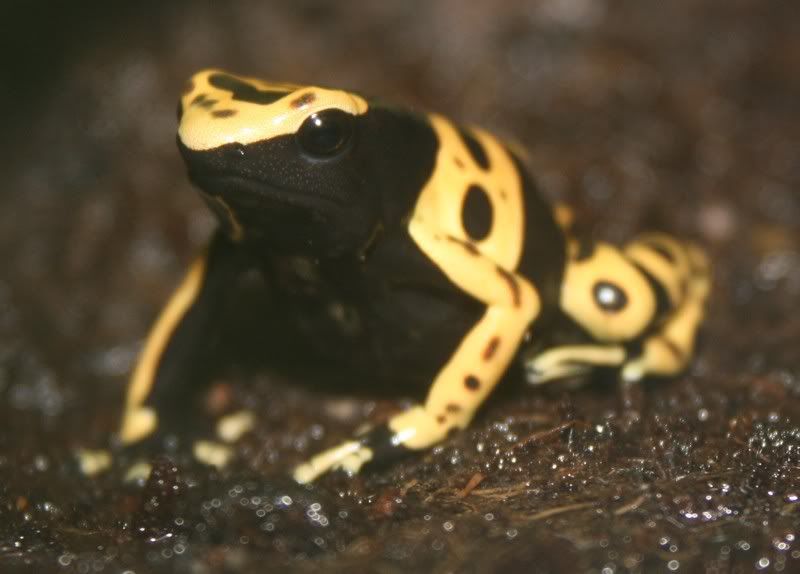
I have two D. leucomelas (Bumble Bee) darts. I had three but one died soon after putting in the tank. I plan on adding more when weather will be more favorable for shipping. I live in Montana. I've had the tank, and frogs sense August.

Here is the tank. 35 gallons.

These are the frogs.

One always sleeps in the log at night.

Thanks for looking.
-Dell
Image

Replies (8)

Daniel Klopson Dec 25, 2007 10:57 AM

Looks very nice! Fun stuff, cute frogs.

Slaytonp Dec 25, 2007 08:08 PM

Your tank looks like it will be fine for these leucs. Think about one thing, since one of them looks to be bordering on obese rather than merely female-- You may want to skip a day from feeding them now and then. This may just be an individual captive trait, however. I have 6 of them in an 80 gallon tank. 5 are slender, both male and females, but one is an real Idaho Butt--looks like she was raised on McDonald's fast food eaten on a couch in front of a TV set. She isn't as fast as the rest of them, so she is definitely not out-competing them for food, and seems otherwise healthy. While I like to keep my frogs a bit on the lean, mean, and active side, rather than stuffed couch potatoes, this is sometimes difficult to control with certain individuals in groups.
-----
Patty
Pahsimeroi, Idaho

Dendrobates: auratus blue, auratus Ancon Hill, tinctorius azureus, leucomelas. Phyllobates: vittatus, terribilis, lugubris. Epipedobates: anthonyi tricolor pasaje. Ranitomeya fantastica, imitator, reticulata. Adelphobates castaneoticus, galactonotus. Oophagia pumilio Bastimentos. (updated systematic nomenclature)

terryd Dec 25, 2007 08:46 PM

Thanks for the advice Patty. I just started skipping feedings two weeks ago. You have confirmed what I thought too. Thanks.

Patty would you keep other species of darts together or just keep one species of darts together?

-Dell

Slaytonp Dec 26, 2007 07:36 PM

Until you have a lot of experience with each species, it's best not to mix them together.

I think the mixing question comes up more often than any other, and it is rather complicated, but maybe I can remember the major concerns many people have with this, other than it gooses a lot of people up into a rage against it vs a defense for it, every time it is mentioned.

1. The dart frog community of breeders and hobbyists in general attempts to avoid hybrids and interbreeding, trying to keep the off-spring of WC specimens as close to the original as we can. It's an ethical, perhaps even a conservational kind of concern, although the conservation question is also controversial. None of us wants to see "designer" frogs get into the hobby. We don't even tend to mix different color morph populations of the same species for this reason. The original species are endangered, even those not designated as such, and therefore, we somehow think we can preserve them in the hobby. The reasoning gets a bit odd from here. Reintroduction into the original habitats after they are destroyed, which is occurring at a rapid rate, would not be possible, of course, because the original habitats won't be there. But we all, at least most of us persevere with an attitude of saving them in our cages.

2. Any kind of mixing should only be done in a very large tank, with room for separate territories, with full knowledge of the various species habits, such as their requirements for territory, tendencies toward aggressive behavior, ability to "get along with others," which some species don't have.

3. Zoos and some individuals, especially in Europe, do mix successfully for "show and tell tanks." But they generally have more faculties and facilities to monitor this than most beginning hobbyists, more alternatives to move things around if the mixing is not working out.

I would simply start out with your original plan of one specie, then see what it does, learn some more, and go from there. These delightful, often entertaining, always colorful frogs are very addictive. Once you've kept your first pair or group of a single specie, you may see why most people don't even bother to mix them.

-----
Patty
Pahsimeroi, Idaho

Dendrobates: auratus blue, auratus Ancon Hill, tinctorius azureus, leucomelas. Phyllobates: vittatus, terribilis, lugubris. Epipedobates: anthonyi tricolor pasaje. Ranitomeya fantastica, imitator, reticulata. Adelphobates castaneoticus, galactonotus. Oophagia pumilio Bastimentos. (updated systematic nomenclature)

terryd Dec 27, 2007 03:41 PM

Well duh, on my part. I should have thought of all of the points you made to me.
I keep a large group(around 150) of locality North American Milk snakes and would never think to crossbreed them to other subspecies or species. But you can't really keep a group of snakes together in a tank w/ much succes. Like you can w/ Dart frogs.
I just assumed putting in another species would be fine and that they would stay away from each other, and that they would try and mate w/ each other never occured to me, duh. Big brain cramp on my part.
I see Darts come into the pet store I like to use and all are put into the same tank and sold from that tank, and thought this was fine. You know what they say, "if you just assume you may become the first three letters of the word."

I know some of these newbie questions get mundane, but really thanks for taking the time to answer back.

Do you have a Dartfrog book, or two, you could recommend? I have a little pet store book on Darts, and I'd give you the name of it but it's out on loan to a friend. It really just covers the basics on Dartfrogs.

Again, thanks for you time.

-Dell

Here are a few locality Milksnakes I keep.


Thanks again.
Image

Slaytonp Dec 27, 2007 06:58 PM

First of all, those are gorgeous snakes. I've never gotten into keeping snakes, but do really like them.

Don't worry about asking questions. If anyone gets impatient with it, it's because they have a short memory. We all started at the beginning, and personal answers, sharing experiences, getting different views, feeding back, is so much more satisfying than being told to "do a search," or some such rudeness. Forums are for this purpose, in my opinion.

As for books, here is a list with some comments:

Poison Dart Frogs, (Complete Herp Care) by Amanda Sihler and Greg Sihler, Sept. 2007. I don't have this one myself, but others have declared it is one of the most useful of the affordable books. I believe Greg and Amanda have the Arizona Dendrobatid Ranch in Mesa, Arizona.

Poison Frogs (Success with an Amphibian Pet) William Samples, November 99. I don't have this one, either, but it has been recommended.

Keeping Poison Frogs by Jerry G. Walls. (paperback, 1994) This is useful, although some of the information on the species and availability is out of date. He also published the big coffee table book, Jewels of the Rain Forest-Poison Frogs of the family Dendrobatidae. This is a beautiful, rather expensive picture book, with a lot of information--although as above, somewhat outdated in certain areas.

My own favorite among the "affordable" books, but more expensive than the others above (around $35.00, I think) is the Professional Breeders Series Poison Frogs by W. Schmidt and F.W. Henkel. (2004)

Schmidt and Henkel also collaborated with others on a really interesting tome, which I believe is selling for around $165.00 now. This is Poison Frogs--Captive Care and Husbandry. This is a beautiful book, but includes a rather extensive and still controversial revising of the nomenclature, which can be a bit confusing to those of us used to the old names, and doesn't have an index. It does have some great detailed chapters on building vivariums, and more detailed information on origins, skin toxins, etc.

There are others I have that are of a more esoteric bent, including a 3 volume set of reports, photos and rain forest pictures from an excursion. Dendrobatidae-Poison Frogs-(The fantastic Journey through Ecuador,-Peru-Colombia.) While it has some care advice, it includes only frogs from those countries, so isn't an overview of the entire family. I don't think it's something a beginner would find useful, unless one was a beginner with a big budget and a lot of curiosity.

I hope this helps. Enjoy your leucs, and keep us posted on what's happening.

-----
Patty
Pahsimeroi, Idaho

Dendrobates: auratus blue, auratus Ancon Hill, tinctorius azureus, leucomelas. Phyllobates: vittatus, terribilis, lugubris. Epipedobates: anthonyi tricolor pasaje. Ranitomeya fantastica, imitator, reticulata. Adelphobates castaneoticus, galactonotus. Oophagia pumilio Bastimentos. (updated systematic nomenclature)


terryd Dec 27, 2007 07:42 PM

Patty,
Thanks, and wow. Great advice. I'll get three or four of these books. Jewels of the Rain Forest by Jerry G. Wall sounds interesting. Didn't he write for Reptiles Mag.?

This is the first year in 5 years that I haven't worked in Brazil, in the Amazon Basin. I wasn't there to herp so didn't do to much looking for frogs. Work was guiding fishermen for Peacock bass and the little spare time I did have was spent looking for snakes. So, I read Jewels of the Rain Forest, and started to drool. I love Brazil.

Patty thanks for your time. It's out going people like yourself that keep people coming back to these forums.
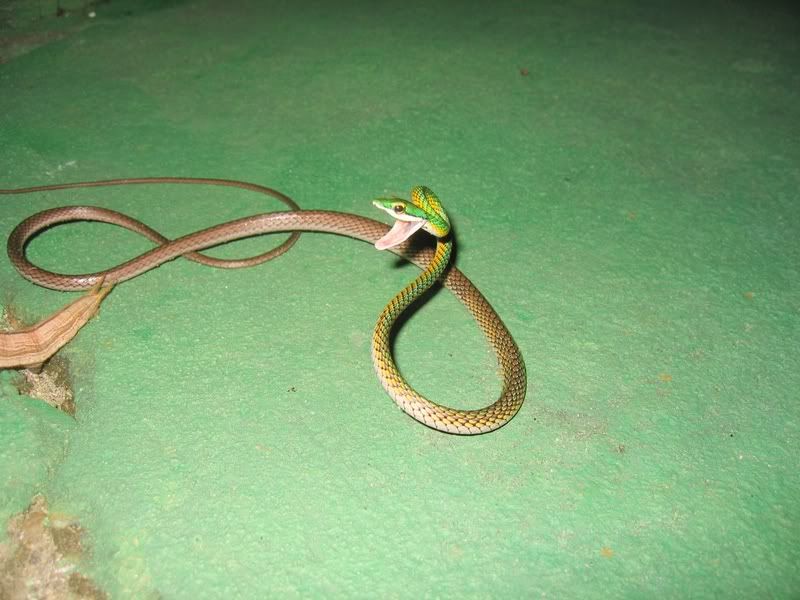
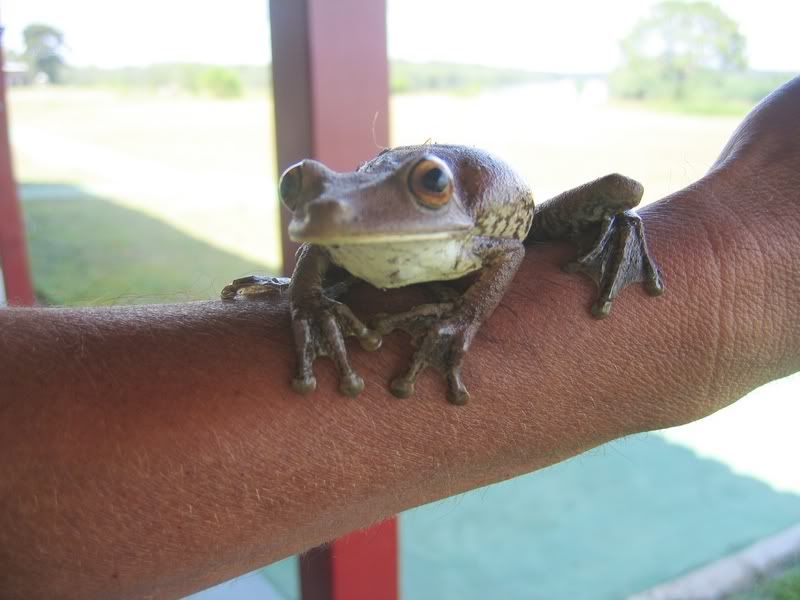
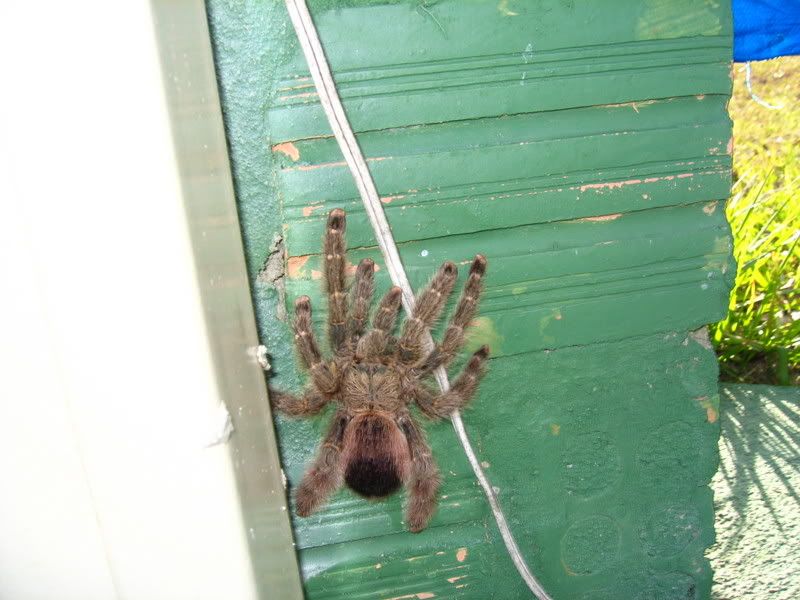
I'll post again. Meanwhile here are a few critters from the Amazon.

-Dell

Parrot snake

Not a Dart. If I remember right this is a Chaco treefrog.

And a Peacock bass.

And a good/bad photo of a arboreal Tarantula, one of the avicularia type pink toes. This dude was as big as a beer can.

Image

Slaytonp Dec 27, 2007 08:05 PM

Thanks for sharing your photos and a bit of your life. We all need to do this more often.

I spent some time in South America too, mostly Peru, Chile, and Bolivia, but it was in the drier coastal and Altiplano areas, assisting a paleopathologist and an anthropologist, autopsying mummies for some DNA studies, etc.--not much other zoology, and no frogs at all. We didn't ever get into the rain forests. It was a job, so it was narrowed down without much freedom to explore other things.
-----
Patty
Pahsimeroi, Idaho

Dendrobates: auratus blue, auratus Ancon Hill, tinctorius azureus, leucomelas. Phyllobates: vittatus, terribilis, lugubris. Epipedobates: anthonyi tricolor pasaje. Ranitomeya fantastica, imitator, reticulata. Adelphobates castaneoticus, galactonotus. Oophagia pumilio Bastimentos. (updated systematic nomenclature)

Site Tools