Reptile & Amphibian Forums

Welcome to kingsnake.com's message board system. Here you may share and discuss information with others about your favorite reptile and amphibian related topics such as care and feeding, caging requirements, permits and licenses, and more. Launched in 1997, the kingsnake.com message board system is one of the oldest and largest systems on the internet.

Click here for Dragon Serpents
Click for ZooMed
Click for 65% off Shipping with Reptiles 2 You

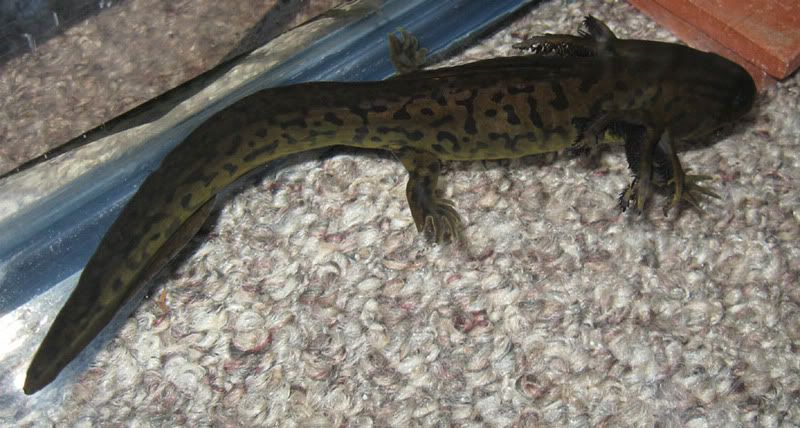
ID this waterdog?

redmoon Apr 26, 2008 10:31 PM

I picked up a waterdog the other from the pet store I'm working in, and I was wondering if anyone would be able to tell me which subspecies it would be.

We got in two of them, and they appear to be very obviously male and female, respectively. I bought home the female, because he gills and tail are a little prettier. One has a very obvious hemipenal bulge around his cloaca, and this one doesn't, so I'm assuming male & female, anyway. They're both just about the same size- the male might be 1/2" longer, but I doubt it.

Any help would be appreciated.

thanks,
Ronnie Nocera

Replies (6)

batrachos Apr 28, 2008 12:51 PM

Hmmm, looks like one of the Western Tiger Salamanders (Ambystoma mavortium). Not sure which subspecies, probably one of the southwestern ones.

CKing Apr 28, 2008 02:46 PM

>>I picked up a waterdog the other from the pet store I'm working in, and I was wondering if anyone would be able to tell me which subspecies it would be. >>

It is not possible to determine subspecies of the tiger salamander using larvae. The size of this animal rules it out as a California subspecies (A. t. californiense), which is a protected species. My guess is that it is probably nebulosum, melanostictum, diaboli, or mavortium, all of which may be netted and sold as pets or fish bait.

>>We got in two of them, and they appear to be very obviously male and female, respectively. I bought home the female, because he gills and tail are a little prettier. One has a very obvious hemipenal bulge around his cloaca, and this one doesn't, so I'm assuming male & female, anyway. They're both just about the same size- the male might be 1/2" longer, but I doubt it.>>

Male salamanders do not have hemipenis, the swollen cloaca is indeed a sign of a male, but it is swollen only during the mating season. So, it is possible that the animal you brought home is also a male but not in breeding condition.

>>
>>Any help would be appreciated.
>>
>>
>>
>>thanks,
>>Ronnie Nocera

Where you live or where the animal came from would give you a good idea what subspecies it may be. Basically, all of the species of the tigrinum species group are reproductively compatible with one another, so species boundaries are often quite blurry. The California subspecies, since it is isolated geographically from other subspecies, is sometimes considered a distinct species, but that seems to be news to the tiger salamanders themselves. Introduced tiger salamanders breed freely with the California subspecies, so apparently there is no pre- or post- mating isolation mechanism. In fact, the mating behavior of the Eastern tiger salamander and the California subspecies are identical despite millions of years of geographic isolation.

The tiger salamanders of the Great Basin and Rocky Mountains are interesting. The are very different from the Barred, California and Eastern subspecies in adult coloration. They also seem to have evolved a slightly different mating behavior. Where mavortium meets nebulosum, intergradation is limited. Perhaps the hybrids are not as adaptive as either of the parental subspecies (e.g. if their coloration make them more visible to predators) or perhaps the different habitat preferences of mavortium and nebulosum prevent either of them from making deep incursions into one another's range.


Redmoon May 02, 2008 11:09 PM

Thanks for the help! I'm familiar with the typical swollen cloaca of male newts & salamanders, but these things really look like they have testicles hanging, not even a hemipenal bulge.

I found out that they came from Texas. Can't get more information from the wholesaler than that, unfortunately.

Would the fact that two of them that I've seen now have these swollen cloacas imply that they might be from a neotenic locality? I've been reading that certain groups of these are neotenic, and I'd like to think that maybe it's these guys here. On the other hand, it also makes me think that maybe rather than being neotenic, they getting close to metamorphosizing. Any ideas?

thanks again,
Ronnie

CKing May 03, 2008 09:45 PM

>>Thanks for the help! I'm familiar with the typical swollen cloaca of male newts & salamanders, but these things really look like they have testicles hanging, not even a hemipenal bulge.
>>
>>I found out that they came from Texas. Can't get more information from the wholesaler than that, unfortunately.
>>
>>Would the fact that two of them that I've seen now have these swollen cloacas imply that they might be from a neotenic locality? I've been reading that certain groups of these are neotenic, and I'd like to think that maybe it's these guys here. On the other hand, it also makes me think that maybe rather than being neotenic, they getting close to metamorphosizing. Any ideas?
>>
>>thanks again,
>>Ronnie

These larvae looks like they are neotenic, since they are so big. And of course the swollen cloaca is a sign of sexual maturity. Neotenic salamanders, however, do occasionally transform and become terrestrial adults. Those that do aren't going to look like the typical barred tiger salamanders found in Texas. A sure sign that they are about to metamorphose is the gills. If the gills start shrinking and disappearing, then they are getting ready to transform to the terrestrial stage.

Redmoon May 03, 2008 10:09 PM

Awesome. I think I might pick up a second to go in with "her", if there's a chance they're truly neotenic! Her gills were smaller when I got her, but they are far fuller now than they were a week ago. One of the brances on the left side is still only a stub, but the rest of them have grown those little "fingers" at the end, rather than simply being stubs like they were. Maybe "she" had them nibbled on in a stock tank, or something. Or maybe aquatic conditions are just better now, and she's changed her mind. I can't be sure, but I'm thinking her tail looks more fin-like than it did when I brought her home, too. Is this common, or even possible?

thanks again for the help! I really can't find much information about these guys at the larval stage.

Also- could these be housed with axolotls? Or would I have to worry about one eating the other?

Do you have any recommended reads about these guys? I'd like to find something a little deeper than the standard page that's coming up on Google. . .

thanks,
Ronnie

CKing May 04, 2008 09:57 AM

>>Awesome. I think I might pick up a second to go in with "her", if there's a chance they're truly neotenic! Her gills were smaller when I got her, but they are far fuller now than they were a week ago. One of the brances on the left side is still only a stub, but the rest of them have grown those little "fingers" at the end, rather than simply being stubs like they were. Maybe "she" had them nibbled on in a stock tank, or something. Or maybe aquatic conditions are just better now, and she's changed her mind. I can't be sure, but I'm thinking her tail looks more fin-like than it did when I brought her home, too. Is this common, or even possible?>>

It is possible that the gills are regenerating after being bitten off. Also, it may be a response to less oxygen in the water. Larvae that live in oxygen rich streams have less well developed gills than those that live in oxygen poor stagnant waters like ponds.

>>
>>thanks again for the help! I really can't find much information about these guys at the larval stage.
>>
>>Also- could these be housed with axolotls? Or would I have to worry about one eating the other>>

If they are similar in size than there is no worry they will eat each other. Axolotls (Ambystoma mexicanum) and tiger salamanders (Ambystoma tigrinum) are close relatives. They are both members of the tigrinum species group. They can in fact produce viable hybrids. Not sure if they will mate though.

>>Do you have any recommended reads about these guys? I'd like to find something a little deeper than the standard page that's coming up on Google. . .
>>
>>thanks,
>>Ronnie

You may want to got to a University library and browse through the section on reptiles and amphibians or go to a pet store and look through those books written about newts and salamanders.

Site Tools