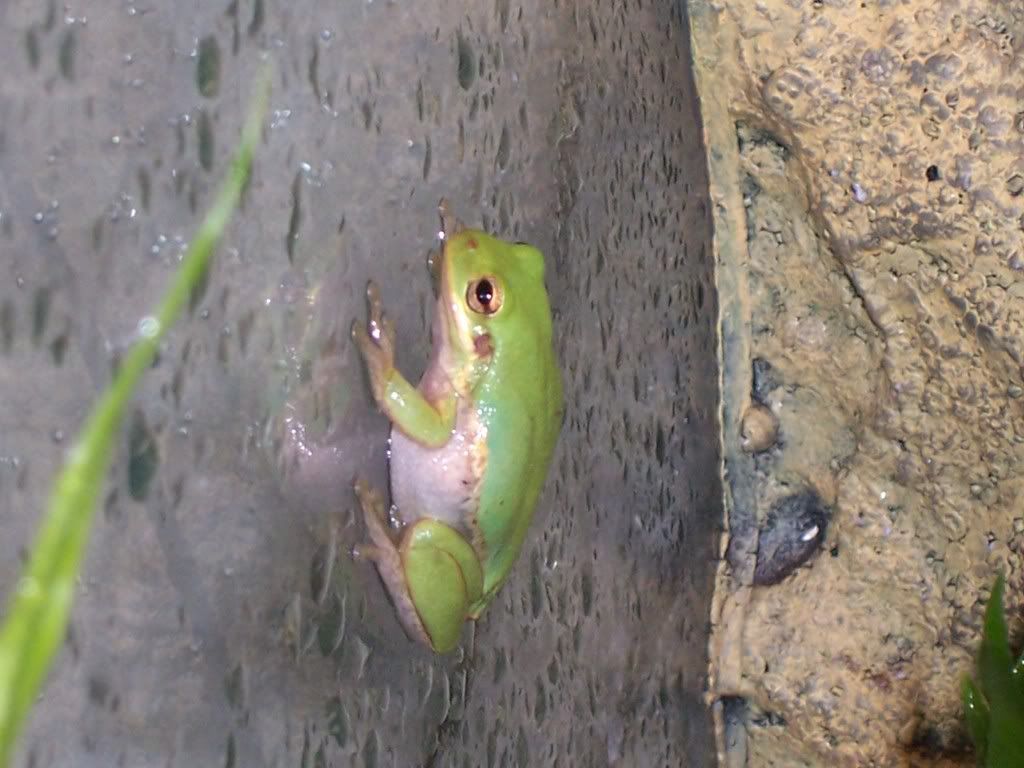
yearling Hyla chrysoscelis. i would have sworn it was a young green , but it was found way north of H. cinerea
-----
2 tham radix
1 Chicago Tham s. semifasciatus
2 elaphe vulpina
1 gray tiger sallie
4 Aphonopelma hentzi
2 G rosea
1 Haplo minax
Reptile & Amphibian Forums
Welcome to kingsnake.com's message board system. Here you may share and discuss information with others about your favorite reptile and amphibian related topics such as care and feeding, caging requirements, permits and licenses, and more. Launched in 1997, the kingsnake.com message board system is one of the oldest and largest systems on the internet.


gray treefrog
wolfpackh
May 01, 2008 08:43 PM
Replies (14)
batrachos
May 02, 2008 01:24 PM
That is Hyla cinerea, no doubt about it. Do you mind sharing the locality info (just in general terms)? I've been researching the range expansion of this species.
wolfpackh
May 02, 2008 04:54 PM
locality: Prairie Creek, Indiana Vigo County. the closest cinerea are in southern Illinois and Kentucky, some 3-4 hours south. the frog pictured is 1 inch. i know all the frogs native to this area and have never seen one like this, although young grays are supposedly green. the area where it was taken has semi trucks parked nearby that make frequent trips to southern illinois-- kinda suspicious .
-----
2 tham radix
1 Chicago Tham s. semifasciatus
2 elaphe vulpina
1 gray tiger sallie
4 Aphonopelma hentzi
2 G rosea
1 Haplo minax
batrachos
May 02, 2008 07:35 PM
Quite likely he was a hitchhiker. There are some recent records from SW Indiana- Posey and Vanderburgh counties- but that's still a long ways from you.
Gray treefrogs are often green, especially when young, but they will still show the characteristic white spot beneath the eye, even as metamorphs:
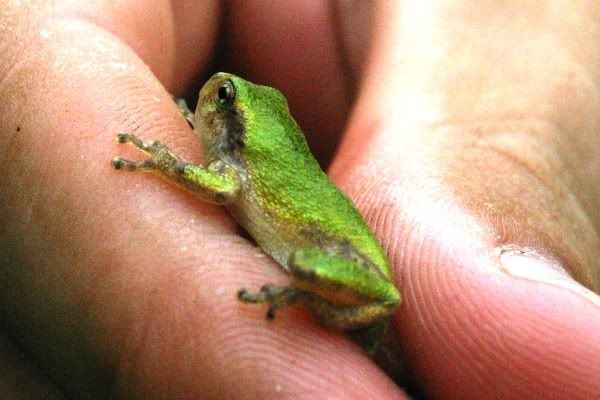
Keep an eye out for more greens; these guys have been establishing themselves in new localities throughout the area just north of their established range in recent years, and you may have a heretofore undiscovered population near you! In any case, this guy may well be worth a distribution note in Herpetological Review. You'll need the ID verified by a herpetologist, and you will likely also need to deposit a copy of your photo in a recognized museum collection. I don't know that Indiana has an active herpetological collection; you can try contacting a curator at the University of Michigan Museum.
wolfpackh
May 02, 2008 11:54 PM
i contacted the person who has several of these in an aquarium. i did a huge double take when i heard where he had been catching these and thought cinerea, but couldnt believe it, so wondered about yearling grays and finally j/ took a pic and posted for a second opinion. i have all the connections for a note in Herp Review and am currently seeking an ID confirmation from several herpetologist. a voucher should be easy to obtain and a trip to the area to listen to frog calls is in the works. Minton suspected cinerea may show up in the evansville area. several years ago mole salamanders (A. talpoideum) turned up in Indiana. I appreciate the input and will gladly keep you posted.
-----
2 tham radix
1 Chicago Tham s. semifasciatus
2 elaphe vulpina
1 gray tiger sallie
4 Aphonopelma hentzi
2 G rosea
1 Haplo minax
batrachos
May 03, 2008 03:27 PM
Excellent! So, someone up there has caught several greens? That's just wild. They must be established. Is the site near the Wabash floodplain? Most of the new populations I've been looking at seem to be immediately adjacent to the big rivers or their tributaries, in floodplain wetlands and around the margins of reservoirs at creek mouths.
wolfpackh
May 03, 2008 03:47 PM
yes, prairie creek is part of the wabash floodplain. the greens you mentioned in Posey County, In., are they @ Hovey Lake? well, what do ya think? Momma green hitched a ride from down south, laid some eggs, and walla': an established population of cinerea? That's my theory, Vigo County has been herped intensely, literature dating all the way back to the 1800s. During the 1960s, both the crawfish frog and spadefoot toad were found to still occur there corraborating w/ published records from the early 1900s.
-----
2 tham radix
1 Chicago Tham s. semifasciatus
2 elaphe vulpina
1 gray tiger sallie
4 Aphonopelma hentzi
2 G rosea
1 Haplo minax
batrachos
May 04, 2008 09:41 PM
Yeah, Hovey Lake. The Vanderburgh County frogs were at Howell Slough.
As far as the mechanism goes- one frog wouldn't do it. H. cinerea, like most frogs, have externally fertilized eggs, so at least a male and a female would be needed to found a population. Other than that, hitchhiking adults are quite possible. Other possibilities are released pets, larvae in baitbuckets, etc.
However, it is also quite possible that the critters moved all that distance overland, up the Wabash over the last few years. It sounds far-fetched, I know, but the patterns of new populations I've been looking at certainly seem to indicate it. They don't just pop up randomly; they move upstream along big rivers in a distinct linear fashion. I've got pretty good data for populations in the Cumberland watershed; this area has been pretty intensively studied, so it's hard to believe they were just overlooked. I started the study when greens started showing up in some of my favorite haunts where I know they weren't present before. These are not glass lizards or something like that; if green treefrogs are present, you will not overlook them.
If I get the chance this summer I would like to sample along the Wabash and Ohio and see how far the greens have gotten.
anuraanman
May 07, 2008 12:35 PM
Just curious, have you done any genetic analysis of the newly-developed populations? It seems like that would be a pretty good way to figure out if the expansion is absolutely natural or if the populations are introduced through bait buckets and stuff like that. Based on the pattern I would guess it's natural but you clearly have more experience with these guys than I do! If as it turns out that all the new frogs have genetic markers from a population 300 miles south where a bait fishery is located then it'd be good to know 
batrachos
May 07, 2008 02:10 PM
I would like to do that in the future, but I have not done any genetic work yet. There are some occurrences that seem to be pretty clear cases of accidental or deliberate introduction, where the frogs show up at fish farms, golf courses, etc. far from the nearest populations, but I think at least a large portion of the range expansion is natural. I don't know what kind of resolution I would be able to get, but if it's pretty fine I might even be able to trace invasion routes!
As far as I can discover no broadscale genetics work has been done on this species, so it will be interesting to see if it has genetic breaks at the Mississippi and Appalachicola like a lot of other species do. I hope I get the opportunity to do some research of that sort with these guys.
wolfpackh
May 14, 2008 10:21 AM
welp, j/ got back from a florida herp trip and have to say this frog is a false alarm. not even close to true greens-- yearling gray IMO. Numerous credible herpetologst said it could go either way, but unlikeley a green
-----
2 tham radix
1 Chicago Tham s. semifasciatus
2 elaphe vulpina
1 gray tiger sallie
4 Aphonopelma hentzi
2 G rosea
1 Haplo minax
batrachos
May 14, 2008 01:28 PM
No, definitely not a gray. Grays (and bird-voiceds) will ALWAYS have a suborbital light spot, and will never have a light labial line extending onto the body. The only possibilities among North American frogs are Hyla cinerea, H. gratiosa, and H. squirella, and it looks much more like cinerea than the other two. What specifically do you think looks different from cinerea about it? The only oddity I can see is the shortness of the snout, but I've seen similarly-shaped cinerea in the Carolinas.
wolfpackh
May 14, 2008 02:18 PM
body shape= gray. grays turn green. know the area it came from, never heard a green call there. resembles squirella more than cnerea. i just seen ump-teen million greens hopping around the south. bodies narrowerer, white lines very well- defined, longer snaout. it's not impossible that it 's a stow-away. good news is, if you happen to be in my neck of the woods you are more than welcome to check the specmen out for yourself or visit sight of capture.
-----
2 tham radix
1 Chicago Tham s. semifasciatus
2 elaphe vulpina
1 gray tiger sallie
4 Aphonopelma hentzi
2 G rosea
1 Haplo minax
batrachos
May 14, 2008 02:47 PM
Thanks. I'm willing to lay down money that it is not a gray; the pattern and skin texture are just wrong. Florida greens are not all that close to northern greens in body shape; ours tend to be much more robust, like this Tennessee green:
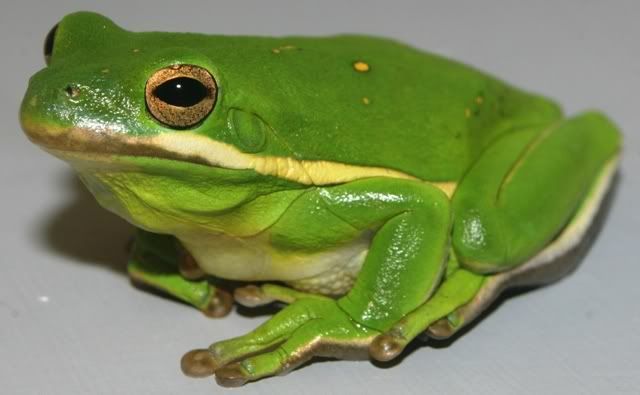
Hyla squirella is definitely a possibility; in that case it would certainly be an introduction and not a natural range expansion. The defined border of the white lateral stripe makes me think it is not squirella, but I'm not familiar enough with that species to know how much that varies.
Hopefully sometime this summer I will be able to head up your way and see this population in person; I'll send you an email before I do.
CKing
Jul 24, 2008 01:42 AM
>>body shape= gray. grays turn green. know the area it came from, never heard a green call there. resembles squirella more than cnerea. i just seen ump-teen million greens hopping around the south. bodies narrowerer, white lines very well- defined, longer snaout. it's not impossible that it 's a stow-away. >>
I agree with you. This frog does not look like a green treefrog, but it also does not look like a gray treefrog either. The gray treefrog has more granular skin, both on the dorsum and the venter, unlike this one. Gray treefrog is also more robust, with a shorter snout. The dorsal skin of your frog is smooth, and the ventral skin is almost translucent. I also agree that it looks more like a H. squirella than a H. cinerea.
